What is collaborative custody, and how do you pass Bitcoin to heirs?
Remove the single point of failure: you.
Sole custody has one fatal flaw: if you lose the seed or die suddenly with no plan, the coins are gone forever, with no bank to call and no reset link. Collaborative custody spreads the keys so that no single loss, including your own death, is fatal, and so a documented plan can move the coins to the people you choose.
Collaborative custody is a 2-of-3 multisig where you hold 2 keys and a service holds 1, so no key alone can move funds and one lost key is survivable. Pair it with written recovery instructions and a live dry run where your heir spends test funds, and the coins survive your death.
- In a 2-of-3 setup you can lose any 1 of the 3 keys and still recover 100% of the funds with the remaining 2.
- The service key is 1 signature short of control: it can never move your coins alone, and with private-key wallets it never sees your balance.
- The step almost everyone skips is a key-handoff dry run: have your heir practice a full recovery with a small test amount (even $20) while you are alive.
- Never write a seed phraseseed phraseA sensitive wallet backup represented by words. Recovery may also require a passphrase and wallet configuration. A mnemonic can derive many private keys; it is not one individual key. Keep it private and use only the verified recovery procedure for the wallet you own.Full definition or private keyprivate keyA secret value used to sign transactions authorizing spending. Wallet software can derive private keys from a backup. A mnemonic phrase is not an individual private key. Keep keys and backups private.Full definition in a will: probateprobateThe court-supervised process of validating a will, paying debts, and distributing assets after death. Slow, costly, and public.Full definition makes a will a public court record, exposing the keys to anyone.
- Four providers dominate collaborative custody as of 2026 (Casa, Unchained, Nunchuk, Theya) with annual fees roughly $0 to a few hundred dollars depending on tier.
A single seed phrase is one point of failure: one fire, one flood, one theft, one forgotten hiding spot, or one sudden death and the Bitcoin is unrecoverable. Collaborative custody replaces that single key with three, held in three places, where any two can spend. You keep control day to day, a specialist company holds a backup key it can never use alone, and your heirs inherit a documented, rehearsed path to the coins instead of a mystery.
Why is sole custody a single point of failure?
Self-custody is the correct default, and the reason to hold your own keys never changes: not your keys, not your coins. But a single-signature wallet backed up by one seed phrase concentrates every risk onto one 12-to-24-word string. Lose it, destroy it, or die with it hidden and undocumented, and there is no recovery, no support line, and no court that can reconstruct the words.
Estimates of permanently lost Bitcoin run from roughly 3 to 4 million coins, on the order of 15-20% of the ~19.8 million mined as of 2026, much of it from single-key loss and forgotten backups. Backing up a wallet, storing the backup in multiple secure locations, and keeping software encrypted are the baseline defenses verify×DON'T TRUST, VERIFYClaim: Wallet security best practices include backing up your wallet, storing backups in several secure locations, and encrypting the wallet, and multi-signature adds redundancy against single-key loss.Verify at: Bitcoin.org: Securing your wallet ↗Bitcoin.org's official wallet-security guide lays out backups, redundancy, encryption, and the multi-signature concept as the core defenses against loss.. A single seed satisfies none of the redundancy ones.
Collaborative custody fixes this by making loss survivable. The question stops being "what happens if I lose the key" and becomes "what happens if I lose a key," and the answer is: nothing, you still have the other two.
How does 2-of-3 multisig tolerate a lost key?
Multisig means a wallet controlled by several keys where a defined threshold of them must sign to spend. The most common collaborative-custody layout is 2-of-3: three separate keys exist, and any two of them together authorize a transaction. No single key can move a satoshi.
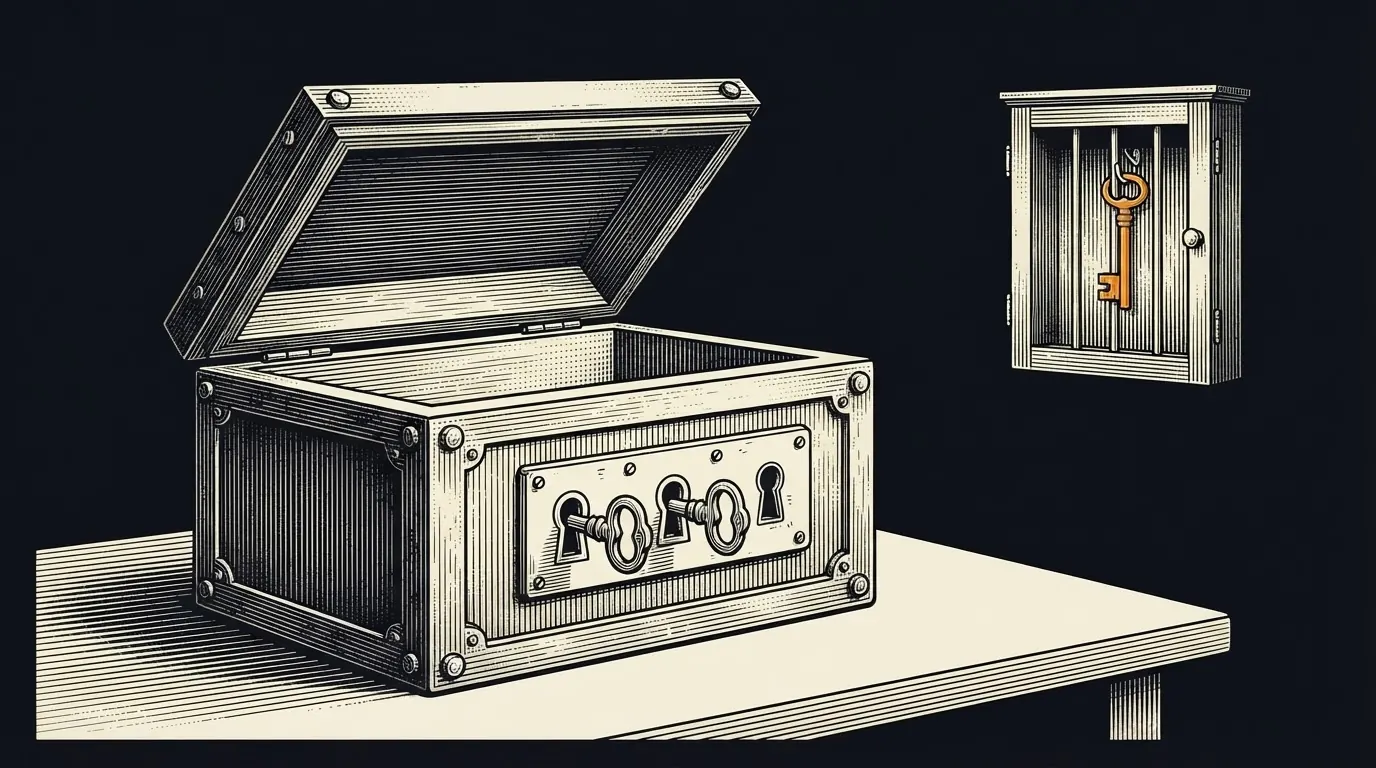
In the standard collaborative arrangement, you hold 2 of the 3 keys yourself (typically two different hardware wallets stored in two locations) and the service holds the 3rd. Day to day you sign with your own two keys and never involve the company. Because the service is only 1 of 3, it is permanently 1 signature short of control: it cannot spend, cannot freeze you, and with a private-key model never even sees your balances. Its only job is to be the spare key that rescues you if one of yours is lost or destroyed.
Lose 1 key of 3 and you recover everything with the remaining 2. You are only locked out if 2 of the 3 fail at once, which is dramatically less likely than any single seed failing. And because no single key spends, a thief who steals one hardware wallet, or a service that turns hostile, controls $0 of your Bitcoin.
The tradeoff is complexity: three keys to generate, label, and store, plus a wallet coordinator that understands the multisig descriptor. That is the whole point of a collaborative provider, and the deeper mechanics live on the multisig page.
Which collaborative-custody providers should you compare?
Four names dominate as of 2026. I hold no referral relationship with any of them and link none of them for money; compare them yourself and pick on tradeoffs, not marketing. Fees and tiers change, so treat the figures below as current-as-of-2026 anchors, not quotes.
| PROVIDER | MODEL | TRADEOFF TO WEIGH | COST SHAPE (2026) |
|---|---|---|---|
| Unchained | 2-of-3, you hold 2 keys, Unchained holds 1. Bitcoin-only. Concierge inheritance product. | Strong inheritance tooling and vault-plus-trust guidance; a flat annual fee rather than free. | Flat annual vault fee (low hundreds of dollars/yr); free tier for a personal wallet. |
| Casa | Tiered 2-of-3 up to 3-of-5; app-guided; supports BTCBitcoin (BTC)The ticker symbol for Bitcoin, used on exchanges and in price quotes.Full definition and some other assets on higher tiers. | Polished mobile UX and health checks; higher tiers carry meaningfully higher subscriptions. | Free 2-key tier; paid tiers from tens to hundreds of dollars/yr for 3-of-5 and support. |
| Nunchuk | Self-directed multisig; the "assisted" key is optional. Open-source; keys never leave you. | Maximum sovereignty and low cost; you own more of the operational burden yourself. | Free core app; optional assisted-wallet/inheritance plan for a modest monthly/annual fee. |
| Theya | Mobile-first 2-of-3, you hold 2 keys, Theya holds 1. Bitcoin-only. | Simplest onboarding of the four; newest company, so shortest track record. | Free tier; paid plan in the low tens of dollars/mo for premium features. |
Fees, tiers, and asset support change frequently; confirm each provider's current terms directly before choosing. The 2-of-3 principle is stable across all of them.
The decision axis that matters most for inheritance: does the provider offer a documented, tested recovery path your heirs can follow without you? Unchained and Casa build entire products around that; Nunchuk and Theya let you assemble it more manually. Match the choice to where you land on the custody-levels ladder.
How do you pass the Bitcoin to heirs?
Multisig makes the coins recoverable. Inheritance planning makes them recoverable by the right person after you are gone. Three components do the work, and they are separate from the wallet itself:
- Documented recovery instructions. A plain-language runbook: what the wallet is, which 3 keys exist, where each lives, what device and software opens them, and the exact steps to sign a spend with 2 keys. Written for a non-technical heir, updated when anything moves.
- A key held by, or releasable to, your heir. Either your heir controls one of the keys directly, or the collaborative service releases its key to them on proof of death, per the provider's inheritance process. That is precisely the product Unchained and Casa sell.
- The step everyone skips: a key-handoff dry run. While you are alive, have your heir perform a real recovery with a tiny test amount, even $20, using only the documents and access they would have. If they cannot spend that $20 without you in the room, they cannot inherit six figures without you either.
The dry run is the whole difference between a plan on paper and a plan that works. Unchained builds its inheritance offering around exactly this pattern, key distribution plus a rehearsed recovery your beneficiarybeneficiaryThe person or entity you name to receive an account or insurance policy when you die. can execute verify×DON'T TRUST, VERIFYClaim: Collaborative-custody providers structure Bitcoin inheritance around multisig key distribution and a documented, executable recovery process for a named beneficiary.Verify at: Unchained: multisig vaults and inheritance ↗Unchained's collaborative-custody and inheritance product is built on 2-of-3 multisig with a documented process for transferring access to heirs; review the current terms directly..
Run the dry run at least once a year and any time you change a device, move a key, or change providers. The full step-by-step lives on the inheritance page.
How does this coordinate with your estate plan (and why not a will)?
The single most important legal rule: never write a seed phrase, private key, or any key material into your will. A will filed for probate becomes a public court record; in most US states anyone can pull it. Putting keys in a will is equivalent to publishing them, and it also creates a single document that, once copied, drains the wallet regardless of the multisig, because the written seeds and descriptor reconstruct the whole thing.
The will (or trust) names who inherits and points to where the instructions are, but contains zero key material. The sensitive recovery runbook lives outside probate, given to your heir, an attorney, or your provider's inheritance program. Public document: who gets it. Private document: how to get it. Never merge the two.
Concretely: a revocable living trust or a will names your beneficiary and grants them legal authority over "the digital assets described in my letter of instruction," and a separate, private, non-probate document holds the recovery steps. For larger balances a trust can hold or direct one of the multisig keys, which also keeps the whole thing out of the public probate file. Coordinate the wording with an estate attorney who has seen a multisig before.
This split, public "who" and private "how," is the backbone of the whole approach. The Bitcoin estate planning page walks the trust-versus-will decision in detail.
Is collaborative custody right for you?
It is not for everyone, and it is not the top rung of the sovereignty ladder. Weigh it:
- Good fit: a balance large enough that permanent loss would be devastating (a common rule of thumb is more than a few thousand dollars), heirs who are not Bitcoiners, or anyone who wants a lost-key backstop without trusting a third party with unilateral control.
- Overkill: a small stack you are actively spending, where a single well-backed-up hardware wallet and a documented seed backup is enough.
- Not sovereign enough for some: a fully self-managed 2-of-3 or 3-of-5 you run yourself, with a trusted person holding a key instead of a company, removes even the annual fee, at the cost of doing all the coordination and support yourself.
Collaborative custody is the middle path: more resilient than a single seed, less operationally demanding than a fully DIY multisig, and specifically engineered so that the person who is hardest to plan around, you, is no longer the single point of failure. Start on the custody levels page to see where you sit today before you upgrade.
No one pays this site: no custody provider, exchange, or affiliate. See /how-this-site-makes-money/.
Related
Last updated 2026-09-25. Not financial advice. Provider fees and features change; verify current terms before relying on them.