Should you rent Bitcoin mining power?
The math says no. Every time.
Cloud mining and hashrate rental contracts promise exposure to Bitcoin mining without owning hardware. Run the numbers on any contract at any price and you find the same thing: the seller captures the upside, the buyer absorbs the variance, and buying BTCBitcoin (BTC)The ticker symbol for Bitcoin, used on exchanges and in price quotes.Full definition outright wins.
Viewpoint. Besides explaining the topic, this page makes the site’s case on money and Bitcoin. The facts are sourced; that case is the site’s view. How pages are labeled.
A hashrate rental sells you mining output at a price that guarantees the seller a profit or an exit. At fair hashpricehashpriceThe dollar revenue a miner earns per unit of hashrate per day. Calculated from block subsidy, transaction fees, BTC price, and network difficulty. Used to evaluate whether mining is profitable at a given cost.Full definition the seller has no reason to sell; below fair hashprice you overpay. The contract expires worthless on day 31. Bought BTC is still BTC. If you want mining exposure, own the hardware.
On this page
Section 1 · What a hashrate rental is
You pay a provider a lump sum for a fixed amount of mining power over a fixed window. The provider runs the hardware. You receive whatever that hashrate produces during the contract, minus fees. You own nothing when the contract ends.
| Tier | Hashrate | Rate | 30-day cost |
|---|---|---|---|
| Small | 10 PH/s | $39/PH/day | $11,700 |
| Medium | 50 PH/s | $39/PH/day | $58,500 |
| Large | 250 PH/s | $39/PH/day | $292,500 |
All tiers: flat $39/PH/day, 30-day one-time payment, solo-mining payout structure. Block subsidyblock subsidyThe new BTC created with each block, paid to the miner who finds it. Started at 50 BTC in 2009, halves every 210,000 blocks. Currently 3.125 BTC after the April 2024 halving.: 3.125 BTC. Block value at $81,262: ~$253,945.
At these prices and this network difficultydifficultyA number that Bitcoin adjusts every 2,016 blocks (roughly two weeks) to keep the average block time at 10 minutes regardless of how much hashrate is on the network. Higher difficulty means each hash has a lower chance of finding a block., what are the odds you make money?
Section 2 · Block odds in 30 days
Mining follows a PoissonPoissonA probability distribution that models the number of rare, independent events in a fixed interval. In mining: predicts how many blocks a given amount of hashrate will find over a period. Each hash attempt is independent. process. Your expected number of blocks in 30 days equals your share of total hashrate multiplied by the number of blocks mined network-wide (~4,320 in 30 days). The probability of finding at least one block follows from there.
Network hashrate: ~926 EH/s (7-day average to Sep 24, 2026) verify×DON'T TRUST, VERIFYClaim: Bitcoin network hashrate is approximately 926 EH/s (7-day average to September 24, 2026).Verify at: CoinWarz hashrate chart ↗ · mempool.space mining ↗ Source 1 in the list belowHashrate fluctuates daily. Verify the live figure before running your own numbers.. Blocks per 30 days: ~4,320. Distribution: Poisson. BTC price: ~$81,262 (Sep 19, 2026 close) verify×DON'T TRUST, VERIFYClaim: BTC price approximately $81,262 at the September 19, 2026 daily close.Verify at: CoinDesk BTC price ↗ · Kraken BTC/USD ↗ Source 2 in the list belowPrice is a dated snapshot. The structural argument holds at any price..
P(at least 1 block in 30 days) = 1 - e-lambda, where lambda = (hashrate / network hashrate) * 4,320. At 10 PH/s your lambda is 0.047, giving a 4.6% chance. Even the $292,500 tier only gets you to 69%.
Section 3 · Make money vs. waste money
Finding a block is necessary but not sufficient for profit. At $81,262 BTC, a single block pays ~$253,945. That covers the $11,700 and $58,500 tiers, but it does not cover the $292,500 tier. The large tier needs two or more blocks to break even, and the odds of that collapse.
The 250 PH/s cliff: at $81,262 a single block ($253,945) no longer covers the $292,500 contract. The tier needs two or more blocks. P(two or more blocks | lambda=1.166) = 32.5%. The "biggest" contract is the worst bet.
Section 4 · Why renting always loses
Positive expected value on paper does not survive contact with the real market. Five forces work against you.
1. The seller is your adversary
Fair hashprice at $81,262 BTC is about $39.49/PH/day. The rental rate is $39/PH/day. No operator sells $39.49 of output for $39 unless they skim the difference elsewhere or cannot deliver the stated hashrate. The rental market is adverse selection: hardware that shows up on a rental platform is hardware the operator decided was worth more as a rental than as self-mined output. That tells you what the operator thinks of the hardware.
2. Fiat-fixed pricing caps your upside
You pay in fiat, they price in fiat, but the output is BTC. If BTC price rises during your contract, your block rewardblock rewardThe brand-new Bitcoin a miner earns for adding the next batch of confirmed transactions to the public ledger. The reward is how new Bitcoin enters circulation, and it gets cut in half every four years. is worth more but you locked the cost already. The rational operator stops selling hashrate and mines for themselves. If BTC drops, you overpaid. You lose in both directions.
3. Skim and dilution
Maintenance fees, pool fees, unannounced downtime, sub-nameplate hash delivery, and difficulty adjustments that go up over a 30-day window. Your effective hashrate on day 30 is lower than on day 1. The operator collects on each of these friction points, and none of them appear in the headline rate.
4. Zero residual, pure variance
Day 31 your contract is worth $0. An owned Bitaxe or S21 keeps hashing and you can resell it. Bought BTC is still BTC. No other Bitcoin-adjacent purchase has a guaranteed terminal value of zero.
5. Base-case loss even at breakeven EV
Suppose the expected value were exactly zero. You still lose money 95.4% of the time at 10 PH/s, 79.2% at 50 PH/s, and 67.5% at 250 PH/s. Positive EVExpected Value (EV)The probability-weighted average outcome of a bet or decision. Positive EV means the average outcome is profitable, but any single trial can still lose. In mining: your expected blocks times block value minus your cost. does not mean positive outcome when the distribution is this skewed. The seller ran the numbers before listing the contract. You are buying a lottery ticket from someone who already knows the odds favor the house.
Section 5 · The price mirage
Cloud mining pitches assume a high BTC price to show positive expected value. The same contract at three price points:
| BTC Price | EV (10 PH) | EV (50 PH) | EV (250 PH) |
|---|---|---|---|
| $100,000 | +$2,880 | +$14,390 | +$71,970 |
| $81,262 (Sep 19, 2026) | +$147 | +$736 | +$3,678 |
| $50,000 | -$4,410 | -$22,050 | -$110,260 |
At the September 19, 2026 price, the EV is barely positive (+$147 to +$3,678, about 1.3% of the contract cost) before fees, downtime and rising difficulty; a large "positive EV" only shows up when you assume a price well above that level. At a price that high, the operator has the strongest incentive to stop selling hashrate and mine for themselves, or to disappear with your payment. The pitch depends on a price that would make the pitch unnecessary.
Section 6 · Case study: HashFlare
HashFlare sold cloud mining contracts to about 440,000 customers between 2015 and 2019. The U.S. Department of Justice indictment found that about 99% of the mining capacity the company claimed to operate did not exist verify×DON'T TRUST, VERIFYClaim: HashFlare sold contracts to ~440,000 customers and ~99% of claimed mining capacity was fabricated, per DOJ.Verify at: DOJ press release: Estonians arrested for $575M cryptocurrency fraud ↗ Source 3 in the list belowThe DOJ indictment is the primary source. Court proceedings may update the figures..
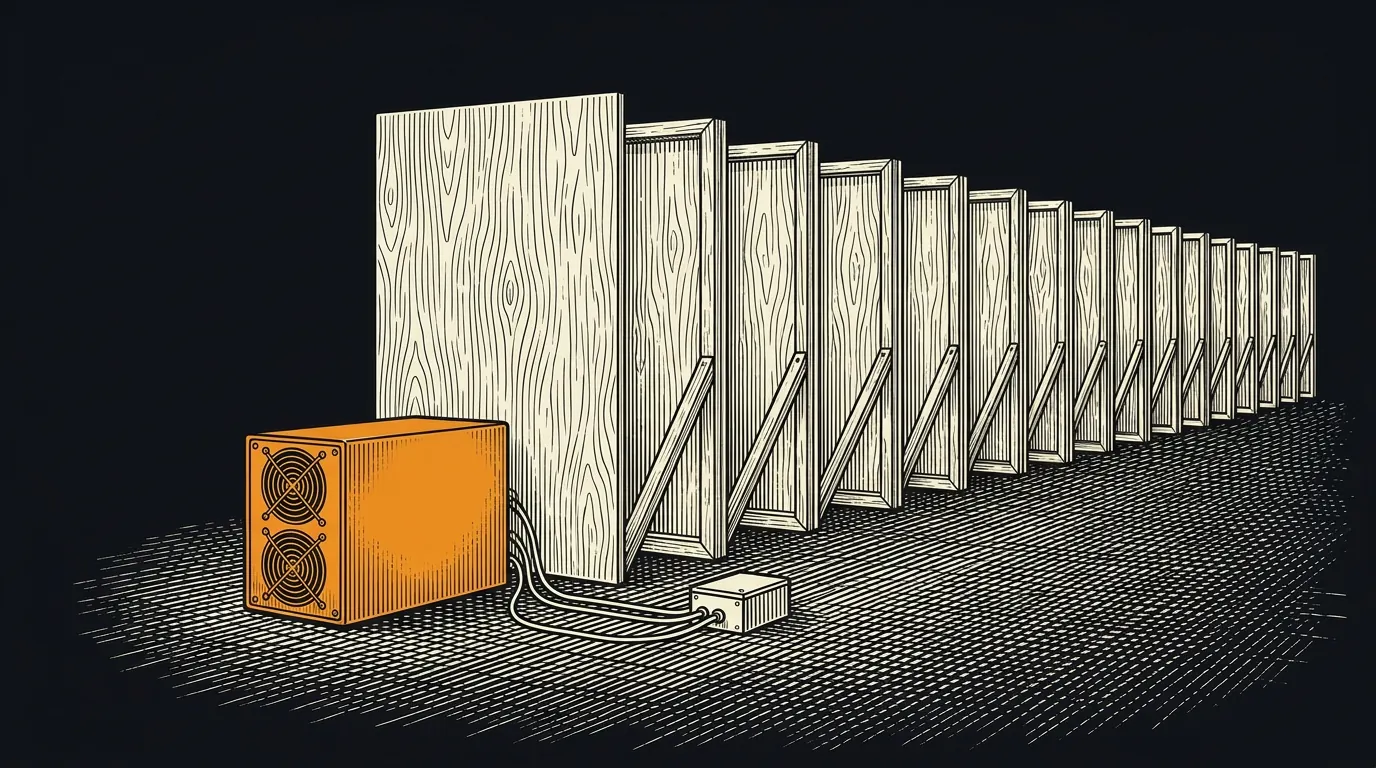
The company displayed fake dashboards showing mining activity and fabricated earnings. Customers could not independently verify that any hardware was running on their behalf. When BTC prices fell in 2018, HashFlare unilaterally terminated all contracts and locked withdrawals. The DOJ charged the founders with wire fraud and money laundering in a $575 million scheme.
HashFlare followed the incentive structure to its logical end: the customer cannot verify the product, the seller controls the infrastructure, and fabricating output pays better than delivering it. Other cloud mining operators face the same incentives. Some may be honest. You cannot distinguish them from the frauds until after you have paid.
Section 7 · The alternative: same dollars, actual Bitcoin
At ~$81,262 BTC, the same contract payments buy outright Bitcoin with no expiration, no counterparty risk, and no variance:
| Contract cost | BTC you could buy instead | Ownership on day 31 |
|---|---|---|
| $11,700 | 0.144 BTC | 0.144 BTC |
| $58,500 | 0.720 BTC | 0.720 BTC |
| $292,500 | 3.60 BTC | 3.60 BTC |
If what you want is mining exposure, own the hardware. A Bitaxe costs a few hundred dollars, hashes indefinitely, and you learn how Bitcoin's security works. If what you want is Bitcoin, buy Bitcoin and DCA.
You are buying a depreciating, variance-heavy, unverifiable derivative of an asset you could own outright. The contract expires. Bitcoin does not. The seller knows the math better than you do, and the math works in the seller's favor at every price point. That is why they sell instead of mine.
Where to go from here
Sources
Verify badges in the text link to these sources. Figures, rates and rules change: check each source’s date before acting on it.
- CoinWarz Bitcoin Hashrate Chart · coinwarz.com/mining/bitcoin/hashrate-chart. ↩
- CoinDesk Bitcoin price · coindesk.com/price/bitcoin. ↩
- U.S. DOJ. "Estonians Arrested for $575 Million Cryptocurrency Fraud and Money Laundering Scheme." · justice.gov. ↩
- mempoolmempoolThe waiting area for Bitcoin transactions that have been broadcast to the network but not yet confirmed in a block.Full definition.space mining statistics · mempool.space/mining.
- Solo CK Pool · solo.ckpool.org.
- Kryptex Mining Calculator · kryptex.com/en/mining-calculator.
Last updated . Reviewed against primary sources. Disclosures · How pages are reviewed