Why did the gold standard end?
Governments couldn't print gold.
Gold convertibility ended in stages across the twentieth century. Here is why it happened, what replaced it, and what its end still costs savers today. Later price changes are evidence for the case that monetary constraints protect savers, not proof of it.[1][2][3]
U.S. gold convertibility ended in stages, and no single event explains every later economic outcome. The 1933 domestic restrictions, 1934 revaluation and 1971 international suspension were three different decisions. By 1971, external dollar claims and pressure on U.S. gold reserves had broken confidence in convertibility; fiscal and monetary policy were among the causes.[1][2][3]
- A gold standard imposes a conversion constraint, and governments suspended it during crises and wars. Gold backing did not mean a fixed money supply, and the timing and form of national restrictions differed.[1][3]
- Three separate U.S. milestones: 1933 domestic suspension of gold redemption and restrictions on private monetary gold; January 1934 Gold Reserve Act and revaluation from $20.67 to $35 per troy ounce; August 15, 1971 suspension of dollar-gold conversion for foreign governments. Bretton Woods exchange-rate arrangements then unwound; floating rates were not universal overnight.[1][2][3]
- The 1971 trigger was a bank runbank runWhen many depositors try to withdraw at once, overwhelming a bank that has lent out most deposits. Self-fulfilling: rational response when you expect others to run is to run first. FDIC insurance prevents this by removing the incentive to panic. at national scale: foreign governments could redeem more dollars than the US had gold, so Nixon shut the window rather than watch the vault empty.
- What replaced U.S. gold convertibility: fiat dollars, redeemable for no fixed quantity of gold. Floating exchange rates emerged as Bretton Woods broke down after 1971. Fiat does not mean every currency floats, or that a currency has no economic or institutional support.[3]
- Using BLS annual-average CPI-U of 40.5 in 1971 and 313.689 in 2024, cash held unchanged lost 87.1% of its CPI purchasing power:
(1 − 40.5 / 313.689) × 100. This is an observation over those dates, not a causal estimate of the cost of ending gold convertibility.[4][5]
A gold standard commits to a fixed conversion price for eligible claims. It does not put one gold dollar in a vault behind every deposit, and it does not fix the money supply. The U.S. restricted domestic redemption in 1933 and suspended official foreign conversion in 1971, before gold reserves ran out. Bitcoin enforces the same kind of supply constraint, though neither gold convertibility nor a Bitcoin supply cap guarantees stable consumer purchasing power.[1][3][6]
On this page
- How did the gold standard work?
- When did the gold standard end? The break, step by step
- What did the gold standard do well?
- Why did governments abandon it?
- What replaced the gold standard?
- What did the gold standard get wrong?
- What does the end of the gold standard mean for savers today?
- Is Bitcoin a digital gold standard?
- Common questions about the gold standard
How did the gold standard work?
“Money backed by gold” meant a conversion promise written into law, with eligibility and reserve rules that changed by period. The 1913 Federal Reserve framework required gold equal to 40% of Federal Reserve notes, not full backing for every dollar of bank deposits.[1]
- 1837–1933: $20.67 per troy ounce of gold[7]. This rate held, with brief wartime suspensions, for nearly a century.
- 1934–1971: $35 per ounce after FDR's 1934 revaluation. The Bretton Woods international system used this rate.
- Post-1971: no peg. Gold traded freely. The price has gone from $35 to over $2,500 since.
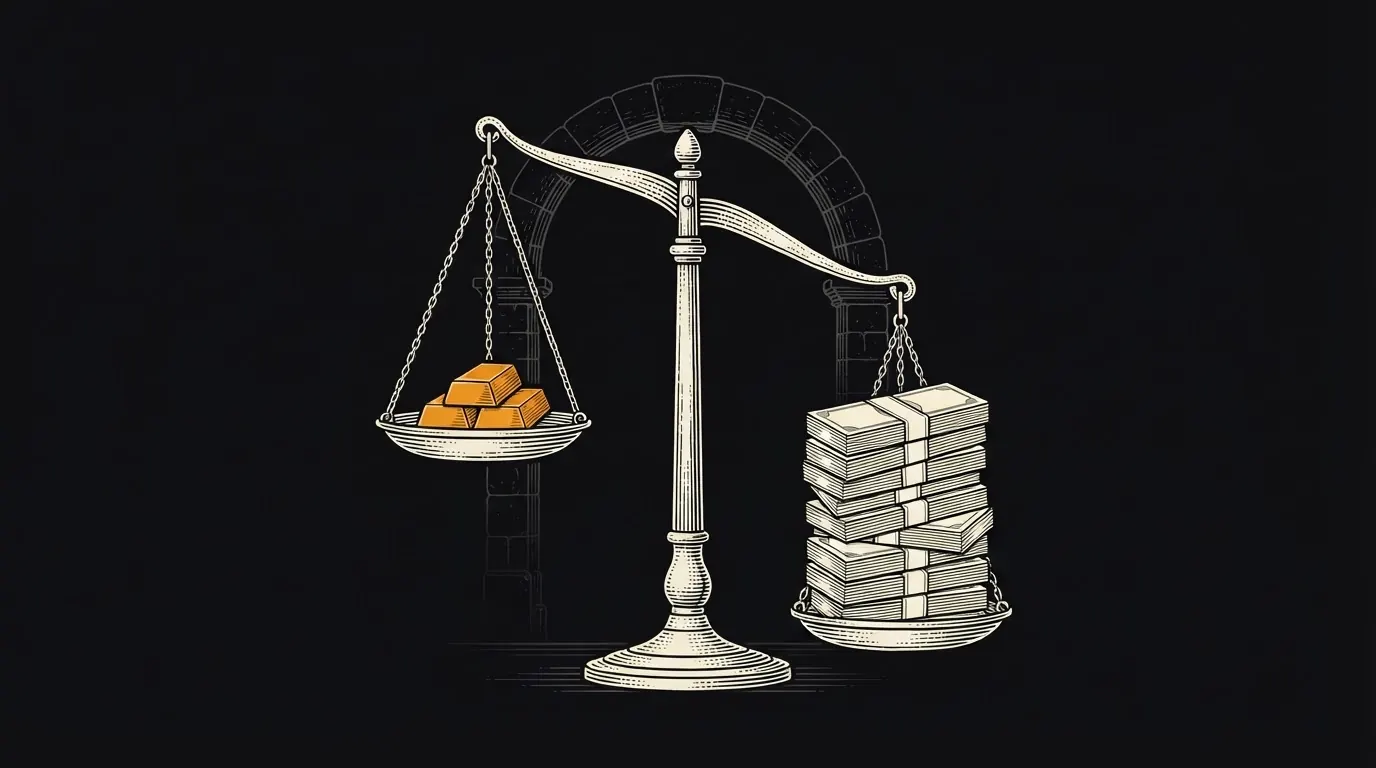
The constraint that mattered was on the issuer. A central bank with $1B in gold reserves could issue only so much currency before the ratio of paper to metal exceeded what a run on the bank could survive. Print too much, people redeemed, gold left the vault, and the system broke. Discipline was not a policy choice; it was an engineering property of the system.
When did the gold standard end? The break, step by step
There is no single end date, which is why the question confuses people. The gold standard died in five recognizable stages, from the classical peak to the fully fiat era.
Germany adopts gold in 1871; most of Europe and the US follow by the 1880s. Prices are remarkably stable, and international trade booms because currencies convert through fixed gold weights. This is the era gold bugs romanticize: solid growth, roughly flat price levels over decades, no coordinated "policy" required. It also coexisted with bank panics, because a gold standard does not stop fractional-reserve lending from overextending.
World War I forces every combatant off gold. Governments need to print money to fund the war and cannot do that under a gold constraint. Britain, France, and Germany suspend convertibility; the United States restricts gold exports. The war exposes the basic tradeoff: under gold you cannot fund a war of that scale; without gold you can fund anything.
Interwar attempts to restore gold parities ran into banking stress and deflation. The U.S. suspended domestic gold redemption in 1933 and restricted private holdings of monetary gold; the $35-per-ounce revaluation came in January 1934, not 1933. Federal Reserve History covers the controversy and the evidence that dropping the constraint helped the recovery.[1][2]
The postwar dollar-gold peg. The US dollar is convertible to gold at $35/oz for foreign central banks (not citizens); every other major currency pegs to the dollar. The US holds roughly two-thirds of the world's monetary gold. See why the dollar is the world's reserve currency for the full Bretton Woods story.
By 1971, foreign-held dollar claims exceeded the U.S. gold available at the official price, and a run was in reach. Nixon suspended foreign official convertibility on August 15, 1971. The Smithsonian attempt to hold pegged rates together came after, which is why suspending gold redemption and the world going to floating rates are two different events.[3]
Chart collections such as wtfhappenedin1971.com raise the right questions, but lines bending in the same year do not prove causation. Check definitions, common dates and the alternatives (productivity, demographics, taxes, housing supply, demand and other policy) before you hang the whole pattern on 1971. See the verification worksheet.
What did the gold standard do well?
It disciplined the issuer. A government that wanted to spend more than it collected in taxes had three options: issue debt (repayable in gold-backed money), raise taxes (politically costly), or run down its gold reserves by printing and watching redemptions drain the vault. None of those options were unlimited.
The result: deficits were bounded, wars required borrowing or outright suspension, and welfare states could not be expanded indefinitely by the printing press. Purchasing power was remarkably stable over long periods because the money supply was roughly tied to the supply of gold, which grows only about 1.5–2% per year from mining. Sovereigns on gold also borrowed more cheaply. Economists Bordo and Rockoff called the gold standard a "good housekeeping seal of approval" for exactly this reason[8].
The bands show which monetary regime was in force, not what caused each move. The sharpest jumps before 1971 came in wartime: the War of 1812 (peak 1814), the Civil War, when gold payments were suspended for greenbacks (peak 1864), World War I (peak 1920), which brought a 1917–19 gold-export embargo, the unshaded gap before 1920, and World War II. The first three were followed by years of falling prices; the World War II rise was not reversed. Before 1834 the dollar was bimetallic in law and silver in practice. From 1934 to 1971 Americans could not redeem dollars for gold; foreign official holders could, at $35. Values before 1913 are estimates.
"In the absence of the gold standard, there is no way to protect savings from confiscation through inflationinflationA general increase in prices over time, meaning each dollar buys less than it did before.Full definition. There is no safe store of value. […] This is the shabby secret of the welfare statists' tirades against gold. Deficit spending is simply a scheme for the confiscation of wealth. Gold stands in the way of this insidious process. It stands as a protector of property rights."
Alan Greenspan, "Gold and Economic Freedom," The Objectivist, 1966[9]Greenspan wrote that two decades before becoming Fed chair, then spent 19 years presiding over exactly the monetary expansion he had warned against. Make of that what you will. The essay still captures the case for hard money better than most modern treatments.
Why did governments abandon it?
The same discipline that savers valued was, to a government, a straitjacket. Three forces made abandonment almost inevitable once the political appetite for spending outgrew the gold supply:
- Total war. Modern industrial wars cost more than any nation could raise in gold-backed taxes and bonds. Every major power suspended convertibility to print for the fight, twice in 30 years.
- The Depression. A gold standard forces prices down in a slump instead of letting the central bank ease. That deepened the Great Depression and made "keep the gold peg" politically radioactive. Countries that left gold earlier recovered earlier.
- The welfare-and-deficit state. Post-1945 governments promised pensions, healthcare, and permanent military spending that a fixed money supply could not underwrite. By 1971 the US was funding the Vietnam War and the Great Society while foreign creditors cashed dollars for gold. Something had to give, and it was the gold, not the spending.
The gold standard was abandoned because it worked as designed. It said no to unlimited spending, and governments wanted to say yes. See the US national debt for where that "yes" has led.
What replaced the gold standard?
Fiat money is not redeemable by its issuer for a fixed quantity of any commodity. U.S. dollar-gold conversion ended for foreign governments in 1971, after the earlier domestic changes. Call it “not redeemable for gold” rather than “backed by nothing”: what holds the dollar up is institutions, payments, taxation and confidence, and fiat currencies can run fixed or floating exchange rates.[1][3]
- Legal tender laws and taxes. You owe your taxes in dollars, which creates permanent demand for them.
- Reserve-currency status. The world prices oil and trade in dollars and holds them in reserve. After gold, that role was cemented by the petrodollar arrangement, oil sold for dollars, and the dollar's role as the world reserve currency.
- Central-bank management. Instead of a gold ratio, an inflation target. The Federal Reserve now decides the money supply directly; the constraint is a committee's judgment, not a vault. The IMF formally recognized the end of the Bretton Woods gold system by 1976[10].
The trade was discipline for flexibility: hold the conversion commitment, or keep room to act in a crisis. The constraint is what protected savers. The gold era also had bank runs and swinging price levels, and neither regime guarantees a saver’s real return.[1][3]
What did the gold standard get wrong?
A fair treatment has to include what gold did poorly, not just what it did well. The honest list:
- Deflationary pressure during recessions. The money supply could not expand to cushion downturns. When demand collapsed, prices had to fall, which extended unemployment. The 1873 "Long Depression" and the early Great Depression are the canonical cases.
- Arbitrary supply shocks. New gold discoveries (California 1849, South Africa 1886, the Klondike 1896) injected new money unrelated to economic need. The economy had to absorb the windfall.
- International fragility. The classical standard worked because major economies cooperated. When cooperation broke down (war, diplomatic disputes, competitive devaluations), the system fragmented.
- Bank runs were still possible. Gold constrained the central bank but did not stop commercial banks from issuing more deposits than they had gold on hand. The 1907 panic and the 1930–1933 bank runs all happened under gold.
- Physical custody is clumsy. Gold is heavy, hard to verify quickly, expensive to transport, and easy to confiscate (see FDR, 1933). The metal had to sit somewhere, which made the whole system a target.
"Experience however shews, that neither a state nor a bank ever have had the unrestricted power of issuing paper money, without abusing that power."
David Ricardo, On the Principles of Political Economy and Taxation, Ch. XXV (1817)[11]Gold did the hard-money job well but the logistical job poorly. Bitcoin inherits the hard-money discipline and drops the physical baggage. That is the argument in one sentence.
What does the end of the gold standard mean for savers today?
Compare your after-tax interest with consumer-price inflation over the same dates. The 87.1% figure is the CPI-based purchasing-power loss of unchanged cash between the 1971 and 2024 annual averages, not the return on savings accounts, wages or investments. The Fed’s longer-run target is 2% total PCE inflation, not 2–3% CPI.[4][5][12]
The practical consequences are the reason this page exists:
- Cash earning nothing loses purchasing power whenever prices rise. An interest-paying account can still lose after inflation and tax. Cash does buy liquidity for near-term bills. Use the real-return tool, not a blanket guarantee.[13][14]
- Owning assets is how you defend against inflation, and stocks, property, gold and Bitcoin each carry their own risk. Hard money is a conviction and a thesis, not proof that every goal requires concentrated price risk.[6]
- Whoever gets the new money first wins. Newly created money reaches the government, banks, and asset owners before it reaches wages, the Cantillon effect, which is a large part of why the wealth gap widened after 1971.
See how much your own currency has eroded on the purchasing power page and the full debasement timeline.
Is Bitcoin a digital gold standard?
In its core constraint, yes. Bitcoin enforces the same rule on issuers that gold did: you cannot spend more than you have, because you cannot create more. A government running a deficit cannot command the Bitcoin network to inflate the supply. The 21-million cap is enforced by every node on the network, and no central authority can override it. Where it differs: Bitcoin is not government-issued, it is far more volatile than gold has been, and adoption is still early.
What Bitcoin fixes about gold:
Move a billion dollars of Bitcoin across borders with a memorized seed phraseSeed phraseA wallet backup written as a list of words, usually 12 or 24, that can recreate the wallet's private keys. In a single-signature wallet, anyone who sees it can take the bitcoin unless a separate passphrase also protects it. Keep it offline and private; recovery may also need the passphrase and wallet setup details.Full definition. Gold requires armored trucks and customs declarations. In a crisis, portability is a survival feature.
One Bitcoin divides into 100,000,000 satoshis. Gold divides into grams, but precisely weighing and verifying micro-amounts is impractical. Bitcoin scales down to penny-level transactions natively.
Anyone running a node can verify the total Bitcoin supply in seconds. Gold requires assay, chemical testing, and trust in the vault's custody. Tungsten-plated fake bars have been caught in major vaults more than once.
Gold adds ~1.5–2% new supply annually from mining. Bitcoin's issuance is scheduled, halvingHalvingThe scheduled event, built into Bitcoin's code, that cuts the new bitcoin paid to miners per block in half. It happens every 210,000 blocks, about every four years; the April 2024 halving at block 840,000 cut it from 6.25 to 3.125 BTC, slowing the rate of new supply.Full definition every four years, asymptoting at 21M by 2140. No California gold rush moment can double the supply.
Gold disciplined governments for a hundred years. It failed because it was physical, because cooperation broke down, and because governments eventually chose deficit spending over the constraint. Bitcoin is the digital version of the same discipline, with portability, divisibility, verifiability, and a schedule no new discovery can alter. That is why "digital gold" is a structural description, not a marketing line. Compare them directly on Bitcoin vs gold.
Common questions about the gold standard
Why did the gold standard end?
U.S. convertibility ended through separate domestic and international decisions: the 1933 restrictions, the 1934 revaluation, and the 1971 suspension under gold-run pressure and lost confidence. Fiscal and monetary policy drove those decisions, and the fixed-supply explanation alone is incomplete.[1][2][3]
When did the US leave the gold standard?
Three separate U.S. milestones: 1933 domestic suspension of gold redemption and restrictions on private monetary gold; January 1934 Gold Reserve Act and revaluation from $20.67 to $35 per troy ounce; August 15, 1971 suspension of dollar-gold conversion for foreign governments. Bretton Woods exchange-rate arrangements then unwound; floating rates were not universal overnight.[1][2][3]
What replaced the gold standard?
Fiat dollars no longer carried a promise of official gold conversion. Bretton Woods pegged rates unwound after the 1971 suspension; not every currency became freely floating that day.[3]
Could the US return to a gold standard?
Almost certainly not in its old form. There is not enough US gold to back today's money supply except at an extreme gold price, and re-pegging would force severe deflation and surrender the Fed's ability to respond to crises, which no government will accept. A digital, rules-based hard money is the more plausible modern version of the same discipline.
Is Bitcoin like a digital gold standard?
In its constraint, yes: Bitcoin's 21-million cap enforces the same "you can't print it" discipline gold did, while fixing gold's weaknesses in portability, divisibility, and verifiability. It differs in being volatile, still early in adoption, and not issued by any government.
Where to go from here
Sources
Bracketed numbers in the text link to these sources. Figures, rates and rules change: check each source’s date before acting on it.
- Roosevelt's Gold Program | Federal Reserve History ↩
- Gold Reserve Act of 1934 | Federal Reserve History ↩
- Federal Reserve History. "Nixon Ends Convertibility of US Dollars to Gold and Announces Wage/Price Controls," August 1971 · federalreservehistory.org. Nixon's August 15, 1971 address is archived with full text and audio at millercenter.org. ↩
- Historical CPI-U ↩
- Summary of annual and semi-annual indexes : Mid–Atlantic Information Office : U.S. Bureau of Labor Statistics ↩
- FAQ - Bitcoin ↩
- Federal Reserve Bank of St. Louis (FRED). "Gold Fixing Price / historical gold prices" · fred.stlouisfed.org. Pre-1933 parity of $20.67/oz set by the Coinage Act of 1837. ↩
- Bordo, Michael D., and Hugh Rockoff. "The Gold Standard as a 'Good Housekeeping Seal of Approval.'" NBER Working Paper 3939, 1992 · nber.org. Empirical analysis of gold-standard credibility and sovereign-borrowing costs. ↩
- Greenspan, Alan. "Gold and Economic Freedom." The Objectivist, 1966. Reprinted in Capitalism: The Unknown Ideal (Rand, 1967). ↩
- International Monetary Fund history archive. "The end of the Bretton Woods System (1972–81)" · imf.org. ↩
- Ricardo, David. On the Principles of Political Economy and Taxation. Ch. XXV, "On Currency and Banks." 1817 · Project Gutenberg. ↩
- The Fed - Why does the Federal Reserve aim for inflation of 2 percent over the longer run? ↩
- Consumer Price Index Frequently Asked Questions : U.S. Bureau of Labor Statistics ↩
- Topic no. 403, Interest received | Internal Revenue Service ↩
- Eichengreen, Barry. Golden Fetters: The Gold Standard and the Great Depression, 1919–1939. Oxford University Press, 1992 · oup.com. The authoritative academic account of the interwar gold standard and its failure.
- US National Archives / Federal Register. Executive Order 6102, April 5, 1933 (FDR's gold-confiscation order) · federalregister.gov.
Last updated . Not financial advice. Do your own research. Disclosures · How pages are reviewed