Early career.
Ages 25 to 35.
Your income is climbing, your options are multiplying, and the decisions are getting harder. Buy or rent. Marry or not. Job-hop or stay. The ten years between 25 and 35 determine more about your net worthnet worthEverything you own (assets) minus everything you owe (debts). The most comprehensive measure of financial health.Full definition at 55 than any other decade.
This page covers personal finance fundamentals that apply regardless of your view on Bitcoin or fiat currencyfiat currencyMoney declared legal tender by a government, not backed by a physical commodity. Its value rests on trust in the issuing government.Full definition.
This page covers US-specific accounts and tax law. Outside the US? The priority order is the same, the account names differ (ISAIndividual Savings Account (ISA)A UK tax-advantaged account where contributions are post-tax but all growth and withdrawals are tax-free.Full definition in the UK, TFSATax-Free Savings Account (TFSA)A Canadian tax-advantaged account where contributions are post-tax but all growth and withdrawals are tax-free.Full definition/RRSPRegistered Retirement Savings Plan (RRSP)A Canadian tax-deferred retirement account; contributions reduce taxable income and growth is tax-deferred until withdrawal.Full definition in Canada, Super in Australia, etc.).
This page covers ages 25-35, after the first-job foundation is built. For your first paycheck and ages 18-24, see New Graduate Finance and Your First Real Paycheck.
Maximize your income - negotiate every role, job-hop when the math works, get promoted. Rent until the 5% rule says buy. Follow the order of operationsOrder of operationsA default sequence for spare money after essentials and minimum payments: a starter emergency fund, any employer retirement match, high-interest debt, a full emergency fund and tax-advantaged accounts (HSA, Roth IRA, more 401(k)), then taxable investing. Vesting, unstable income and near-term goals can shift it.Full definition: match, Roth, taxable, Bitcoin. Start a 1 to 5% Bitcoin allocation once the foundation is built. Have the uncomfortable money conversations before moving in together.
On this page
Your income is your biggest asset
People obsess over expense ratios and fund picks while ignoring the lever that moves the needle by 10x: how much they earn. A $5,000 raise at 25 - negotiated once, then carried through every future role as a higher base - compounds to a remarkable amount by 65.
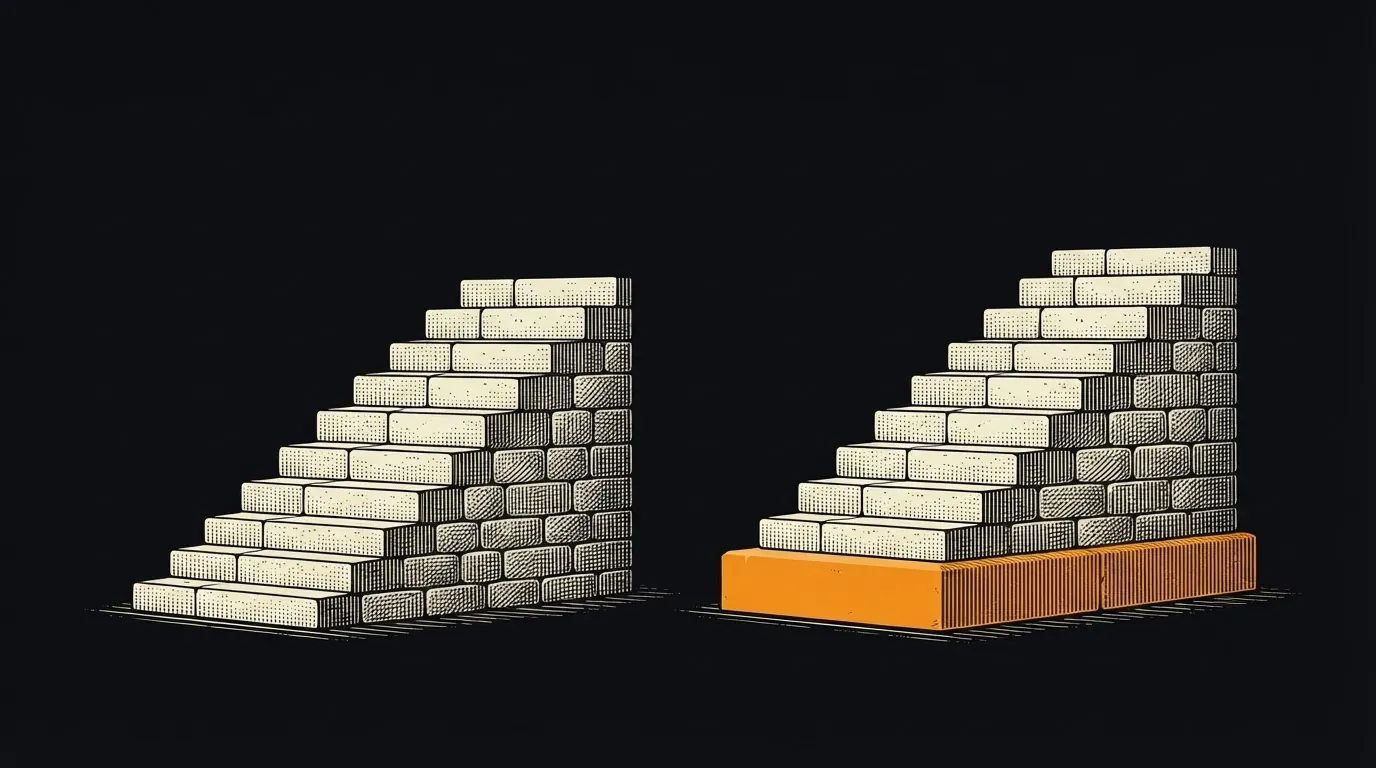
A $5,000 salary bump at 25, assuming normal 3% annual raises on top of the new base, puts roughly $377,000 more through your paycheck over a 40-year career. Invest just a third of that extra income at 7% real and it becomes roughly $500,000 by 65.
Tactics that work in your 20s and 30s:
- Job-hop every 2 to 4 years. Internal raises rarely beat the outside offer.
- Always counter the first offer. 60%+ of the time they will say yes to more.
- Target roles where your impact is legible - sales, engineering, product, partnerships - over roles where review cycles decide your pay.
- Focus on the 1 to 2 skills that compound into specialist pay.
Buy vs rent in your 20s and 30s
The internet will moralize at you in both directions. The math is cleaner than the narrative. Homeownership costs roughly 5% of the home's value every year once you add property tax, insurance, maintenance, and the opportunity costopportunity costWhat you silently give up when you pick one option over another. Spending $100 today on dinner means giving up whatever that $100 could have grown into if you had invested it instead.Full definition of the capital tied up in equity. If market rent on a comparable home is below that 5%, renting wins financially.
On a $500,000 home, the 5% rule says all-in housing cost is about $25,000 per year - roughly $2,080 per month. If you can rent a similar home for less than that, rent. If rent is higher, buy. Transaction costs are the other side of this: buying is typically worth it only if you expect to stay 5+ years.
- You plan to move in under 5 years
- Market rent is well below 5% of local prices
- Down payment would empty your emergency fund
- Your career is likely to relocate you
- You will stay 7+ years
- Rent exceeds 5% of home value locally
- You have 20% down plus reserves
- Total housing stays under 28% of gross incomegross incomeYour total income before any taxes or deductions are subtracted.
This is a financial calculation, not a moral one. Renting is not throwing money away. A mortgage is not automatically an investment. Do the math for your city.
The order of operations at this stage
By your late 20s, income usually outruns the basic bucket sequence. The order gets slightly more sophisticated:
- Emergency fund: 3 to 6 months in a high-yield savings account.
- Full 401(k) employer matchemployer matchAn employer contribution linked to qualifying employee contributions under a plan formula. Eligibility, vesting and plan terms determine what you receive and keep. The match ratio is not an annual investment return, and the invested balance can fall.Full definition - always.
- Max the Roth IRAIndividual Retirement Account (IRA)A retirement account with tax advantages and eligibility rules. Traditional IRA contributions may be deductible; taxable withdrawals generally enter income. Roth contributions use after-tax money, and qualified Roth withdrawals are tax-free.Full definition. $7,500 in 2026.
- Max the HSAHealth Savings Account (HSA)A health savings account available only when eligibility requirements are met. Federal tax benefits depend on contribution limits and qualified medical expenses. Health coverage, other coverage and Medicare enrollment can affect eligibility; state tax treatment can differ.Full definition if you are on an HDHPHigh-Deductible Health Plan (HDHP)A health-plan category with statutory deductible and out-of-pocket rules. HSA eligibility also depends on other conditions. Special 2026 rules cover qualifying bronze and catastrophic plans; verify the plan and your own eligibility rather than relying on its deductible alone.Full definition - the most tax-advantaged account in America.
- Max the 401(k).4,500 in 2026.
- Taxable brokerage - VTI or a three-fund portfolio.
- Bitcoin DCADollar-cost averaging (DCA)Investing a fixed amount on a regular schedule, such as $50 every payday, regardless of price. It spreads out when money enters the market and buys more units when prices are low, but it does not guarantee a better price than investing all at once, a profit or protection against loss.Full definition, 1 to 5% of net worth at first, scaled up as you learn.
- Extra mortgage or student-loan payments, if rates are above 6%.
Full breakdown: Order of Operations.
When to add a Bitcoin allocation
Once the emergency fund is full and you are capturing the 401(k) match, start allocating 1 to 5% of new savings to Bitcoin. As you learn more and volatility stops unsettling you, scale up. A 10% allocation at 28 with a 30-year horizon is not reckless - it is one of the more defensible positions in a diversified portfolio.
In your 20s and 30s, your single biggest financial advantage is time. That is exactly what Bitcoin rewards the most.
See Bitcoin Strategy and DCA.
What to avoid
The stock or coin your coworker bragged about at the barbecue is already up. By the time you hear about it, the asymmetric opportunity is gone.
If you pulled out of the S&P 500 and missed the 10 best days of the decade, your returns were cut roughly in half. Staying invested beats everything.
You lose the compounded growth while the money is out. If you leave the job, the loan usually becomes due fast - or it is treated as a taxable distribution.
Roll it over into an IRA or the new employer's 401(k). Never cash out. A $15K balance at 28, cashed out, is roughly $150K gone by 65.
Lenders will qualify you for mortgages that destroy your savings rateSavings rateThe share of income you save or invest, usually (income minus spending) divided by income. Saving $1,000 of $5,000 take-home pay is a 20% rate. Whether you use gross or take-home pay, and whether 401(k) contributions and an employer match count, changes the number, so compare rates only on the same definition.Full definition. Keep all-in housing under 28% of gross income, ideally closer to 20%.
Marriage and money
Money is the number-one cause of relationship conflict. Most of that is because couples do not talk about it explicitly until they are already angry. Have these conversations before they are loaded:
- What is your number? What does "enough" look like?
- How do you feel about debt? Any current balances?
- Yours, mine, ours? A joint account for shared expenses and individual accounts for personal spending is the most resilient structure.
- Credit scores on both sides. Any old collections or missed accounts.
- Emergency fund - shared or separate? Most couples benefit from one joint emergency fund.
- Bitcoin position. Keys. What happens to that wallet if one of you dies. See Inheritance.
- Kids, yes/no. Timeline. Expected cost.
Have these conversations before you move in, not after the first disagreement over the grocery bill.
Your ten-year plan
This is the decade where the conflict between retirement savings and a house down payment is most real. The order of operations says retirement first. But if you want to buy in the next 3–5 years, the math changes, a down payment on a short timeline can't be in the stock market. When to pause retirement contributions and when to keep them: Saving for a House Without Wrecking Retirement.
Where to go from here
Sources
Figures, rates and rules change: check each source’s date before acting on it.
- IRS contribution limits - irs.gov
- Ben Felix, The 5% Rule - YouTube / Rational Reminder
- NYU Stern, historical S&P 500 returns - stern.nyu.edu
- JL Collins, The Simple Path to Wealth - jlcollinsnh.com
Last updated . Not financial advice. Do your own research. Disclosures · How pages are reviewed