Your money is
slowly dying.
Fiat currencyfiat currencyMoney declared legal tender by a government, not backed by a physical commodity. Its value rests on trust in the issuing government.Full definition is government-issued money not backed by any physical commodity. The U.S. dollar, euro, yen: all fiat. Their value comes from trust and government policy, not scarcity. This hub examines six problems with that reliance on trust.
Viewpoint. Besides explaining the topic, this page makes the site’s case on money and Bitcoin. The facts are sourced; that case is the site’s view. How pages are labeled.
"The root problem with conventional currency is all the trust that's required to make it work. The central bank must be trusted not to debasedebaseTo reduce the value of a currency, usually by increasing its supply or by lowering the metal content of coins. the currency, but the history of fiat currencies is full of breaches of that trust."
Satoshi Nakamoto, 2009"By a continuing process of inflationinflationA general increase in prices over time, meaning each dollar buys less than it did before.Full definition, governments can confiscate, secretly and unobserved, an important part of the wealth of their citizens."
John Maynard Keynes, The Economic Consequences of the Peace (1919)"The great inflations of our age are not acts of God. They are man-made or, to say it bluntly, government-made."
Ludwig von Mises, The Theory of Money and Credit (1912; 1952 preface)A dollar in 1971 buys about 13 cents today. The money supply grew 41% in 25 months during 2020-2022. Banks create most new money as debt. National debt has crossed $40.0T with $1T+ in annual interest alone. Every major fiat in history has ended the same way. And the cost of a middle-class life has outrun wages for 25 years. Each of the six guides below goes into depth on one piece of the picture.
On this page
- WTF Happened in 1971
- The Debasement Dashboard
- One cause. Many consequences.
- Why this doesn't look like hyperinflation (but is the same thing)
- Why it's hard to understand what's happening to your money
- Your work is energy. Inflation drains it.
- The business cycle: why the economy moves in waves
- Rent-seeking: the economy within the economy
- The bigger picture: debt, demographics, and the dollar
- Retirement savings and the bailout problem
WTF Happened in 1971
A collection of charts showing wages, productivity, housing costs, debt, inequality, and more, all bending at the same inflection point: the year the dollar was decoupled from gold.
No explanation needed. The charts speak for themselves.
The Debasement Dashboard
M2 money supply, CPI, mortgage and Treasury rates, and Bitcoin, with month-over-month and year-over-year change, refreshed from public Federal Reserve data. The six guides below explain why; this is the live scoreboard.
"Inflation is always and everywhere a monetary phenomenon in the sense that it is and can be produced only by a more rapid increase in the quantity of money than in output."
Milton Friedman, The Counter-Revolution in Monetary Theory (1970)If you want the clearest visual explanation of how credit cycles drive the monetary mechanics behind all of this, Ray Dalio's How the Economic Machine Works (YouTube, 30 minutes, 40M+ views) is the best free primer available. For the long version, Dalio's Principles for Navigating Big Debt Crises is a free PDF at principles.com, 300+ pages covering every major debt crisis in history.
The 2% inflation target was adopted deliberately to give policymakers a small buffer against deflationary debt spirals while supporting employment and growth. On the target's own terms, a modestly elastic money supply can fund real productivity gains that a fixed supply might not. The critique on this site is that the realized path has consistently overshot the target, the benefits have accrued unevenly (Cantillon), and the costs are paid by wage earners and savers over decades.
Full version of the mainstream case, with sources: The mainstream steelman →
"Rather than banks receiving deposits when households save and then lending them out, bank lending creates deposits."
Bank of England, Money Creation in the Modern Economy, Quarterly Bulletin Q1 2014One cause. Many consequences.
Each box below has its own page elsewhere on this site. The diagram exists because these aren't separate problems. They share a cause.
Full narrative with primary sources on each step: Downstream Consequences.
Sound money is money that cannot be easily created by governments or banks. Historically, gold filled this role: physically scarce, durable, and universally recognized. Fiat broke every one of these properties.
Why this doesn't look like hyperinflation (but is the same thing)
Open any history book about monetary collapse and you'll find photos of Germans with wheelbarrows full of cash, buying loaves of bread. Weimar Germany. Zimbabwe. Venezuela.
Looking at those photos, the reaction is obvious: that's clearly going to end badly. Anyone can see it.
The mental disconnect is that we look at those photos and think: we're not doing that.
Jerome Powell doesn't wheel carts of currency into supermarkets. He types numbers into a computer. The Federal Reserve adds zeros to a balance sheet. The mechanism is identical, more money units chasing the same goods and services, but the visual is a spreadsheet instead of a printing press verify×DON'T TRUST, VERIFYClaim: US M2 money supply has grown substantially over recent decades.Verify at: FRED M2 Money Supply ↗ · BLS CPI Inflation Calculator ↗ Source 1 in the list belowCompare M2 chart with CPI over the same period to see the mechanism behind rising prices..
Because it doesn't look like hyperinflationhyperinflationInflation above 50% per month, equivalent to roughly 13,000% per year (Cagan threshold). Caused when a government creates money far faster than the economy grows. Documented cases: Weimar Germany 1923, Zimbabwe 2008, Venezuela 2018, Argentina 2024.Full definition, it doesn't feel like hyperinflation. People have a mental dissociation between the Weimar Republic and quantitative easing. They are the same mechanism. One is visible. One isn't.
The invisible version is in some ways more dangerous because it's harder to see coming. There are no wheelbarrows to photograph. No obvious moment when the public recognizes what's happening. Just numbers on a spreadsheet, and prices that seem to rise for no particular reason.
"The history of government management of money has, except for a few short happy periods, been one of incessant fraud and deception."
Friedrich Hayek, The Fatal Conceit (1988)Why it's hard to understand what's happening to your money
The language of monetary policymonetary policyThe central bank's control of money supply and interest rates to influence the economy. is not accidentally complicated. Terms like "quantitative easing," "open market operationsopen market operationsThe Federal Reserve buying or selling Treasury bonds to adjust how much cash is in the banking system. Buying bonds adds reserves and lowers rates. Selling bonds removes reserves and raises rates. The Fed primary tool for moving the federal funds rate.," "sterilized intervention," and "reserve requirement ratio" describe relatively simple concepts wrapped in specialist vocabulary that takes years to learn.
The effect is that ordinary people cannot evaluate whether the people managing their money are doing a good job. They can't even understand what those people are saying.
This isn't unique to monetary policy. But in monetary policy specifically, the complexity creates a priest class. Economists who speak a language only other economists understand, making policy decisions that affect everyone while being accountable to no one who isn't fluent in the jargon.
Bitcoin's rules are public, permanent, and written in code. The supply schedule is fixed. The difficultydifficultyA number that Bitcoin adjusts every 2,016 blocks (roughly two weeks) to keep the average block time at 10 minutes regardless of how much hashrate is on the network. Higher difficulty means each hash has a lower chance of finding a block. adjustment is automatic. Nobody has to take anyone's word for it. The code is the rule. Anyone who can read code can verify it. See Don't Trust, Verify and How It Works.
Your work is energy. Inflation drains it.
When you go to work, you're converting time and effort into money. The money is stored energy, the value of what you contributed, held in a form you can spend later.
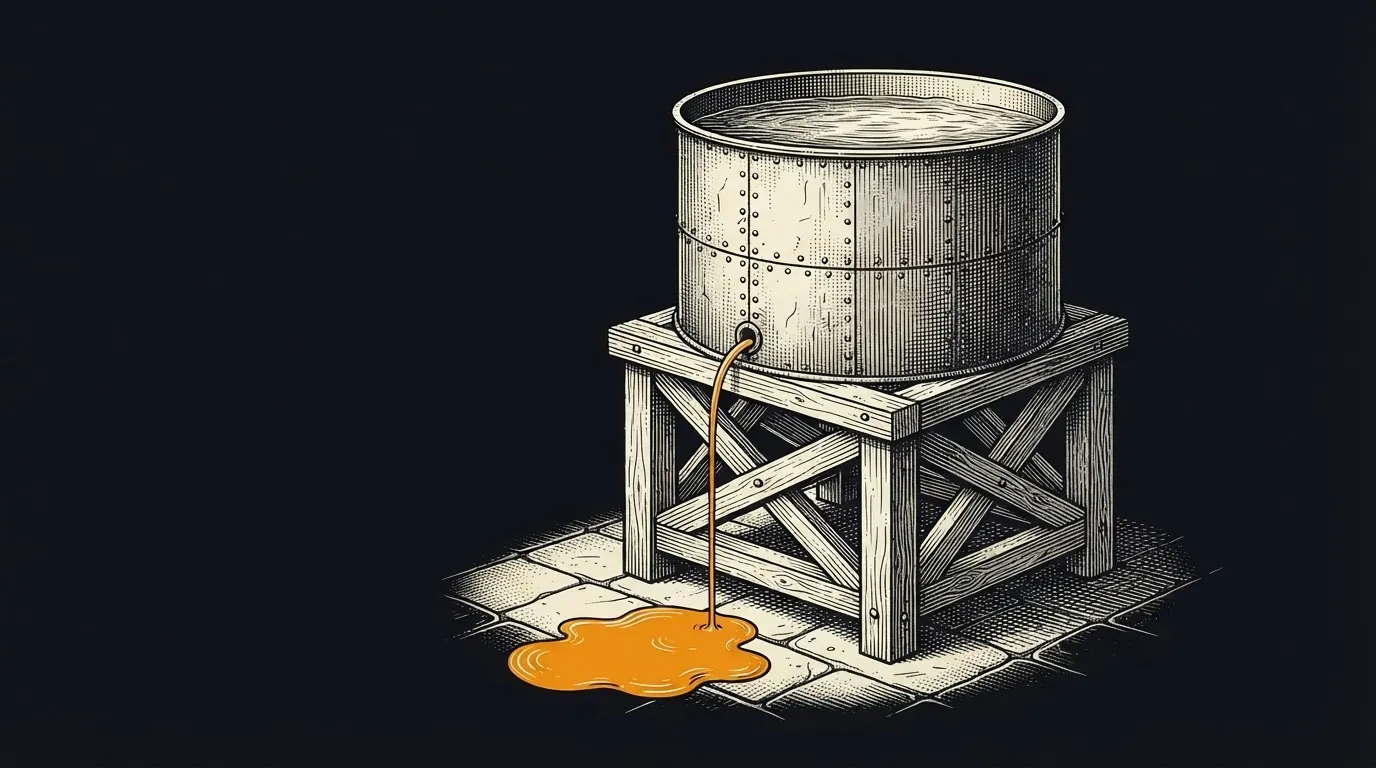
The problem with that stored energy is that it leaks.
Every year, the purchasing powerPurchasing powerWhat money can actually buy, not the number on the bill or in the account. Inflation shrinks it over time: by the BLS consumer price index, it takes more than $8 today to buy what $1 bought in 1971. Same dollar, much less buying ability.Full definition of that stored energy decreases. Not because you did anything wrong. Not because the economy failed. Because the number of currency units in circulation keeps growing while the amount of goods and services grows more slowly verify×DON'T TRUST, VERIFYClaim: US dollar purchasing power erodes year over year as money supply expands faster than real output.Verify at: FRED M2 ↗ · BLS CPI inflation calculator ↗ Source 1 in the list belowCompare M2 growth rate to real GDP growth rate. The gap is the mechanical source of the purchasing-power loss..
The gap between those two growth rates is what drains your stored energy.
Someone who spent 30 years saving carefully, investing conservatively, doing everything right, stored decades of economic energy in a system that silently transferred a portion of it, every year, to whoever was closest to the money printer.
This isn't an accident of the system. It's a feature of the system for those who benefit from it.
The question Bitcoin asks is whether you want to store your energy in something that can't be inflated. Where nobody can expand the supply and dilute your share. See Dollar-Cost Averaging and Bitcoin Allocation.
The business cycle: why the economy moves in waves
Economies do not grow in straight lines. They expand for several years, peak, contract, and trough, then expand again. The four phases repeat. Recognizing where you sit in the cycle is the difference between buying near a top because everything feels good and selling near a bottom because everything feels terrible.
The four phases
Two consecutive quarters of falling real GDP is the common shorthand. The official arbiter, the National Bureau of Economic Research, uses a broader framework including employment, income, and industrial production. Unemployment rising. Investment falling. Credit tightening. Average post-WWII US contraction: 10 months.
The bottom. Identifiable only in retrospect. Unemployment at its cyclical high. Credit conditions most restrictive. This is when fear feels most justified and selling feels most rational. It is also exactly when reinvesting historically pays off most. The behavioral pull is wrong here.
Why cycles happen, the competing views
- Keynesian: demand shocks. The paradox of thrift turns rational individual saving into aggregate demand collapse. Government can shorten the contraction with fiscal and monetary stimulus.
- Austrian business cyclebusiness cycleThe recurring pattern of expansion, peak, contraction, and trough. Average post-WWII US expansion lasts 58 months; average contraction lasts 11 months. The cycle is why markets go up and down and why timing the market fails.Full definition theory: central bank credit expansion produces artificially low rates that encourage malinvestment. The contraction is the inevitable correction. Policy that delays it makes it worse.
- Monetarist: central bank errors, too loose then too tight, drive cycles. The Great Depression was a Fed failure. Rules-based policy would smooth the cycle.
- Real Business Cycle theory: cycles are efficient responses to real productivity or technology shocks. Recessions are optimal adjustments, not policy failures. A minority academic view, but important context.
All four schools have produced testable claims. None has won decisively. The honest position: each captures part of the picture; the mix that drives any given cycle is debated.
NAIRU and the output gap
NAIRUNon-Accelerating Inflation Rate of Unemployment (NAIRU)The unemployment rate at which inflation neither accelerates nor decelerates. The Fed targets monetary policy partly around this estimate. Currently about 4 to 4.5% for the US, though it is unobservable and the estimate is contested. (Non-Accelerating Inflation Rate of Unemployment) is the unemployment rate at which inflation neither speeds up nor slows down. CBOCongressional Budget Office (CBO)A nonpartisan federal agency that provides economic and budget analysis to Congress. estimates put the US figure around 4.0 to 4.5%. The output gapoutput gapThe difference between actual GDP and potential GDP (what the economy could produce at full employment). Negative gap = slack, deflationary pressure. Positive gap = overheating, inflation risk. The Fed tries to close the gap with rate decisions. is the difference between actual GDP and potential GDP at full employment. Positive gap = overheating; negative gap = slack verify×DON'T TRUST, VERIFYClaim: CBO estimates of the natural rate of unemployment cluster around 4.0 to 4.5% in recent forecasts.Verify at: CBO Budget and Economic Outlook (most recent edition) ↗ Source 4 in the list belowCBO publishes the natural rate semi-annually. Both NAIRU and potential GDP are estimates rather than observations; that is the chronic Fed-policy challenge.. The Fed targets policy partly around these estimates. Both are unobservable, which is why Fed policy errors often trace back to NAIRU or output-gap mistakes.
What this changes for your money
The single most important rule: do not make permanent financial decisions based on cyclical conditions. People consistently buy near peaks (confidence is high) and sell near troughs (fear is high). DALBAR's annual investor-behavior report has documented this gap for three decades; the average individual investor underperforms the market by several percentage points per year, and most of the gap comes from poorly timed buys and sells verify×DON'T TRUST, VERIFYClaim: DALBAR's QAIB study consistently shows the average mutual-fund investor underperforming benchmark indices by several percentage points annually.Verify at: DALBAR Quantitative Analysis of Investor Behavior ↗ Source 5 in the list belowThe DALBAR methodology is contested by some academics for its weighting; the qualitative finding (timing-driven underperformance) is broadly accepted..
- Asset allocationasset allocationHow you divide your money across different types of investments like stocks, bonds, and Bitcoin.Full definition should be set for the full cycle and held through it. The behavioral pull to act at extremes is the main way cycles destroy individual wealth.
- "The market is down 30%, I should sell" locks in losses near a trough. "The market is up huge, I should add leverage" adds risk near a peak. Both feel right at the time. Both are usually wrong.
- Mortgage rate decisions should turn on your specific math, not the cycle phase. You can refinance later if rates fall.
- The behavioral discipline is the hard part. Detail at Behavioral Finance and Index Funds.
Rent-seeking: the economy within the economy
Most people understand that wealth comes from creating things people value: products, services, ideas. There is a second source of wealth that creates nothing. Capturing political advantages that redirect existing wealth toward yourself. Economists call this rent-seekingrent-seekingUsing political power, lobbying, or regulatory capture to extract wealth rather than create it. Securing a tariff that blocks competitors, an excessive licensing requirement, or a too-big-to-fail guarantee. Transfers wealth without producing new value.. The "rent" here does not mean housing rent; it means returns above what a competitive market would produce, earned by being shielded from competition.
The mechanism
A company can spend resources two ways. Build a better product and compete on value. Or lobby for regulations that block competitors and win by making competition harder. Option two earns profit without creating anything new. It transfers wealth from consumers (who pay more) and potential competitors (who cannot enter) to the rent-seeker. The lobbying, legal maneuvering, and regulatory-capture spending produce nothing economically verify×DON'T TRUST, VERIFYClaim: Gordon Tullock's 1967 paper "The Welfare Costs of Tariffs, Monopolies, and Theft" is the foundational rent-seeking analysis.Verify at: Concise Encyclopedia of Economics: Rent Seeking ↗ Source 6 in the list belowTullock identified the resource-waste problem; Krueger named the phenomenon "rent-seeking" in 1974. Both are standard references..
Examples across the economy
- Occupational licensing. Surgeons, pilots, and structural engineers have legitimate safety rationales. Florists, interior decorators, tour guides, and hair braiders generally do not. In each case, existing practitioners lobby for licensing; new entrants are blocked; prices rise; safety does not improve. A 2015 White House report found that nearly 30% of US workers required a license to do their job, up from about 5% in the 1950s, with the increase concentrated in low-skill occupations verify×DON'T TRUST, VERIFYClaim: A 2015 Obama-administration report found nearly 30% of US workers required occupational licensing, up from approximately 5% in the 1950s.Verify at: White House Report (2015), "Occupational Licensing: A Framework for Policymakers" ↗ Source 7 in the list belowThe bipartisan critique of excessive licensing has been echoed by the Institute for Justice and by Brookings; the policy implications are debated, the data are not..
- Tariffs. A steel tariff protects domestic steel producers. Steel workers and companies benefit. Every industry that uses steel (cars, appliances, construction) pays more. Consumers pay more for everything made from steel. Net economic effect is typically negative unless national-security or strategic-industry arguments apply.
- Financial sector. Large banks favor regulations expensive to comply with. Smaller banks cannot afford the compliance cost and exit. Concentration increases. Too-big-to-fail status entrenches further. Each requirement that protects incumbents is worth billions in competitive shielding.
The monetary system connection
The most pervasive rent-seeking in any economy happens through monetary policy. Banks closest to money creation, the primary dealers who transact directly with the Federal Reserve, receive newly created money before it spreads through the economy. By the time new money reaches ordinary workers and savers, asset prices have already risen. The real value of the new units has been partially consumed by those who received them first. This is the Cantillon EffectCantillon EffectThe idea that new money does not raise all prices at once. Whoever receives it first, often banks, governments and asset owners, can spend it before prices adjust, while people paid last, like most wage earners, face higher prices before their income catches up. Named for economist Richard Cantillon (died 1734).Full definition as rent: not earned through productivity, but extracted through proximity to the money printer. Detail at Cantillon Effect.
What this changes for your money
- Rent-seeking explains why certain industries are persistently profitable without obvious productivity advantages. The financial sector's share of GDP grew significantly in the decades after deregulation even as its measurable contribution to productive output remained contested.
- It is one structural reason wealth concentrates at the top. Those with political access extract returns unavailable to those competing in open markets.
- The individual response is the one this site recommends throughout: own productive assets (broad index funds, businesses, real estate, Bitcoin) rather than holding wealth in the cash that rent-seekers dilute. Detail at Index Funds and Bitcoin Allocation.
This is the strongest counterargument to everything on this page. The honest answer has three parts.
The US dollar is the world's reserve currency, used in international trade and held by central banks globally verify×DON'T TRUST, VERIFYClaim: The US dollar is the dominant reserve currency, held in large share by foreign central banks.Verify at: IMF COFER ↗ Source 8 in the list belowIMF COFER data tracks the currency share of global reserves. The dollar's share has trended lower but remains dominant.. This creates global demand for dollars that absorbs some inflation that would otherwise stay domestic.
Technological progress increases the supply of goods and services. If productivity grows faster than the money supply, prices can stay stable or even fall. Electronics, food, and clothing have all gotten cheaper in real terms despite ongoing money creation.
Much of the new money sits in bank reserves or inflates asset prices (stocks, real estate) rather than flowing directly to consumer goods. CPI measures consumer prices, not asset prices.
The counterargument to the counterargument: these conditions may not persist. Reserve currency status can erode. Productivity growth is not guaranteed. And the inflation that has occurred in housing, healthcare, and education, inadequately captured in CPI, represents significant real cost increases for working people.
The bigger picture: debt, demographics, and the dollar
The fiat debasement story does not stop at the Federal Reserve's balance sheet. Three forces are connected and resolve in the same direction.
Financial repressionfinancial repressionImagine you owe someone $100. If you can persuade them to accept repayment in dollar bills and you quietly print more bills so each one buys less, your debt shrinks in real terms without you officially defaulting. Governments do this with their debt by keeping interest rates below the rate of price increases for years at a time. Savers pay for it.Full definition. Sustained inflation above the interest rate on debt, quietly reducing the real value of fixed-dollar obligations. The rational response is asset allocation weighted toward things the government cannot print.
Retirement savings and the bailout problem
By the end of 2024, US retirement accounts held about $44.6 trillion, with the majority directly tied to financial-market performance. verify×DON'T TRUST, VERIFYClaim: Total US retirement assets reached $44.6 trillion at year-end 2024 per ICI Quarterly Retirement Market Data.Verify at: ICI Quarterly Retirement Market Data ↗ Source 9 in the list below That number creates a specific political dynamic.
Every time a sector of the financial industry faces serious losses, the same argument appears: "we cannot let this fail; people's retirement savings are at stake." That argument has been used to justify or accelerate responses to the 2008 financial crisis, the March 2020 COVID crash, the 2023 regional banking stress, and the gradual expansion of alternative investments into 401(k) plans.
The structure of the problem
In aggregate, the 401(k) system functions as a private investment account with a public guarantee quietly attached to the back end. Workers put money into 401(k) accounts. Those accounts invest in a wide range of financial assets. When those assets face significant stress, the government often intervenes to prevent broad losses, justified as protecting retirement savings.
The downside risk of investing was framed as the worker's responsibility. In practice it is often absorbed by the government when the losses become large enough.
The political use
The retirement-savings argument also gets deployed to block or weaken regulation. The chain runs: stricter regulation makes a financial sector less profitable, that affects asset prices, and asset prices affect 401(k) returns. So the regulation "hurts people's retirement." This reasoning has been used to resist consumer financial protections, antitrust enforcement, housing-market regulation, and worker-compensation rules.
For the majority of American workers, particularly those with modest 401(k) balances, stronger worker protections, real consumer rights, and housing affordability would be worth more in lifetime financial terms than a few extra basis points of return inside a retirement account.
The honest counterargument
- Market-based retirement has produced enormous aggregate wealth. $44 trillion is real money.
- Government-run alternatives like Social Security face their own structural funding problems.
- The defined-benefit era also had failures: company bankruptcies wiped out worker pensions before ERISA tightened the rules.
- Individual control over investments has genuine value.
Two things are both true. You should max your 401(k) and Roth IRAIndividual Retirement Account (IRA)A retirement account with tax advantages and eligibility rules. Traditional IRA contributions may be deductible; taxable withdrawals generally enter income. Roth contributions use after-tax money, and qualified Roth withdrawals are tax-free.Full definition. The system those accounts exist inside has structural problems that benefit financial institutions more than most workers. Understanding the system does not change what you should do within it. Related: Social Security, national debt, accounts.
Where to go from here
Sources
Verify badges in the text link to these sources. Figures, rates and rules change: check each source’s date before acting on it.
- FRED M2 Money Supply ↩
- BLS CPI Inflation Calculator ↩
- NBER Business Cycle Dating Committee ↩
- CBO Budget and Economic Outlook (most recent edition) ↩
- DALBAR Quantitative Analysis of Investor Behavior ↩
- Concise Encyclopedia of Economics: Rent Seeking ↩
- White House Report (2015), "Occupational Licensing: A Framework for Policymakers" ↩
- IMF COFER ↩
- ICI Quarterly Retirement Market Data ↩
- CoinGecko BTC history
- SEE IT FOR YOURSELF WTF Happened in 1971 A collection of charts showing wages, productivity, housing costs, debt, inequality, and more, all bending at the same inflection point: the year the dollar was decoupled from gold. No explanation needed. The charts speak for themselves. wtfhappenedin1971.com
- Principles by Ray Dalio
Last updated . Not financial advice. Do your own research. Disclosures · How pages are reviewed