A history of
debasement.
Every empire has debased its money. Rome cut silver content. Weimar Germany paid in marks worth less than the paper. The only variation is the speed. Here are the canonical examples and what each one teaches us about fiat.
Viewpoint. Besides explaining the topic, this page makes the site’s case on money and Bitcoin. The facts are sourced; that case is the site’s view. How pages are labeled.
This page gives the 2,000-year arc of debasement, from coin clipping to fiat collapse. For the mechanics, causes and endings of four modern hyperinflations case by case, see Hyperinflation: Four Documented Cases.
Currency debasement is not new and not rare. It is the standard end-state of any monetary system controlled by an authority that also has spending obligations it cannot meet. Rome, the Ottomans, Weimar Germany, Zimbabwe, Venezuela - the cast changes, the script doesn't. Fiscal pressure leads to monetary expansion. Monetary expansion leads to price inflationinflationA general increase in prices over time, meaning each dollar buys less than it did before.Full definition. Price inflation accelerates until the currency is replaced - by a foreign currency, a hard asset, or a successor regime. Bitcoin exists precisely because this pattern is so consistent.
On this page
- Rome - the silver denarius (1st to 3rd century AD)
- Ottoman akce - the slow, persistent debasement (15th to 19th century)
- Weimar Germany - the canonical hyperinflation (1921 to 1923)
- Zimbabwe - the modern repeat (2007 to 2009)
- Venezuela - hyperinflation in the 21st century (2017 onward)
- The common pattern
- What this teaches Bitcoin holders
Rome - the silver denarius (1st to 3rd century AD)
The Roman denarius was the workhorse silver coin of the empire. Under Augustus (early 1st century) it was about 95 percent silver. Each successive emperor reduced the silver content slightly to mint more coins from the same metal - paying soldiers, funding building projects, financing wars. By the reign of Gallienus around 270 AD, the denarius was less than 5 percent silver. The coin had become a copper disk with a thin silver wash that wore off in months.
The result was the Crisis of the Third Century: collapse of long-distance trade, hoarding of older coins, breakdown of tax revenues (because the coins paid in were worth less than the goods taxed), and the slow fiscal unraveling of the western empire. Diocletian's price controls in 301 AD failed because they tried to fight a monetary problem with a legal one. The playbook hasn't changed.
Ottoman akce - the slow, persistent debasement (15th to 19th century)
The Ottoman silver akce is one of the longest debasement records in history. Introduced in the 14th century at about 1.2 grams of silver, the akce was repeatedly reduced over four centuries to fund military campaigns and palace expenses. By the 19th century the coin was a tiny fraction of its original silver content.
The lesson is that debasement does not require crisis. It can run as a slow, multi-generational drift, with each individual cut small enough to seem reasonable. Compounded over centuries, the cumulative loss is total. The U.S. dollar's 87 percent loss since 1971, the year it broke from gold, is the same pattern at modern speed.
Visual proof of the 1971 inflection across wages, productivity, housing, debt, and inequality: wtfhappenedin1971.com ↗.
Weimar Germany - the canonical hyperinflation (1921 to 1923)
After losing World War I, Germany was required by the Treaty of Versailles to pay reparations in gold or foreign currency. The German government, unable to do this from tax revenue, printed paper marks and sold them for foreign currency to make payments. As trust in the mark collapsed, the printing accelerated.
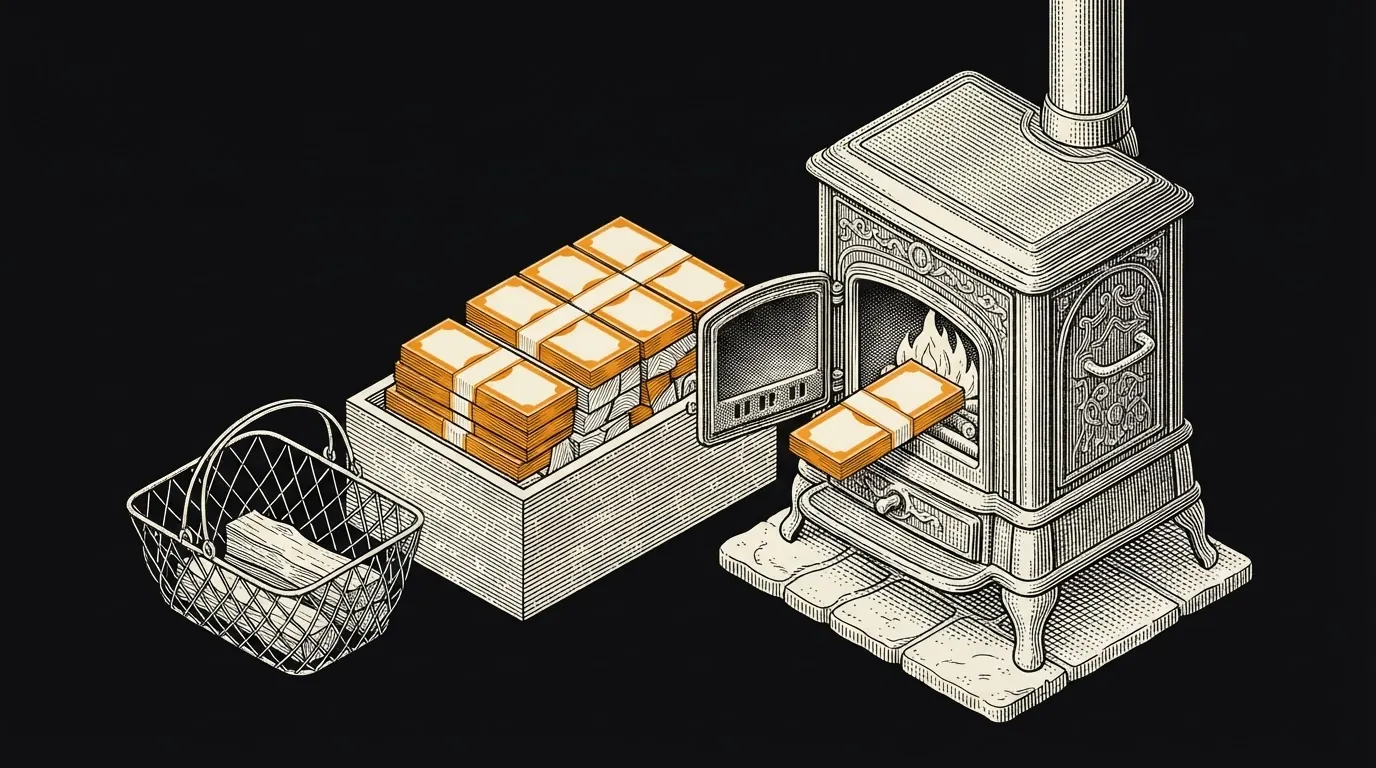
People burned cash for warmth because it was cheaper than firewood. Workers were paid twice a day so they could shop at lunchtime before prices doubled in the afternoon. Middle-class savings - pensions, life insurance, bank deposits - were wiped out in months. The political instability that followed contributed directly to the collapse of the Weimar Republic and the rise of the Nazi regime within a decade.
HyperinflationhyperinflationInflation above 50% per month, equivalent to roughly 13,000% per year (Cagan threshold). Caused when a government creates money far faster than the economy grows. Documented cases: Weimar Germany 1923, Zimbabwe 2008, Venezuela 2018, Argentina 2024.Full definition does not destroy the rich first. It destroys the saving middle class. People who held real assets (land, foreign currency, gold) preserved wealth. People who held marks - the prudent, the law-abiding, the pensioners - were ruined.
Zimbabwe - the modern repeat (2007 to 2009)
Eighty-five years after Weimar, Zimbabwe ran the same script. The Mugabe government's land seizures collapsed agricultural output, foreign reserves dried up, and the central bank printed Zimbabwean dollars to fund the gap. Peak monthly inflation in November 2008 was estimated at roughly 79.6 billion percent (Hanke and Kwok, Cato Journal 2009).
The central bank issued a 100 trillion Zimbabwean dollar note - at peak it bought about three eggs. The currency was abandoned in 2009 in favor of a multi-currency system using the U.S. dollar, South African rand, and Botswanan pula. The country effectively imported the monetary policymonetary policyThe central bank's control of money supply and interest rates to influence the economy. of foreign central banks because its own had become unusable.
"The Zimbabwean dollar's collapse was not a developing-world anomaly. It was the same dynamic as Weimar, run on a different currency at a different latitude. The mechanism is universal."
Venezuela - hyperinflation in the 21st century (2017 onward)
Venezuela holds the world's largest proven oil reserves. It has nonetheless run one of the longest hyperinflations in modern history. The Maduro government, facing collapsing oil revenue and U.S. sanctions, financed deficits by printing bolivares. Annual inflation exceeded 1,000,000 percent at the peak in 2018 (IMF World Economic Outlook).
A grocery basket required wheelbarrows of cash. The bolivar has been re-denominated multiple times - dropping zeros to make the numbers easier to handle - without addressing the underlying issuance. Each re-denomination was followed by more inflation.
Venezuela is also a leading data point for Bitcoin and stablecoin adoption. Per-capita usage of both has been among the highest in the world during the inflation. When the local currency becomes unusable, people choose alternatives - any alternative. The order of preference observed in Venezuela: U.S. dollars, then stablecoins, then Bitcoin, then foreign-currency black markets, then barter.
Two modern dates did not debasedebaseTo reduce the value of a currency, usually by increasing its supply or by lowering the metal content of coins. a currency in a single act, but they set up the architecture that made the 87 percent post-1971 dollar decline possible. Both are covered in depth on their own pages.
The U.S. dollar becomes the world's reserve currencyReserve currencyA currency that central banks and governments hold in large amounts to pay for trade, settle debts and defend their own money. The US dollar became the dominant one after the 1944 Bretton Woods agreement and made up about 57% of reported global foreign exchange reserves in early 2026., pegged to gold at $35/oz with every other currency pegged to the dollar. Keynes's proposal for a neutral international currency (the bancor) was rejected. The architecture that has shaped global finance ever since was set here. See: World Reserve Currency →
Three years after Nixon closed the gold window, Treasury Secretary William Simon negotiated an arrangement with Saudi Arabia: price oil exclusively in dollars, recycle oil revenues into U.S. Treasuries, in exchange for U.S. military protection. The deal gave the dollar a new anchor (oil) and created artificial global demand for dollars for the next fifty years. See: The Petrodollar System →
The common pattern
Different empires, different centuries, different commodities. The mechanism is identical. Every documented currency collapse has followed roughly the same sequence.
What this teaches Bitcoin holders
Three things, all observed in the historical record:
Where to go from here
Sources
Figures, rates and rules change: check each source’s date before acting on it.
- Harl, Kenneth W. "Coinage in the Roman Economy, 300 B.C. to A.D. 700." Johns Hopkins University Press, 1996. Silver content figures from imperial denarius assays.
- Pamuk, Sevket. "A Monetary History of the Ottoman Empire." Cambridge University Press, 2000.
- Federal Reserve Bank of St. Louis. "Hyperinflation in the Weimar Republic." Liber8 Economic Information Newsletter - research.stlouisfed.org
- Cagan, Phillip. "The Monetary Dynamics of Hyperinflation." In Studies in the Quantity Theory of Money, ed. Friedman, 1956. The classic study of post-WWI inflations.
- Sargent, Thomas. "The Ends of Four Big Inflations." NBER, 1982 - nber.org/papers/c11452
- Hanke, Steve H. and Alex K. F. Kwok. "On the Measurement of Zimbabwe's Hyperinflation." Cato Journal, 2009 - cato.org
- International Monetary Fund. World Economic Outlook database, Venezuela inflation series - imf.org/Publications/WEO
- Chainalysis. "Geography of Cryptocurrency" annual report - Venezuela adoption metrics - chainalysis.com
- U.S. Federal Register. Executive Order 6102, April 5, 1933 - federalregister.gov
Last updated . Not financial advice. Do your own research. Disclosures · How pages are reviewed