Your dollar's
slow erosion.
A dollar in 1971 buys roughly 13 cents of goods today. That's not a rounding error - that's 87 percent of purchasing power erased in a single lifetime. Here is the mechanism, the math, and what it means for anyone trying to save.
Viewpoint. Besides explaining the topic, this page makes the site’s case on money and Bitcoin. The facts are sourced; that case is the site’s view. How pages are labeled.
Check before acting. Rates, prices, fees and product terms change often. Confirm the current figures with the provider or the linked source before you act.
This page explains the mechanism behind the dollar's lost purchasing power and what it means for a saver. For the sourced long-run charts, see What Happened to the Dollar; for this month's numbers, see the Debasement Dashboard.
The U.S. dollar has lost roughly 87 percent of its purchasing power since 1971, the year it stopped being convertible to gold. Official CPIConsumer Price Index (CPI)The government's measure of how much a typical basket of consumer goods costs over time.Full definition averages a basket that includes goods that have gotten cheaper. The categories that define a middle-class life - housing, healthcare, education, insurance - have inflated 2 to 4 times faster. Wage earners absorb the loss. Asset owners outrun it. That gap is the wealth gap.
On this page
Purchasing power of $1 since 1971
A dollar saved in 1971 and stuffed in a mattress now buys about 13 cents of goods at official CPI. The chart shows the steady, compounded decline. Note that the line accelerates around 2020 - that is the post-pandemic monetary expansion working through to consumer prices.
Why 1971 is the dividing line
On August 15, 1971, President Nixon announced the U.S. would no longer convert dollars held by foreign governments into gold at the agreed rate of $35 per ounce. That announcement, intended as temporary, became permanent. It ended the Bretton Woods system that had anchored global currencies to the dollar and the dollar to gold since 1944.
Before 1971, the U.S. money supply was constrained by the volume of gold in Treasury vaults. After 1971, the only constraint was political will. Every chart of debt, money supply, asset prices, and inequality has a visible kink in 1971. The site WTF Happened in 1971 catalogues dozens of them.
Gold was $35 an ounce in 1971. In 2026 it trades near $4,250 an ounce. That is not gold getting more valuable - that is the dollar shedding roughly 99 percent of its value when measured against a scarce reference asset.
How inflation compounds
Inflation does not subtract - it compounds. A 3 percent annual inflation rate halves purchasing power in roughly 24 years. A 5 percent rate halves it in 14. The official CPI from 1971 to 2025 has averaged about 4 percent, which compounds to the 87 percent loss observed.
Below is what $100 a year of spending in 1971 looks like in 2026 dollars, under three different inflation assumptions. The official CPI line is the conservative case. The shadow basket - the real cost of housing plus healthcare plus education - has run far higher.
The real basket vs the official basket
Official CPI is a weighted average that includes electronics, apparel, and vehicles. Many of those items have stayed flat or gotten cheaper thanks to globalization and productivity. Their inclusion drags the headline number down.
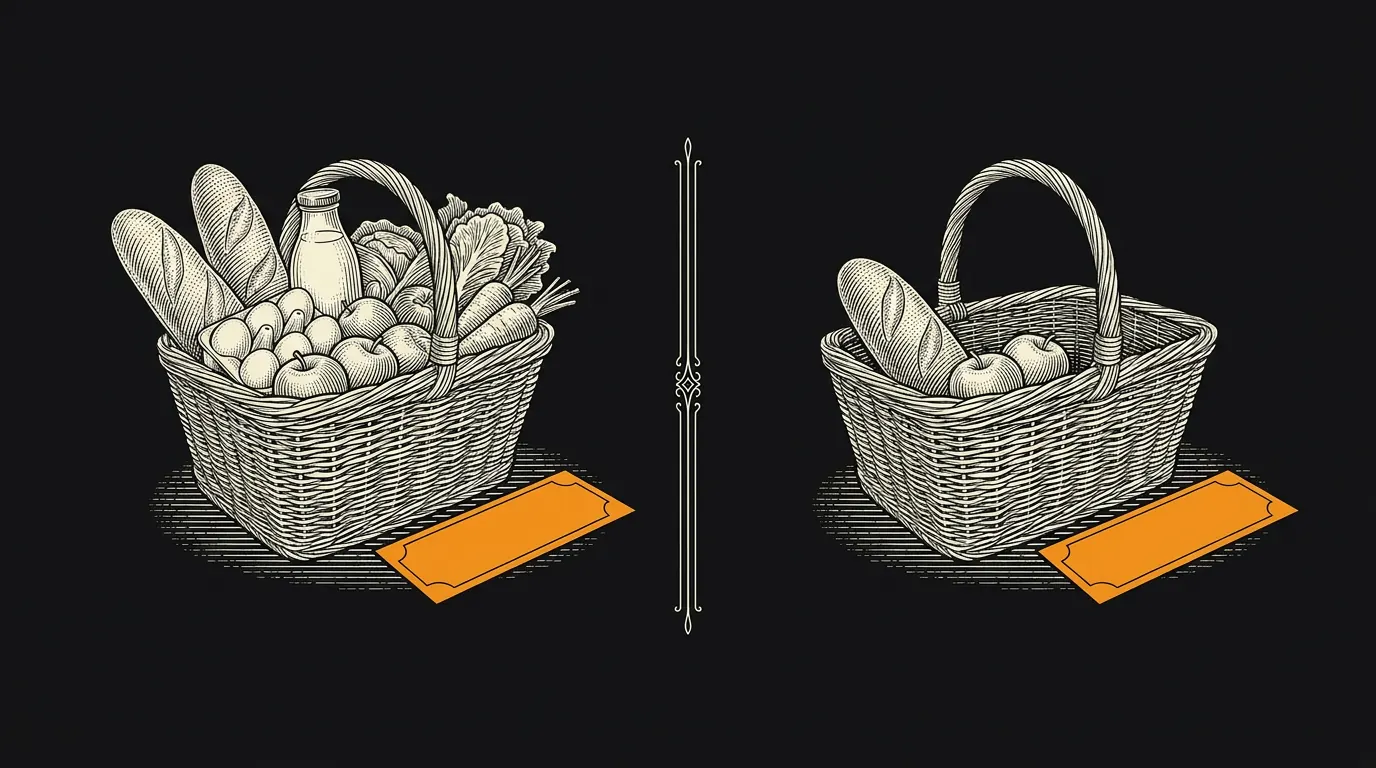
The categories that dominate household budgets do not behave like consumer electronics. They are the credit-dependent sectors of the economy - the parts that absorb new dollars first.
When people say "inflation feels worse than 3 percent" they are not imagining things. They are weighting the basket toward the items that consume their paycheck. See the full breakdown at The Cost of the American Dream.
Who absorbs the loss
The 87 percent loss is an average. It does not fall on every American the same way. The mechanism that creates new dollars also decides who gets them first.
Money in a checking or savings account loses purchasing power every year. Wages adjust slowly, often after the prices of essentials have already moved. The longer your savings sit in dollars, the more they erode.
Stocks, real estate, gold, Bitcoin - assets in fixed or slow-growing supply tend to absorb monetary expansion as a rising nominal price. That is not always real wealth creation. It is often just measurement against a shrinking unit.
This is the structural mechanism behind the widening wealth gap of the past five decades. New money enters the economy via credit and asset markets first. People closest to those flows get the boost. People furthest from them get the bill. The full mechanism is at The Wealth Gap.
What this means for a saver
The simplest defense is to stop measuring wealth in a unit that shrinks. Hold an emergency fund in dollars because liquidityliquidityHow quickly and easily you can convert an asset to cash without significantly affecting its price.Full definition matters. Park the rest in assets that cannot be created by decree - broadly diversified equity index funds, productive real estate, and a meaningful Bitcoin allocation.
Start with Dollar-Cost Averaging and the Order of Operations. The goal is not to get rich - it is to stop getting poor while standing still.
Where to go from here
Sources
Figures, rates and rules change: check each source’s date before acting on it.
- U.S. Bureau of Labor Statistics. CPI Inflation Calculator - bls.gov/data/inflation_calculator.htm
- Federal Reserve Bank of St. Louis FRED. Consumer Price Index for All Urban Consumers (CPIAUCSL) - fred.stlouisfed.org/series/CPIAUCSL
- Federal Reserve Bank of St. Louis. "The End of Bretton Woods" research summary - research.stlouisfed.org
- Federal Reserve Board. Statement by President Nixon, August 15, 1971 - historical archive - federalreservehistory.org
- WTF Happened in 1971 (chart compendium) - wtfhappenedin1971.com
- College Board. "Trends in College Pricing" annual report - research.collegeboard.org
- Kaiser Family Foundation. "Employer Health Benefits Annual Survey" - kff.org
- Federal Housing Finance Agency. House Price Index - fhfa.gov/data/hpi
Last updated . Not financial advice. Do your own research. Disclosures · How pages are reviewed