The dollar as a world reserve currency.
How reserve status works and how it can change.
A reserve currency is what other countries hold to settle international trade and debt. The dollar has held that role since Bretton Woods in 1944. The United States gets enormous advantages from it. Everyone else gets structural costs. The whole global monetary system runs on this arrangement.
Viewpoint. Besides explaining the topic, this page makes the site’s case on money and Bitcoin. The facts are sourced; that case is the site’s view. How pages are labeled.
This page covers dollar reserve status as a whole: Bretton Woods, the Triffin Dilemma, exorbitant privilege, past reserve currencies and today's challengers. For the 1974 oil-pricing and Treasury-recycling arrangement that reinforced it after 1971, see The Petrodollar.
A reserve currency is what monetary authorities hold as part of their foreign-exchange reserves. The Fed’s July 2025 review puts the dollar at 58% of disclosed official foreign-exchange reserves in 2024. That number measures reserves, not trade invoicing, payment volumes or total reserve assets including gold. Reserve status keeps the dollar in wide use; it says nothing about what a dollar will buy you later.[1][2]
On this page
- Section 1 · What reserve currency means
- Section 2 · How it happened · Bretton Woods, 1944
- Section 3 · The Triffin Dilemma
- Section 4 · The exorbitant privilege
- Section 5 · No reserve currency lasts forever
- Section 6 · Current challengers
- Section 7 · What losing reserve status means
- Section 8 · Why this matters for Bitcoin
Section 1 · What reserve currency means
A country's central bank holds foreign reserves, a stockpile of currencies (and gold) used to settle international trade, defend the domestic currency in a crisis, and pay off foreign-denominated debts. Historically, gold was the reserve asset. Post-1944, the dollar took its place. Today, per IMF COFER data[1] don't trust, verify×DON'T TRUST, VERIFYClaim: Roughly 58% of global reserves are in U.S. Dollars (IMF COFER, 2024 Q4).Verify at: IMF COFER ↗ Source 1 in the list belowIMF COFER is released quarterly. The dollar share has ranged 57–60% over the past few years. Check the latest release for the current figure before quoting., the composition is roughly:
The practical meaning: countries must earn or buy dollars to participate in global trade. Oil is priced in dollars. Most commodities are priced in dollars. Most cross-border bank settlement runs through dollar-clearing systems. That creates persistent, structural demand for dollars no other currency has.
Section 2 · How it happened · Bretton Woods, 1944
In July 1944, delegates from 44 Allied nations gathered at the Mount Washington Hotel in Bretton Woods, New Hampshire. The war was ending. The world needed a new monetary order to replace the collapsed gold standardGold standardA monetary system in which paper money can be exchanged for a fixed weight of gold, which limits how much money can be printed. The US stopped redeeming dollars in gold for its own citizens in 1933 and ended foreign governments' right to exchange dollars for gold at $35 an ounce on August 15, 1971.Full definition of the interwar period.
The United States held roughly two-thirds of the world's monetary gold reserves[2]. That economic reality dictated the terms. The Bretton Woods agreement established:
- The U.S. Dollar would be pegged to gold at $35/oz.
- Every other currency would peg to the dollar at fixed exchange rates.
- The IMF and World Bank (then the IBRD) would stabilize the system and fund post-war reconstruction.
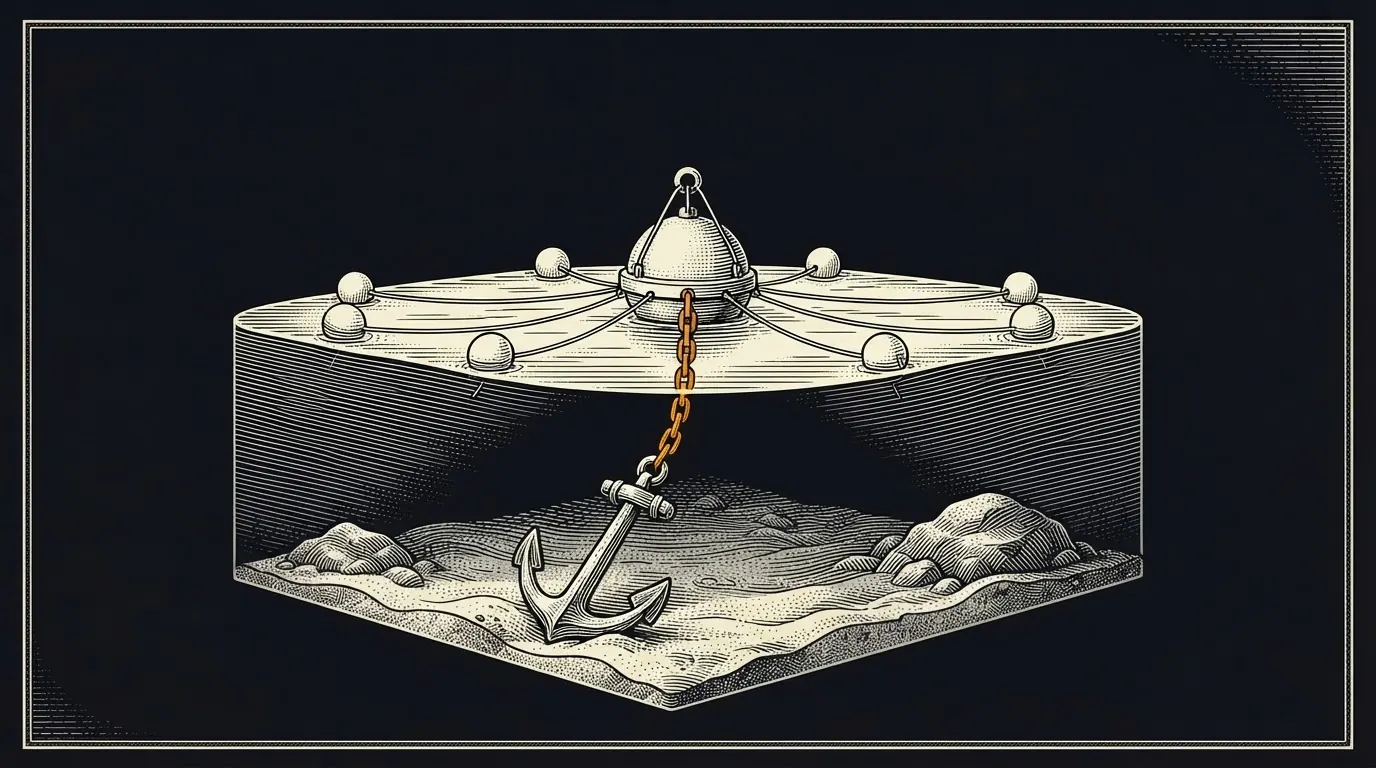
- The dollar became the anchor of the global monetary system. Gold became the anchor of the dollar.
John Maynard Keynes, representing Britain, proposed an alternative: a neutral international reserve currency called the bancor, managed by an International Clearing Union. Countries with surpluses and deficits would both face pressure to rebalance, preventing the accumulation of persistent imbalances. The bancor would not belong to any nation[4].
The United States rejected Keynes's proposal. The U.S. Had the gold, the production capacity, and the leverage; a neutral reserve currency would have diluted that position. The dollar won.
The dollar-gold peg survived until 1971, when Nixon closed the gold window under pressure from foreign redemption requests the U.S. Could no longer honor. The dollar then became pure fiat, still the reserve currency, but no longer backed by anything but trust. The petrodollarPetrodollarDollars that oil exporters earn by selling oil, which is mostly priced in US dollars. The term also names the system built in the mid-1970s, including a 1974 US-Saudi economic commission, in which exporters recycle large sums into US assets like Treasury bonds, adding steady foreign demand for dollars.Full definition deal of 1974 (see The Petrodollar: How Oil Backs the Dollar) gave it a new anchor: oil.
Section 3 · The Triffin Dilemma
In 1959, Belgian-American economist Robert Triffin testified before Congress on a fundamental contradiction he had identified in the Bretton Woods system[5]. The argument is now known as the Triffin Dilemma.
Triffin’s dilemma was about confidence: foreign claims on dollars grew while the gold-conversion promise stayed fixed. Dollars also reach the world through cross-border credit, not only through trade deficits, and no rule says each new dollar claim lowers the value of every other dollar.[2][5]
In 1971 Nixon suspended foreign official gold conversion because the promise was under pressure. Nothing anchors the dollar to gold now, so what it is worth against other currencies comes down to current economic and financial conditions rather than an automatic depreciation rule.[2][5]
Triffin described a confidence problem: supply the world with liquidity while promising to convert dollars into gold. Under fiat there is no mechanical rule that each added dollar claim depreciates the currency in proportion, and cross-border credit flows matter alongside trade. The framework names a pressure on the system; it is not a countdown clock.[2][5]
Section 4 · The exorbitant privilege
The phrase "exorbitant privilegeExorbitant privilegeThe advantages the US gets because the dollar is the world's main reserve currency. Global demand for dollars lets the US borrow in its own currency at lower rates and fund large, persistent deficits more easily than other countries. French Finance Minister Valéry Giscard d'Estaing coined the phrase in the 1960s.Full definition" is generally attributed to Valéry Giscard d'Estaing, who served as French Finance Minister in the 1960s (later President of France, 1974–1981). The phrase captures in two words what Bretton Woods gave the United States, and what it took from everyone else[6] don't trust, verify×DON'T TRUST, VERIFYClaim: “Exorbitant privilege” attributed to Valéry Giscard d'Estaing, 1960s.Verify at: Barry Eichengreen, Exorbitant Privilege (OUP 2011) ↗ Source 2 in the list belowSometimes attributed to Charles de Gaulle or to d'Estaing's then-colleague Jacques Rueff. Eichengreen's book is the authoritative academic source for the attribution and context..
- Borrows in its own currency. No country can force a dollar devaluation on U.S. Borrowers.
- Pays lower interest rates because foreigners must hold Treasuries as reserves.
- Can run deficits that would cause currency crises in other countries.
- U.S. Corporations and consumers get cheaper imported goods from a structurally strong dollar.
- Sanctions become a geopolitical weapon with global reach.
- Exports must compete against an artificially strong dollar.
- Countries accumulate dollars they did not want to trade.
- Domestic monetary policymonetary policyThe central bank's control of money supply and interest rates to influence the economy. is partially captive to Fed decisions.
- When the Fed raises rates, emerging-market debt burdens surge.
- Central banks face sanctions risk on reserves they were forced to hold.
When the U.S. Sneezes, the world gets pneumonia. Fed decisions ripple through every dollar-pegged and dollar-borrowed economy on Earth. Emerging-market crises in Latin America in the 1980s, East Asia in 1997, and the Taper Tantrum of 2013 all trace at least partly to Fed tightening. That is the cost of having a domestic monetary policy shaped by a central bank in a country you do not live in.
Section 5 · No reserve currency lasts forever
The dollar is not the first global reserve currency. It will not be the last. Previous reserve currencies did not collapse overnight, they lost share slowly as the next dominant power rose. The transition from the British pound to the U.S. Dollar took roughly 30 years, spanning two world wars[7].
Reserve-currency dominance has historically lasted roughly 80–110 years don't trust, verify×DON'T TRUST, VERIFYClaim: Historical reserve-currency reigns average ~80–110 years.Verify at: Ray Dalio, The Changing World Order ↗ Source 8 in the list belowThis figure is often cited in macro commentary (Ray Dalio, others) but the dating of “dominance” start and end points is fuzzy. Use as an order-of-magnitude reference, not a precise statistic.. The U.S. Dollar is now ~80 years old in the dominant role, which puts it at the older end of the historical range but not clearly at its end. Past transitions took decades and ran concurrently with power shifts between nations, not clean handoffs.
Section 6 · Current challengers
Structurally limited. The eurozone is 21 countries sharing one currency with no unified fiscal policyfiscal policyGovernment decisions about spending and taxation to influence the economy. and no joint eurozone sovereign bond. Every sovereign-debt crisis since 2010 has tested whether the euro survives. A reserve currency cannot be one vote away from dissolution.
China maintains capital controls. You cannot freely move yuan in and out of the country, and the PBOC sets the exchange rate in bands. A reserve currency requires free capital movement, because central banks need to be able to convert reserves into other assets on demand. China is extremely unlikely to give up capital controls, doing so would mean giving up control of domestic monetary policy, which Beijing treats as a core sovereignty issue.
Central banks have been net buyers of gold every year since 2010[3]. Net purchases hit a 55-year high in 2022 and remained elevated through 2024. Gold is the canonical neutral reserve asset, no one issues it; no one can freeze it. But gold does not settle transactions in real time, is expensive to transport, and earns no yield. It is the backup reserve asset, not a replacement for the dollar.
No country issues Bitcoin, which is what makes it interesting to a reserve holder. A government can still borrow or run a deficit denominated in Bitcoin if lenders agree, but it cannot create base Bitcoin to settle the obligation. A supply cap does not answer every reserve-management question on its own: volatility, liquidity, custody and uncertain demand all still apply.[9][10]
Section 7 · What losing reserve status means
- Interest rates rise, less structural demand for Treasuries.
- Dollar weakens, less structural demand for dollars.
- Import prices surge, a weak dollar makes foreign goods more expensive.
- The deficit can no longer be financed at near-zero real rates.
- Living standards fall materially for the middle class, which has spent decades consuming cheap imports.
- No obvious replacement means volatility, not a clean transition.
- Central banks holding dollars see those reserves lose value.
- Trade denomination fractures, which currency replaces the dollar for oil, commodities, cross-border settlement?
- Gold and non-state bearer assets (including Bitcoin) absorb flight from dollar-denominated reserves.
Nobody knows exactly how this plays out or when. Dedollarization is real but slow: the dollar's share of reserves declined from ~72% in 2000 to ~58% in 2024, a 14-point slide over 24 years, not a crash. The more likely scenario is a multipolar currency world (dollar + euro + yuan + gold + Bitcoin) rather than a clean handoff to a single successor. The transition from pound to dollar took three decades and two world wars. The dollar-to-whatever-comes-next transition may take just as long.
Section 8 · Why this matters for Bitcoin
Sovereign issuers face incentives that a non-sovereign asset does not, and that difference is the whole argument. Past reserve transitions are not a law: nothing guarantees a given currency fails on a schedule, or that Bitcoin succeeds it.[2][9]
Bitcoin breaks the pattern in a way gold never quite could. Gold is neutral but physically clumsy, hard to transport, hard to verify, hard to settle at internet speed. Bitcoin is neutral, verifiable instantly, settles in minutes, and is portable across borders as a bearer asset. For the first time since the Dutch guilder, the world has a plausible candidate reserve asset that belongs to no country.
It does not have to "win" for Bitcoin to matter. In a multipolar reserve world, which is the most likely outcome, Bitcoin's role is to sit alongside gold as the scarce, neutral bearer asset. If you believe the multipolar world is coming, you want some exposure to the assets that are neutral by design. The dollar is not one of them. Bitcoin is.
Reserve status describes how money gets used, and it pays no return. Bitcoin appeals because no state issues it, but a weakening dollar does not hand you a profit. Measure currency risk against the money you spend and owe, and size the position so a substantial or permanent loss does not break you.[2][9][11]
Where to go from here
Sources
Bracketed numbers and verify badges in the text link to these sources. Figures, rates and rules change: check each source’s date before acting on it.
- International Monetary Fund. Currency Composition of Official Foreign Exchange Reserves (COFER). Quarterly release · data.imf.org/cofer. ↩
- Eichengreen, Barry. Exorbitant Privilege: The Rise and Fall of the Dollar. Oxford University Press, 2011 · oup.com. The authoritative academic history of dollar dominance and the Bretton Woods transition. ↩
- World Gold Council. "Gold Demand Trends" quarterly reports · gold.org. Central bank net purchases hit a 55-year high in 2022 and remained elevated through 2024. Gold represents ~27% of global official reserves. ↩
- Steil, Benn. The Battle of Bretton Woods: John Maynard Keynes, Harry Dexter White, and the Making of a New World Order. Princeton University Press, 2013. Definitive account of the 1944 negotiations including the bancor proposal. ↩
- Triffin, Robert. Gold and the Dollar Crisis: The Future of Convertibility. Yale University Press, 1960. The original statement of what became the Triffin Dilemma. Testimony to Congressional Joint Economic Committee, October 28, 1959. ↩
- The phrase "exorbitant privilege" traces to French Finance Minister Valéry Giscard d'Estaing, mid-1960s. See Eichengreen (src3) for primary-source citations and context. ↩
- Eichengreen, Barry, and Marc Flandreau. "The Rise and Fall of the Dollar, or When Did the Dollar Replace Sterling as the Leading Reserve Currency?" European Review of Economic History, 2009. Detailed quantitative account of the ~30-year pound-to-dollar transition. ↩
- Dalio, Ray. Principles for Dealing with the Changing World Order. Avid Reader Press, 2021 · bridgewater.com. Macro framework for reserve-currency cycles across centuries. ↩
- FAQ - Bitcoin ↩
- Crypto Asset Custody Basics for Retail Investors – Investor Bulletin ↩
- Foreign currency exchange (forex) | Investor.gov ↩
- COFER
- The Fed - The International Role of the U.S. Dollar – 2025 Edition
- Nixon Ends Convertibility of U.S. Dollars to Gold and Announces Wage/Price Controls | Federal Reserve History
- Bank for International Settlements. Triennial Central Bank Survey of Foreign Exchange · bis.org. Dollar is on one side of ~88% of global FX transactions.
Last updated . Not financial advice. Do your own research. Disclosures · How pages are reviewed