A strong dollar
is its own crisis.
Brent Johnson's dollar milkshake theory explains why the dollar could surge even as the U.S. debases it, and why that surge would be catastrophic for everyone else.
Viewpoint. Besides explaining the topic, this page makes the site’s case on money and Bitcoin. The facts are sourced; that case is the site’s view. How pages are labeled.
The global financial system is a milkshake. Every major central bank has a straw in it, adding liquidityliquidityHow quickly and easily you can convert an asset to cash without significantly affecting its price.Full definition through QEQuantitative Easing (QE)When a central bank creates new money electronically to buy government bonds and other assets, expanding the money supply. and stimulus. The U.S. Has the biggest straw, the dollar is the world's reserve currencyReserve currencyA currency that central banks and governments hold in large amounts to pay for trade, settle debts and defend their own money. The US dollar became the dominant one after the 1944 Bretton Woods agreement and made up about 57% of reported global foreign exchange reserves in early 2026.. When stress hits, capital does not flow equally to every straw; it rushes into the safest, most liquid one. The dollar sucks up the milkshake while everyone else's currencies weaken. Emerging markets that borrowed in dollars get crushed. Eventually the surge breaks the system, the Fed prints massively to bail it out, and the straw itself gets pulled from the cup. Bitcoin is the exit from both phases.
On this page
Section 1 · Who and what
The dollar milkshake theory was developed by Brent Johnson, CEO of Santiago Capital, starting around 2018. It is not mainstream academic economics. It is a macro framework used by traders, hedgehedgeAn investment made to offset potential losses in another position, like buying gold to protect against currency declines. fund managers, and macro analysts to explain apparent contradictions in the global dollar system.
Give it a fair hearing without overselling. It has predicted several dollar-strength episodes accurately (2022 DXY rally, emerging-market stress). It has also been "imminent" in various forms for years. Use it as a lens for understanding the dollar, not as a price target for next quarter.
Johnson's core insight: in a globalized dollar-denominated financial system, the dollar's strength is a relative measure, not an absolute one. The dollar does not need to be good. It only needs to be less bad than everything else.
Section 2 · The setup: the world is dollar-denominated
The theory starts with a fact: there is roughly $13 trillion in dollar-denominated debt held by non-U.S. Borrowers[1] don't trust, verify×DON'T TRUST, VERIFYClaim: ~$13T in dollar-denominated debt outside the U.S.Verify at: BIS Global Liquidity Indicators ↗ Source 1 in the list belowBIS publishes quarterly data on USD credit to non-bank borrowers outside the United States. The figure has ranged $12–14T for the past several years; check the latest Global Liquidity Indicators release for the current number.. This is the BIS measure of U.S. Dollar credit to non-bank borrowers outside the U.S., as of recent quarterly data.
When these loans were made, the borrowers received dollars. When they come due, the borrowers must repay in dollars. If the dollar rises against their local currency, the real cost of the debt rises with it. A Brazilian company earning reais and owing dollars sees its effective debt load increase every time the dollar strengthens.
This creates structural, non-discretionary demand for dollars that exists no matter what the Fed does. Every dollar-denominated maturity is a forced buyer of dollars. That is the foundation the milkshake theory is built on.
Section 3 · The milkshake analogy
Picture the global financial system as a giant milkshake. The milk is global liquidity, all the money, credit, and capital sloshing around. Every major central bank has a straw in the cup:
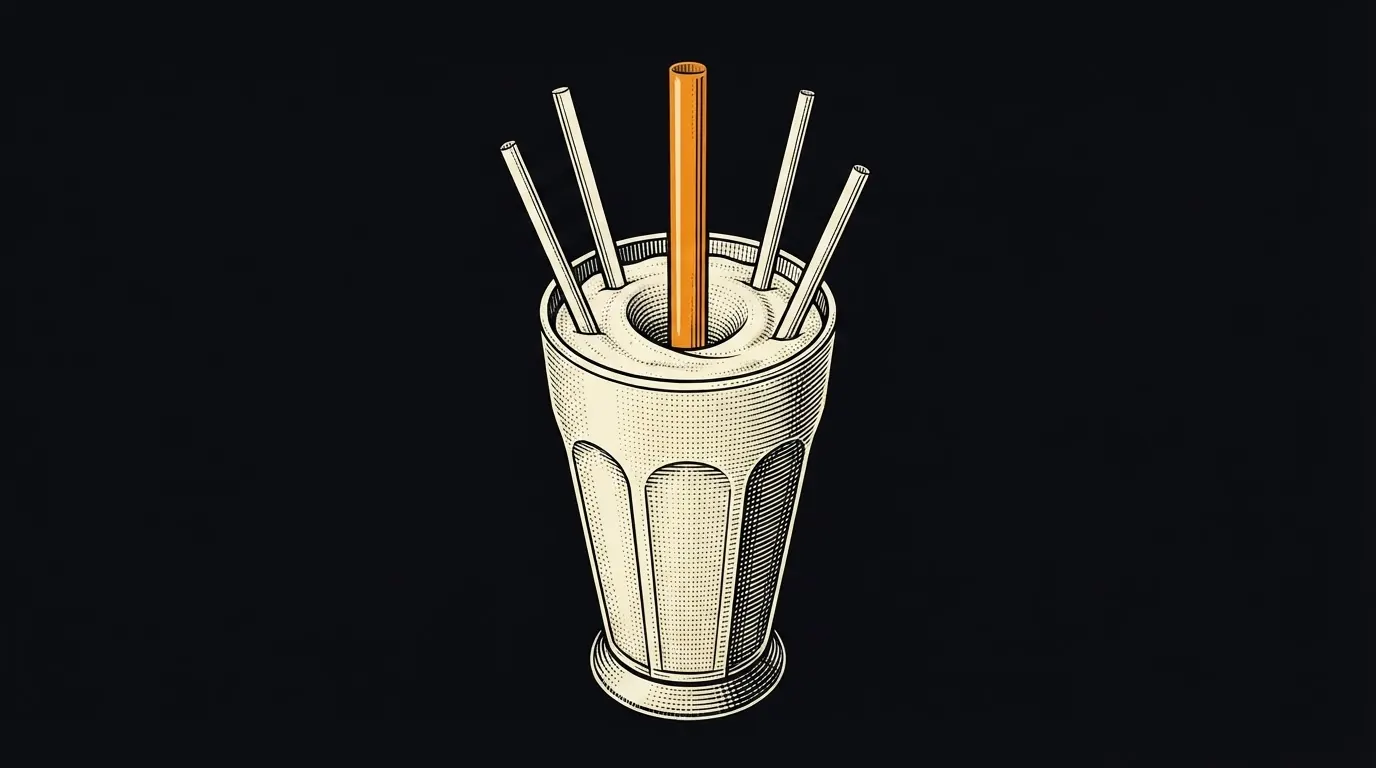
When central banks do QE, they are all adding milk to the cup. When stress hits, capital does not flow evenly to every straw. It flows to the safest, most liquid straw available, the dollar. The U.S. Has the deepest capital markets, the strongest rule of law (relative to the alternatives), and the reserve currency of global trade.
The dollar sucks up the milkshake. Other currencies weaken. Emerging markets that borrowed in dollars see their repayment burden surge in local-currency terms. The cup drains faster than any central bank can refill it.
Section 4 · The paradox
Here is the apparent contradiction Johnson's framework resolves.
The U.S. Is running some of the largest nominal deficits in history. The Fed's balance sheet expanded by roughly $5T between early 2020 and its April 2022 peak[2]. National debt has crossed $40.0T. By every traditional metric, the dollar should be weakening dramatically.
And yet: the DXY dollar index rose roughly 25% between January 2021 and October 2022[3], reaching 20-year highs. The dollar did not weaken. It surged.
Relative strength matters more than absolute strength. The dollar does not need to be good. It needs to be less bad than everything else. In 2022, the yen collapsed (BoJ yield-curve control), the euro hit parity with the dollar for the first time since 2002 (European energy crisis), China was locked down, and emerging markets were stressed. The dollar was the least bad option. That is the only condition the milkshake theory requires.
Printing is not the variable that matters. Relative printing is. When everyone is printing and your reserve-currency straw is biggest, capital flees the weaker currencies into yours. Your currency strengthens even as you debasedebaseTo reduce the value of a currency, usually by increasing its supply or by lowering the metal content of coins. it, because they are debasing faster and have no escape velocity.
Section 5 · How it ends
Johnson's thesis: the dollar's relative strength eventually becomes severe enough to break the global financial system. A cascade of emerging-market defaults forces the Fed to act as global lender of last resort, swap lines, direct liquidity injections, massive USD creation to calm the system. At that point, the dollar has sucked up so much of the milkshake that the system itself breaks. The Fed prints on a scale that finally breaks dollar confidence. The straw gets pulled from the cup.
The sequence, as Johnson frames it:
Dollar strengthens. Emerging markets with dollar debt face repayment stress. Commodity prices fall in dollar terms (oil, copper, metals). Risk assets fall. The dollar looks like the only safe place.
EM defaults begin cascading. The Fed opens swap lines with every major central bank (the 2020 template). Direct USD creation on a scale that makes 2020 QE look small. The dollar finally weakens as everyone realizes the endgame.
Capital that has been hiding in dollars flees into hard assets. Gold, commodities, scarce real estate, and Bitcoin absorb the flight. No clean handoff to a successor reserve currency, the euro and yuan are too structurally compromised. A multipolar currency world emerges, with hard assets playing a much larger role than they have since the U.S. began leaving the gold standard in 1971.
Lyn Alden has written a nuanced response arguing the milkshake dynamic is real but the end-state is more complex, specifically that the Fed has learned to use swap lines proactively, and that a true "pull the straw" event may be delayed longer than the theory suggests[4]. The theory has been "imminent" for several years without full resolution. Use it as a framework for understanding dollar dynamics and emerging-market stress, not a price prediction for any specific quarter.
Section 6 · What it means for Bitcoin
If the milkshake theory plays out, Bitcoin holders should expect three phases, not a straight line:
- Phase 1 · Dollar surges. Bitcoin and all risk assets fall in dollar terms. This is not a Bitcoin-specific failure; it is the same dynamic that hits stocks, gold, oil, and everything else priced in dollars.
- Phase 2 · The pivot. The Fed reverses course and prints aggressively to counter the global dollar squeeze. Every risk asset rallies. Bitcoin, as the scarcest risk asset, rallies hardest.
- Phase 3 · The exit. When dollar credibility finally cracks, capital that has been hiding in dollars flees. Bitcoin, with a fixed supply, becomes one of the clearest exits. Gold, real estate, and scarce commodities absorb the rest.
Bitcoin is not just an alternative to the dollar. It is an alternative to the entire system in which one country's currency is everyone else's problem. If the milkshake dynamic plays out, the reason people will want Bitcoin is not the usual "number go up" thesis. It is that their local currency is failing, their dollar-denominated debt is being called, and they need a bearer asset that no central bank controls.
The milkshake theory says a strong dollar is not a sign of American strength. It is a sign the system is under stress and the dollar is sucking up global liquidity. The end-state is not a clean transition to a new reserve currency, it is chaos in which hard assets and bearer assets like Bitcoin become essential. Use the framework to understand dollar dynamics. Do not use it as a trading signal.
Where to go from here
Sources
Bracketed numbers and verify badges in the text link to these sources. Figures, rates and rules change: check each source’s date before acting on it.
- Bank for International Settlements. Global Liquidity Indicators. Quarterly measure of U.S. Dollar credit to non-bank borrowers outside the United States · bis.org/statistics/gli. ↩
- Federal Reserve Bank of St. Louis. "Assets: Total Assets" (WALCL) · fred.stlouisfed.org/series/WALCL. Roughly $4.2T (Mar 2020) → ~$8.97T (Apr 13, 2022 peak). ↩
- ICE U.S. Dollar Index (DXY) historical series. Intercontinental Exchange · widely republished via FRED Broad Dollar Index for the trade-weighted equivalent. ↩
- Alden, Lyn. Analysis of dollar dynamics and the milkshake theory at lynalden.com. See in particular her multi-part "Fraying of the Global Monetary System" series and the "Eurodollar System" primer. ↩
- Johnson, Brent. Santiago Capital commentary and YouTube channel · extended interviews on Macro Voices, Real Vision, and Blockworks Macro for the most detailed articulations of the theory.
- International Monetary Fund. Currency Composition of Official Foreign Exchange Reserves (COFER) · data.imf.org/cofer.
Last updated . Not financial advice. Do your own research. Macro frameworks are for understanding, not timing. Disclosures · How pages are reviewed