How to spend less
on the same things.
Not a budget overhaul. Not extreme frugality. The practical tactics for buying the same quality you already buy for significantly less. Most households have $200 to $400 per month hiding in brand premiums, convenience markups, and subscriptions they forgot about.
This page covers personal finance fundamentals that apply regardless of your view on Bitcoin or fiat currencyfiat currencyMoney declared legal tender by a government, not backed by a physical commodity. Its value rests on trust in the issuing government.Full definition.
This page covers US-specific accounts and tax law. Outside the US? The priority order is the same, the account names differ (ISAIndividual Savings Account (ISA)A UK tax-advantaged account where contributions are post-tax but all growth and withdrawals are tax-free.Full definition in the UK, TFSATax-Free Savings Account (TFSA)A Canadian tax-advantaged account where contributions are post-tax but all growth and withdrawals are tax-free.Full definition/RRSPRegistered Retirement Savings Plan (RRSP)A Canadian tax-deferred retirement account; contributions reduce taxable income and growth is tax-deferred until withdrawal.Full definition in Canada, Super in Australia, etc.).
Store brands are the same product with different packaging. Aldi is 30–40% cheaper than traditional chains on staples. Your meal-plan habit matters more than your coffee habit. Delivery fees, service fees and the tip stack on top of the menu price. Audit every subscription you pay for. Most households can find $200–$400 a month in this page without changing anything they enjoy. $300/month invested at 8% for 30 years is about $450,000 in retirement wealth.
On this page
Find the waste first
Before cutting anything, know where your variable spending goes. Most people underestimate their grocery bill by 30 to 40%. They say "$400 a month on groceries" and it's $620. Not because they're lying, because they don't track it.
Pull your last 3 months of bank and credit card statements. Categorize every transaction. Not to shame yourself. so the numbers are accurate before you try to change them.
Categories to track:
- Groceries (food only)
- Household supplies (cleaning, paper, detergent)
- Personal care (toiletries, hair, razors)
- Eating out and delivery
- Gas and transportation
- Subscriptions (all of them, including annual ones)
- Entertainment
The average US household spends about $519 a month on groceries don't trust, verify×DON'T TRUST, VERIFYClaim: Average US household grocery spend around $519/month.Verify at: BLS Consumer Expenditure Survey ↗ Source 1 in the list belowUpdated annually. Varies significantly by household size and region.. If you're significantly above that for your household size, there's recoverable margin. If you're under it, skip to subscriptions.
Groceries
Groceries are the highest-impact category because they're large, recurring, and fully within your control.
Store brands
The single highest-ROI change most people can make. Store brands are 20 to 30% cheaper than name brands verify×DON'T TRUST, VERIFYClaim: Store brands are typically 20-30% cheaper than name brands.Verify at: Private Label Manufacturers Association ↗ Source 2 in the list belowPrice gap varies by category and retailer. Store brands from the same factories as national brands in many categories.. The quality difference on commodities is often zero. The store-brand pasta is the same pasta. The packaging costs $2 more.
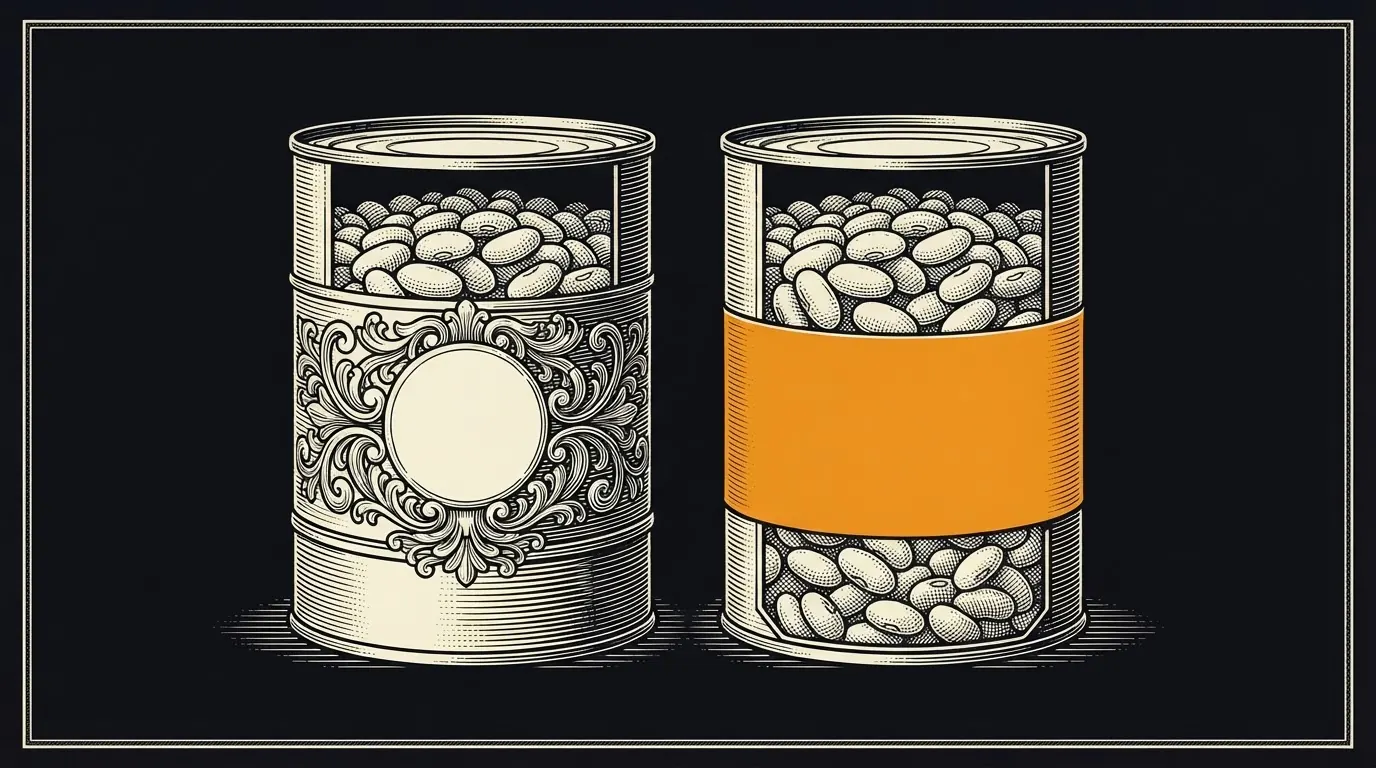
Products where store brand is identical or nearly identical:
- Canned goods (beans, tomatoes, corn, chickpeas)
- Pasta, rice, grains
- Frozen vegetables and fruit
- Baking basics (flour, sugar, salt, oil)
- Spices
- Over-the-counter medications. The FDA requires identical active ingredients for generics. This is law, not opinion.
- Cleaning supplies
- Dairy basics (milk, butter, eggs)
- Bread and crackers
The rule: taste-test the store brand once before deciding. Don't assume name brand is better. Most people can't tell the difference in blind tests on commodity products.
$500/month grocery bill. 20% savings on half the items. $50/month = $600/year. Real money, no taste difference.
Store choice
The store you shop at matters more than the brands you choose.
The split shop: Aldi or Lidl for staples and packaged goods, traditional chain or farmers market for specific produce and fresh items you care about. Takes longer than one-stop shopping. Saves $100 to $200 a month on a typical grocery bill.
Meal planning and prep
The second-highest ROI grocery tactic. USDA puts US food waste at 30 to 40% of the whole food supply, not of what one household buys, and estimates the average family of four loses $1,500 a year to uneaten food verify×DON'T TRUST, VERIFYClaim: USDA estimates US food waste at 30-40% of the food supply and says the average family of four loses $1,500 a year to uneaten food.Verify at: USDA food waste FAQ ↗ Source 4 in the list belowThe 30-40% covers the whole food supply: USDA's Economic Research Service measured 31% lost at the retail and consumer levels in 2010 (10% at retail, 21% at the consumer level). The $1,500 is USDA's household figure on the same page.. That is about $125 a month in the trash.
A system that works:
- Sunday: decide 4 or 5 dinners for the week.
- Write the grocery list from those specific recipes.
- Buy only what's on the list plus your regular staples.
- Shop once. Not three times that week because you forgot something.
What to prep on Sunday: a batch of chicken thighs or ground beef, a pot of rice, chopped raw vegetables in containers (you'll eat them if they're visible), a batch of beans from dry (3 to 4x cheaper than canned if you plan ahead).
Bringing lunch 5 days a week vs buying it saves $8 to $15 per day. Even at $10/day and 250 work days a year, that's $2,500/year on lunch alone. 3 days a week still gets you $1,500/year.
Fresh vs frozen produce
Frozen vegetables are frozen at peak ripeness and nutritionally equivalent to fresh verify×DON'T TRUST, VERIFYClaim: Frozen vegetables are nutritionally equivalent to fresh.Verify at: Journal of Food Science nutrient comparison ↗ Source 5 in the list belowMultiple peer-reviewed studies show frozen produce matches or exceeds fresh on most vitamins after transport and storage.. They're 40 to 60% cheaper per serving. Zero waste since you use what you need.
Frozen makes sense for: spinach, peas, corn, green beans, broccoli, cauliflower, edamame, berries (smoothies or baking), mixed stir-fry vegetables, anything going into a cooked dish.
Fresh makes sense for: salad greens, fruit eaten raw, avocado, items where texture matters. Switching half your produce to frozen on a $100 monthly produce budget saves $30 to $40/month.
Household supplies
Cleaning products, laundry detergent, paper towels. Most people pay a massive brand premium for nearly identical products.
Cleaning supplies
Most commercial cleaners are primarily water plus a small amount of active ingredient. Generic or dollar-store versions clean identically for most tasks.
What cleans:
- White vinegar + water: glass, general surfaces.
- Baking soda: abrasive scrubbing.
- Dish soap + water: most surface cleaning.
- Diluted bleach: disinfecting, mold, bathrooms.
Store-brand laundry detergent works. Use less than the label suggests. Washing machines are designed for less detergent than manufacturers recommend. Using half what the label says gets your clothes as clean.
Paper products
Toilet paper: buy bulk at Costco or Amazon Subscribe & Save. Store-brand bulk is 40 to 60% cheaper per sheet than premium single packs. Test one roll before committing to the mega pack.
Paper towels: switch partially to reusable microfiber cloths for non-critical tasks (wiping counters, drying hands). Keep paper for messy cleanups. A $10 set of microfiber cloths replaces $15 to $20/month in paper towels.
Personal care
Generic medications
FDA regulations require generic drugs to have identical active ingredients at identical dosages to brand-name verify×DON'T TRUST, VERIFYClaim: FDA generic drug rules require identical active ingredients at identical dosages.Verify at: FDA generic drugs overview ↗ Source 6 in the list belowFDA bioequivalence standards are strict. Inactive ingredients may differ but therapeutic effect is the same.. The therapeutic effect is the same.
- Generic ibuprofen vs Advil: identical.
- Generic acetaminophen vs Tylenol: identical.
- Generic loratadine vs Claritin: identical.
- Generic omeprazole vs Prilosec: identical.
Brand name allergy and cold meds run $15 to $25. Generic equivalents run $4 to $8. Buy generic. Always.
Toiletries
Shampoo and body wash: the difference between $3 store brand and $12 salon brand is mostly marketing. If you have real hair or skin concerns, keep what works. Otherwise, test the store brand once.
Razors: Dollar Shave Club or similar subscription services significantly undercut drugstore cartridges. Or go further: a single-blade safety razor is about $30 one-time plus $15/year in blades, versus $60 to $80/year on cartridges.
Sunscreen: generic SPF 50 is identical to brand by FDA standards. The active ingredient at the stated SPF is regulated. Buy the cheapest SPF 50 you can find.
Gas and transportation
GasBuddy and Google Maps both show real-time gas prices within a few miles. A 10 to 15 cent/gallon difference between nearby stations is common. On a 15-gallon fill-up at 10 cents cheaper, that's $1.50 per tank. Weekly fill-ups: $78/year without doing anything hard.
Costco or Sam's Club gas is typically 15 to 25 cents/gallon cheaper than street prices. If you fill weekly, the membership pays for itself on gas alone at most locations.
A gas cashback credit card (3 to 5% back) on $150/month of gas returns $54 to $90/year. Only worthwhile if you pay the balance in full every month. 22% credit card interest obliterates cashback the moment you carry a balance.
Combine errands into one trip instead of five trips per week. Most households cut gas usage 10 to 15% from planning. Not a sacrifice. less driving.
Subscriptions
Subscriptions renew without asking, so they are easy to stop noticing. Most households find $30 to $80/month in subscriptions they don't actively use.
Pull 3 months of statements. Find every recurring charge. List them all, including the annual ones that hit once and you forget about.
For each one, ask:
- Did I use this in the last 30 days?
- If no: cancel today. Not "I might use it." Cancel now. Restart if you miss it.
- Is someone else in the household paying for the same one?
- Am I using the tier I'm paying for, or could I downgrade?
Common review targets: streaming services (how many do you have?), gym membership (when did you last go?), cloud storage, food delivery subscriptions, news and magazine subscriptions, software you no longer use, Amazon Prime if it's out of habit rather than actual use. $50/month recovered is $600/year.
Eating out and delivery
This is not the "stop eating out" section. That's not realistic and creates resentment. The goal is cutting the unconscious spending while keeping the deliberate enjoyment spending.
Delivery apps
Delivery markups are brutal. Same $12 restaurant meal:
Via delivery: $12 + $4 delivery fee + $3 service fee + 15% tip + surge = $22-$25
In that example, delivery nearly doubles the price of the same meal. And the fee the app shows first is not the whole charge: in its 2024 case against Grubhub, settled for $25 million, the FTC charged that added fees often made the final price more than double what Grubhub advertised verify×DON'T TRUST, VERIFYClaim: The FTC charged that Grubhub advertised a single low charge for delivery, then added fees that often made the final price more than double the advertised amount; Grubhub paid $25 million to settle in December 2024.Verify at: FTC: action against Grubhub over hidden delivery fees (December 2024) ↗ Source 7 in the list belowFTC release on the complaint and the $25 million settlement. It compares the final price with the delivery charge Grubhub advertised, not with the restaurant's menu price.. You're paying for someone to carry a bag. Know that when you order.
Cutting delivery from 4 to 2 times a week saves $80 to $120/month for most households. $960 to $1,440/year.
Coffee
The $5 coffee is real but small. $5 a day × 5 days = $100/month. Not trivial, not retirement-defining either.
If $100/month makes your mornings better, keep it. If it's habit, cutting to 3 days a week and making it at home (~$0.50/cup) on the other days saves $36/month and nobody cares.
The system that sticks
Individual tactics without a system revert to old habits in 2 to 3 months. sticks:
Transfer savings the day your paycheck lands, before you see the money sitting in checking. What's left is your budget. You can't spend what isn't there.
No list equals impulse spending. Meal plan on Sunday, write the list from the plan, buy the list. Takes 10 minutes. Saves $50 to $100/month in impulse items and trips back to the store.
Every trip is another round of impulse temptations. One planned trip means one set of decisions.
Stores show price per unit on the shelf label. A "bigger" package isn't always cheaper per ounce. Compare the unit price every time.
If it's not on your list and it's over $20, wait 24 hours. Most impulse purchases don't survive a day of reflection. This single rule saves most households $100 to $200/month.
The 24-hour rule handles impulse purchases. It is not the right test for experiences that cost real money but deliver real value. For those, the default answer is usually yes. See the two ways to lose.
Realistic savings summary
| TACTIC | REALISTIC MONTHLY |
|---|---|
| Store brand switch | $30 - $60 |
| Aldi or Lidl for staples | $60 - $120 |
| Meal planning and prep | $80 - $150 |
| Frozen vs fresh produce | $20 - $40 |
| Generic medications | $10 - $25 |
| Subscription audit | $30 - $80 |
| Reduce delivery orders | $60 - $120 |
| Bulk buying (with membership) | $20 - $50 |
| Generic household supplies | $15 - $30 |
| Total range | $325 - $675/mo |
Not all of these apply to every household. Pick 3 or 4 that are realistic for your situation. Even $200/month found is $2,400/year, which is roughly an annual Roth IRAIndividual Retirement Account (IRA)A retirement account with tax advantages and eligibility rules. Traditional IRA contributions may be deductible; taxable withdrawals generally enter income. Roth contributions use after-tax money, and qualified Roth withdrawals are tax-free.Full definition contribution for someone starting out.
$200/month invested at 8% for 30 years = ~$298,000 in additional retirement wealth.
$300/month at the same terms = ~$450,000.
This is why it matters. Not the month-to-month sacrifice. The 30-year result.
What not to cut
Not all spending cuts are equal. Some cuts cost more than they save.
- Don't cut health insurance. One ER visit costs more than two years of premiums.
- Don't cut car maintenance. A $40 oil change you skip becomes a $4,000 engine replacement.
- Don't cut quality on long-lifespan items. A $30 pan that warps in a year costs more than an $80 pan that lasts ten. Cheap shoes that destroy your feet cost more in medical bills than they save on the purchase.
- Don't cut the things that maintain your sanity. A gym membership you use, one restaurant meal a week that resets your week, a coffee shop that makes mornings better. These aren't waste.
The goal is to cut the unconscious waste, not to strip your life bare. A spending plan you hate is a spending plan you abandon by month three.
Where to go from here
Sources
Verify badges in the text link to these sources. Figures, rates and rules change: check each source’s date before acting on it.
Last updated . Not financial advice. Do your own research. Disclosures · How pages are reviewed