The Roth conversion ladder:
access retirement money before 59.5 without the penalty.
If you retire before 59.5, your Traditional 401(k) and IRAIndividual Retirement Account (IRA)A retirement account with tax advantages and eligibility rules. Traditional IRA contributions may be deductible; taxable withdrawals generally enter income. Roth contributions use after-tax money, and qualified Roth withdrawals are tax-free.Full definition money is locked behind a 10% penalty. The Roth conversion ladder converts it to accessible funds over 5 years. The mechanics are simple once you see them. The tax and ACA interactions are where people get hurt.
This page covers personal finance fundamentals that apply regardless of your view on Bitcoin or fiat currencyfiat currencyMoney declared legal tender by a government, not backed by a physical commodity. Its value rests on trust in the issuing government.Full definition.
This page covers US-specific accounts and tax law. Outside the US? The priority order is the same, the account names differ (ISAIndividual Savings Account (ISA)A UK tax-advantaged account where contributions are post-tax but all growth and withdrawals are tax-free.Full definition in the UK, TFSATax-Free Savings Account (TFSA)A Canadian tax-advantaged account where contributions are post-tax but all growth and withdrawals are tax-free.Full definition/RRSPRegistered Retirement Savings Plan (RRSP)A Canadian tax-deferred retirement account; contributions reduce taxable income and growth is tax-deferred until withdrawal.Full definition in Canada, Super in Australia, etc.).
This page covers the early-retirement ladder itself: five-year seasoning, the bridge years and the ACA subsidy trap. For what a Roth conversion is and why it pays, see Roth Conversions; for bracket-filling in any low-income year, see Roth Conversion Timing.
Each year, convert a portion of your Traditional 401(k) or IRA to a Roth IRA. Pay income tax on the conversion now. Wait 5 years, then that converted amount is accessible from the Roth penalty-free. Start the ladder 5 years before you need the money. Plan around ACA income limits; conversions count as income and can reduce healthcare subsidies.
On this page
The problem this solves
Traditional 401(k) and IRA money can't be accessed without a 10% early-withdrawal penalty until age 59.5 verify×DON'T TRUST, VERIFYClaim: Early withdrawal from Traditional 401(k)/IRA before 59.5 triggers 10% penalty.Verify at: IRS Topic 558 ↗ · IRS Pub 590-B ↗ Source 1 in the list belowLimited exceptions exist (Rule 72(t), SEPP, disability, etc.); general rule is 59.5.. If you retire at 45, you have 14.5 years to bridge.
Options for the bridge: taxable brokerage, Roth contributions (not earnings, which are accessible at any time penalty-free), cash, Bitcoin, SCHD dividends, rental income, and the Roth conversion ladder.
How it works, step by step
- Each year, convert some amount from Traditional 401(k)/IRA to a Roth IRA.
- Pay ordinary income tax on the converted amount (reported on Form 1099-R and Form 8606).
- Wait 5 tax years.
- That specific converted amount is now withdrawable from the Roth without the 10% penalty verify×DON'T TRUST, VERIFYClaim: Converted amounts are penalty-free after 5 tax years per IRS rules.Verify at: IRS Publication 590-B ↗ Source 2 in the list belowEach conversion has its own 5-year clock. Separate from the 5-year rule for earnings..
- Each year's conversion has its own 5-year clock.
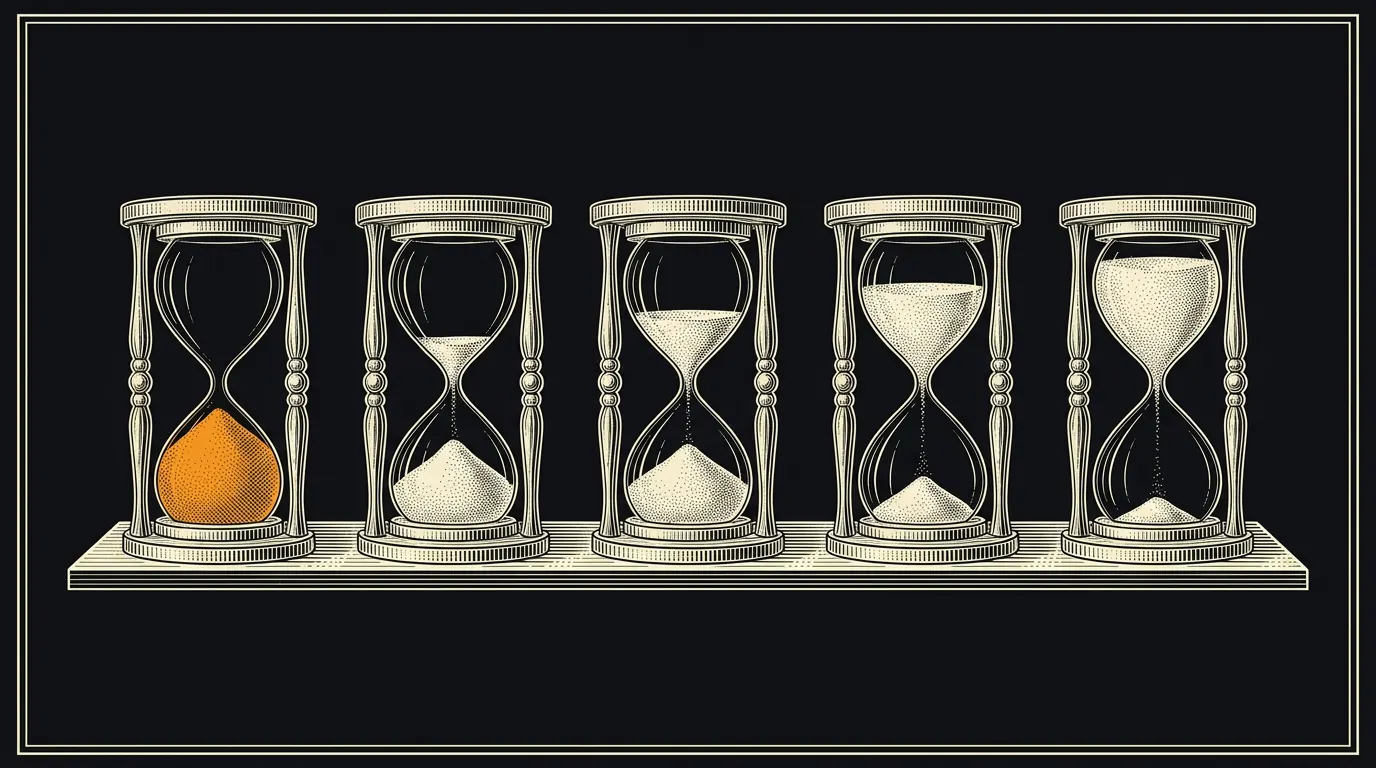
Retire at 45. Convert $40,000/year starting immediately.
Age 45: convert $40k → accessible at age 50
Age 46: convert $40k → accessible at age 51
Age 47: convert $40k → accessible at age 52
...
Age 54: convert $40k → accessible at age 59 (irrelevant, 59.5 kicks in)
You need 5 years of alternate income to bridge before the ladder starts paying out. Plan accordingly.
Tax impact
Each conversion is ordinary income in the year you convert. That means you pay taxes at your current marginal rate on the converted amount. The art is converting enough to be useful but not so much that you push into higher tax brackets.
The sweet spot: convert enough each year to "fill up" the 12% or 22% bracket but not spill into 24%+. Requires year-end projection and a willingness to adjust. The savings compound dramatically over a decade of ladders.
The ACA subsidy trap
Conversions count as income for ACA subsidy calculations. A $60,000 conversion in a year you'd otherwise report $20,000 of income can push you above the subsidy threshold and cost you thousands in healthcare subsidies.
Plan conversions and ACA subsidies together. Sometimes a smaller conversion keeps you under a subsidy cliff and saves more in subsidies than the tax arbitragearbitrageProfiting from price differences in the same asset across different markets, often by buying low in one place and selling high in another. loses. See Healthcare Before Medicare.
Bitcoin interaction
Do not convert Roth AND realize Bitcoin gains in the same year if you can avoid it. Both stack as income, push you into higher brackets, and wreck ACA subsidies. Stagger them: a Bitcoin-sale year followed by a Roth-conversion year. Years where you have low income from both sources are your best window for either move.
Where to go from here
Sources
Verify badges in the text link to these sources. Figures, rates and rules change: check each source’s date before acting on it.
Last updated . Not financial advice. US tax law. Talk to a CPA before large conversions. Disclosures · How pages are reviewed