Money and marriage:
making financial decisions together.
Combining finances when two people have different spending styles, different Bitcoin convictions, different incomes, and different financial histories. The practical systems that work for real couples, not the rosy ones from relationship columns.
This page covers personal finance fundamentals that apply regardless of your view on Bitcoin or fiat currencyfiat currencyMoney declared legal tender by a government, not backed by a physical commodity. Its value rests on trust in the issuing government.Full definition.
The "yours, mine, ours" system works for most couples: joint account for shared expenses, individual accounts for discretionary. Split shared costs by income percentage if incomes are unequal, not 50/50. If one partner believes in Bitcoin and the other doesn't, the believer DCAsDollar-cost averaging (DCA)Investing a fixed amount on a regular schedule, such as $50 every payday, regardless of price. It spreads out when money enters the market and buys more units when prices are low, but it does not guarantee a better price than investing all at once, a profit or protection against loss.Full definition from their individual account, not from joint funds. Every couple should talk about what happens to the Bitcoin if the relationship ends.
On this page
The three systems
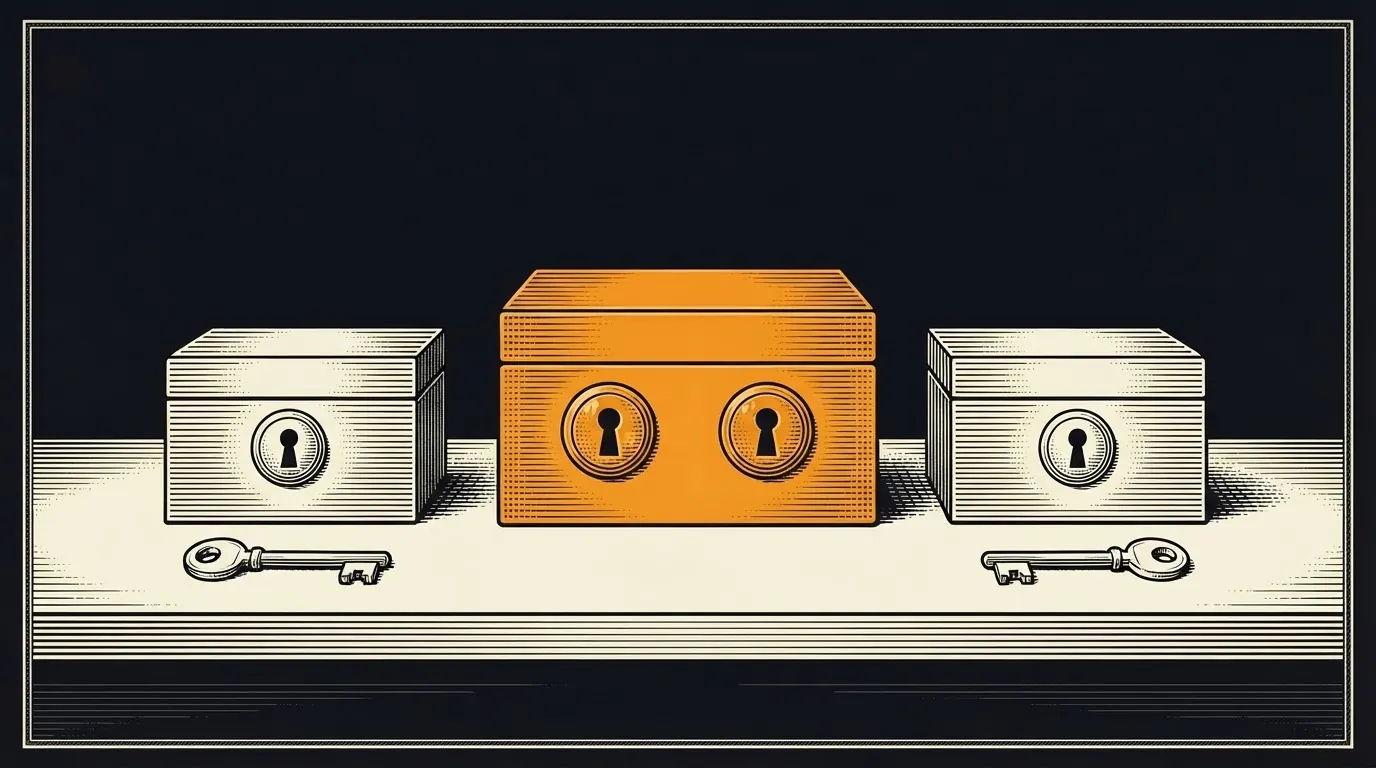
Three accounts. Joint account for shared expenses (rent, utilities, groceries, kids, joint savings). Each person keeps an individual discretionary account. Each person contributes to the joint account. Prevents the "I can't believe you bought that" conversations over small purchases.
Each person gets "no questions asked" money for their own priorities, whether that is shoes or Bitcoin. The operating rules that keep it working, a monthly "money date" and a dollar threshold for individual purchases (common: $200-500), are covered in the conversation before marriage.
Unequal incomes
Splitting shared expenses 50/50 when incomes are very different creates resentment. The percentage approach fixes it.
Partner A earns $80,000. Partner B earns $50,000. Combined: $130,000.
A's share: 80/130 = 62%. B's share: 50/130 = 38%.
Shared monthly expenses of $4,000: A contributes $2,480, B contributes $1,520. Each person has the same percentage of their income left for individual spending and saving.
Different Bitcoin convictions
One partner believes in Bitcoin. The other is skeptical. This is common and doesn't have to be a fight.
The honest conversation:
- What's the agreed-upon maximum Bitcoin allocation as a percentage of joint net worthnet worthEverything you own (assets) minus everything you owe (debts). The most comprehensive measure of financial health.Full definition?
- Is Bitcoin held jointly or individually?
- What happens to the Bitcoin if the relationship ends?
- Does the believer's DCA come from joint funds or their individual account?
Structure that works: Bitcoin DCA from the believer's individual account. Not from joint funds without explicit agreement. The skeptic doesn't have to participate. The believer doesn't have to suppress their conviction. See Bitcoin Allocation.
The Bitcoin talk with a skeptical partner: See Bitcoin for Couples for the full playbook.
Estate planning for couples with Bitcoin
Joint accounts and Bitcoin: how ownership transfers. BeneficiarybeneficiaryThe person or entity you name to receive an account or insurance policy when you die. designations. Who knows the seed phraseSeed phraseA wallet backup written as a list of words, usually 12 or 24, that can recreate the wallet's private keys. In a single-signature wallet, anyone who sees it can take the bitcoin unless a separate passphrase also protects it. Keep it offline and private; recovery may also need the passphrase and wallet setup details.Full definition and what happens if one person dies.
If only one partner knows the seed phrase and they die unexpectedly, the Bitcoin is likely lost. Inheritance planning is not optional at this level of stakes. See Bitcoin Inheritance.
The conversation before moving in
Before sharing a lease or mortgage, answer: who pays what percentage of rent/utilities? What are each person's debts? What are the savings goals? Is there a spending threshold above which you consult each other? These are not romantic conversations. They are the conversations that prevent fights at 11pm on a Tuesday about a $400 purchase.
Financial compatibility before the marriage
Divorce is the single largest wealth-destruction event for most people who experience it. Legal costs, asset division, duplicate household expenses, potential alimony or child support: the financial aftermath can take a decade to recover from verify×DON'T TRUST, VERIFYClaim: Divorce produces significant and lasting negative wealth effects for most households.Verify at: Urban Institute research on divorce and wealth ↗ Source 1 in the list belowMultiple studies document the wealth impact of divorce, particularly on women and on older households..
Kansas State University research finds that financial disagreements are the single strongest predictor of divorce across income levels. It is not about how much money you have. It is about whether you are aligned on how to use it. verify×DON'T TRUST, VERIFYClaim: Arguments about money are the top predictor of divorce, with income, debt and net worth controlled for.Verify at: Kansas State University release: early financial arguments are a predictor of divorce ↗ Source 2 in the list belowDew, Britt and Huston, "Examining the Relationship Between Financial Issues and Divorce," Family Relations (2012), longitudinal data on more than 4,500 couples from the National Survey of Families and Households.
This is not an argument against divorce when a marriage is wrong. It is an argument for choosing a partner with financial compatibility.
What financial compatibility means
- Similar time preference (both willing to delay gratification or both prefer present consumption)
- Aligned views on debt (what is acceptable to borrow for)
- Compatible risk tolerance (one person cannot FIREFinancial Independence, Retire Early (FIRE)A strategy of aggressively saving and investing to reach financial independence decades before traditional retirement age.Full definition-invest while the other lifestyle-inflates to the household ceiling)
- Similar financial goals (homeownership, retirement age, desired lifestyle level)
These conversations before marriage are significantly easier than after.
Questions worth asking before combining finances
- What is your relationship with debt?
- What does retirement look like in your head?
- How do you feel about Bitcoin?
- If one of us lost our job, what would we do?
- What was your relationship with money as a child?
The answers do not have to be identical. They have to be compatible.
The conversation before marriage
For a relationship where both people can participate freely and safely, full financial disclosure means all debts, all accounts and credit scores. If you fear retaliation or monitoring, use the safety guidance above rather than treating disclosure as an obligation. No surprises after the wedding. Agree on: combined vs separate finances (or hybrid), a monthly "money date" to review spending together, a dollar threshold for individual purchases (common: $200-500), and retirement goals.
Prenups: not just for the wealthy
A prenuptial agreement protects both parties. It is especially relevant for: second marriages, partners with unequal assets or debts, business owners, and anyone with significant Bitcoin holdings (which courts may not understand how to value or divide). Think of it as estate planningestate planningOrganizing your assets and legal documents so they transfer correctly and efficiently when you die.Full definition for a marriage, not a prediction of failure, but a framework for fairness if circumstances change. See Prenups Without the Doom and Bitcoin in Divorce.
Where to go from here
Sources
Bracketed numbers and verify badges in the text link to these sources. Figures, rates and rules change: check each source’s date before acting on it.
Last updated . Not financial or relationship advice. Every couple is different; these are starting points, not prescriptions. Disclosures · How pages are reviewed