Proof of work:
the guessing game that secures Bitcoin.
Bitcoin mining is not digging for coins. It's a global guessing game where computers race to find one lucky number.
Viewpoint. Besides explaining the topic, this page makes the site’s case on money and Bitcoin. The facts are sourced; that case is the site’s view. How pages are labeled.
This page explains why proof of work secures Bitcoin and weighs the energy debate. For the mining mechanics and numbers themselves (difficulty retargets, block reward, network hash rate), see Mining & Proof of Work.
Bitcoin mining is computers playing a lottery billions of times per second. The winner gets to add the next batch of transactions to the ledger and receives newly issued Bitcoin as a reward. The work required to win is what makes the ledger secure, because changing history would require redoing all that work.
On this page
The problem proof of work solves
Bitcoin's ledger has no central authority updating it. Thousands of computers maintain it together. Which creates a specific problem: if two computers try to add conflicting entries at the same time, which one wins?
How do you prevent someone from going back and rewriting history in the ledger? Editing an old transaction to say they still have Bitcoin they already spent?
Proof of work is the answer to both.
The guessing game
Bitcoin groups transactions together into blocks. Batches of roughly 1,500 to 3,000 transactions, depending on their size verify×DON'T TRUST, VERIFYClaim: Blocks typically contain 1,500-3,000 transactions.Verify at: mempool.space recent blocks ↗ Source 1 in the list belowVaries with transaction size and weight. Block weight limit is 4 million weight units.. Before a block can be added to the ledger, a computer on the network has to solve a puzzle.
The puzzle is a guessing game. The Bitcoin software asks computers to find a specific number, one that, when combined with the transactions in the block and run through a mathematical function, produces an output that meets certain criteria.
There's no way to calculate that number directly. You can't work backwards from the answer. The only way to find it is to guess. Over and over and over, as fast as your hardware allows.
The first computer to find the right number gets to add the block to the ledger and receives newly issued Bitcoin as a reward. This is what Bitcoin mining is. Not digging. Guessing.
Why it takes work
Finding the right number is deliberately difficult. The Bitcoin protocol adjusts the difficultydifficultyA number that Bitcoin adjusts every 2,016 blocks (roughly two weeks) to keep the average block time at 10 minutes regardless of how much hashrate is on the network. Higher difficulty means each hash has a lower chance of finding a block. every 2,016 blocks (approximately two weeks) to ensure that, regardless of how much total computing power is on the network, a new block is found approximately every 10 minutes verify×DON'T TRUST, VERIFYClaim: Bitcoin retargets difficulty every 2,016 blocks to maintain 10-minute average block time.Verify at: Bitcoin developer reference: block chain ↗ · mempool.space difficulty chart ↗ Source 2 in the list below2,016 blocks is approximately two weeks at 10-minute target. Retarget algorithm is part of the consensus rules..
More miners means harder puzzle. Fewer miners means easier puzzle. The difficulty floats to maintain the ten-minute target.
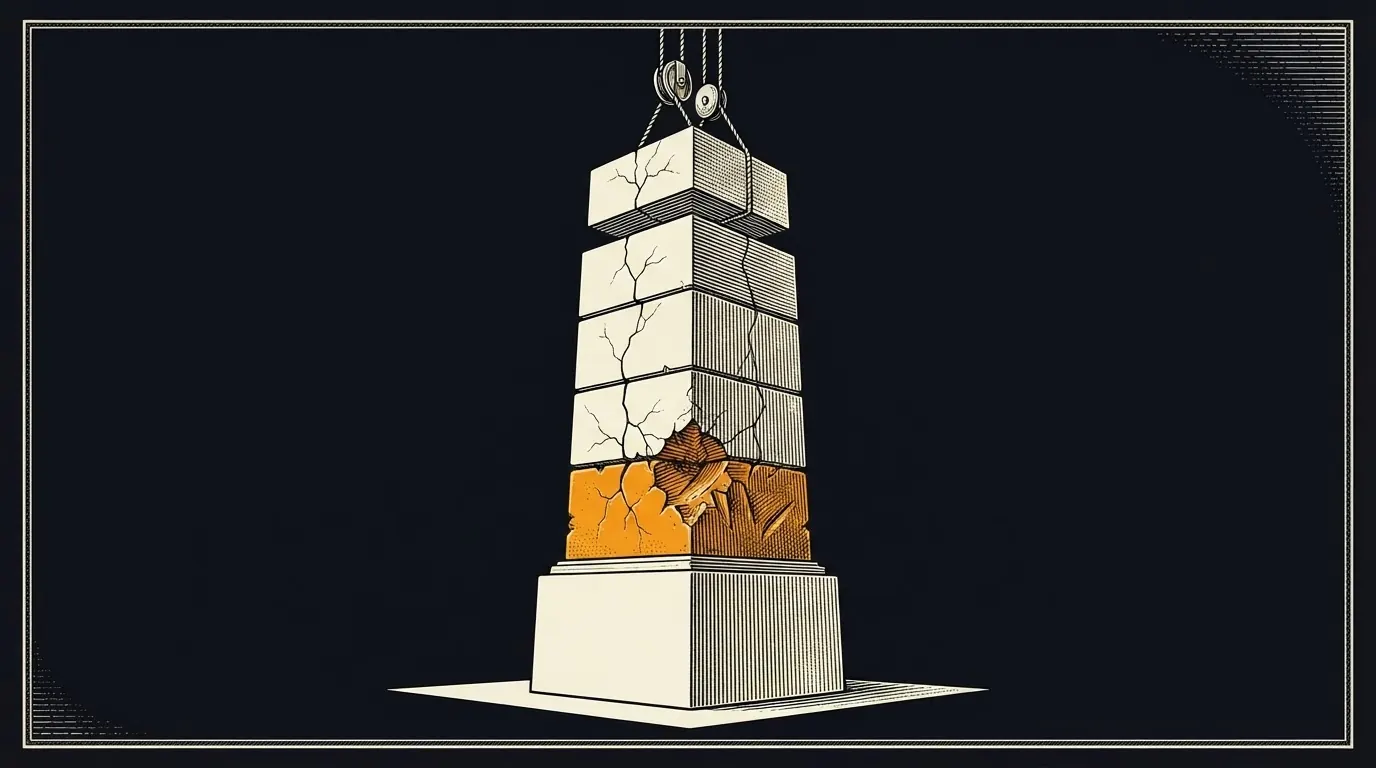
The work is what makes the ledger secure. Every block that gets added contains a fingerprint (a hash) of the block before it. Change anything in an old block and its fingerprint changes. Which breaks the fingerprint of the next block. Which breaks the next one after that.
To rewrite history, you'd have to redo the proof of work for every block from the one you changed all the way to the current block, faster than the rest of the network is adding new blocks.
An attacker competes against the work of the rest of the network. Honest hashpower dominance makes deep rewrites less likely, not impossible; pool concentration and network disruption remain attack surfaces.[3]
The most-work valid chain
Full nodes independently validate blocks and transactions, then select the valid chain with the greatest cumulative proof of work, not the largest miner headcount or the most blocks. Majority hashpower cannot make a node accept invalid signatures or invalid issuance under its existing rules. It can enable censorship, reorganizations and double-spends of the attacker’s own payments; it cannot sign for someone else’s keys. Security is probabilistic and depends on honest hashpower, network communication and correct validation. More confirmations reduce, but do not eliminate, reversal risk.[3]
If two miners find valid blocks at about the same time, nodes can temporarily follow different tips. As additional work arrives, nodes select the most-work chain they have independently found valid; there is no fixed deadline for agreement.[3]
An honest majority of hashpower is expected to accumulate work faster over time. Mining is random: an attacker can win a short race even with less than half of the hashpower.[3]
Think of mining as repeated dice rolls: more attempts improve the expected outcome, not certainty. The chain-selection rule compares accumulated work only after validation.[3]
The energy question
Proof of work uses real energy. This is intentional. The energy expenditure is what makes the security real. You cannot fake the work without doing it.
Bitcoin's energy usage is frequently criticized as wasteful. Two honest observations.
First, the energy used to secure a global, permissionless monetary network that settles billions of dollars in transactions without any central authority might be a reasonable trade-off. Every existing monetary system, from gold mining to banking data centers to the physical security around cash and gold vaults, uses enormous energy too. The comparison should be against the alternative, not against nothing verify×DON'T TRUST, VERIFYClaim: Bitcoin energy usage is measurable and comparable to other monetary infrastructure.Verify at: Cambridge CBECI energy estimates ↗ Source 3 in the list belowCBECI publishes annualized TWh estimates. Compare to gold mining and banking infrastructure independently..
Second, the mix of energy sources matters. Bitcoin mining is increasingly powered by energy that would otherwise be wasted. Stranded natural gas, curtailed renewable energy, excess hydro verify×DON'T TRUST, VERIFYClaim: Bitcoin mining uses a significant share of sustainable or otherwise-wasted energy.Verify at: Bitcoin Mining Council quarterly reports, 2021 to H1 2023 (archived copy) ↗ · Cambridge CBECI ↗ Source 4 in the list belowBMC is an industry association, so treat its figures as one input. Cambridge estimates cover the energy mix more conservatively..
See Bitcoin and Energy for the full debate, with both sides argued in detail.
The energy-cost critique and the honest counterargument
Among credentialed academic critics of Bitcoin, post-Keynesian economist Steve Keen has argued that the asset's energy economics are a structural problem that may eventually force its decline. His argument deserves rigorous treatment because it is the strongest energy-based critique from a credentialed source.
The argument
Keen's position, condensed:
- Bitcoin mining requires sustained energy expenditure to secure the network. Difficulty adjusts upward as more hashpower joins, so energy cost per unit of security keeps rising.
- Block rewards halve every four years. As reward shrinks, miners need higher Bitcoin prices or higher transaction fees to remain profitable. If neither materializes, marginal miners go offline.
- Climate concerns and AI's competing electricity demand create political pressure to ration energy. Keen argues that in a world forced to constrain energy use, governments may shut down Bitcoin mining as a politically expedient target.
- His conclusion: Bitcoin's energy economics are a long-term vulnerability that the market is not pricing correctly verify×DON'T TRUST, VERIFYClaim: Steve Keen has publicly argued Bitcoin's energy-cost structure is a long-term vulnerability that may force its decline.Verify at: Steve Keen's published commentary ↗ · Cambridge CBECI Bitcoin energy index ↗ Source 5 in the list belowKeen's energy-cost critique is a recurring theme in his published commentary. Cambridge CBECI provides the underlying energy-consumption data..
The counterargument
Three structural responses to Keen's argument deserve equal weight:
- Difficulty adjusts in both directions at retarget boundaries, subject to protocol limits. A sudden hashpower loss can slow blocks and delay that adjustment; lower hashpower can also weaken resistance to attack. Continued operation and an adequate fee-funded security budget are assumptions, not guarantees.[3]
- Miners self-select to the cheapest available energy. Stranded hydro, flared natural gas, curtailed renewables. These are energy sources that have negative or zero marginal cost because they cannot be transmitted to centers of demand. Bitcoin mining converts otherwise-wasted energy into security. The "Bitcoin competes with AI for grid electricity" framing assumes miners draw from the same grid as data centers, which the marginal economics push against verify×DON'T TRUST, VERIFYClaim: Bitcoin miners disproportionately use stranded, flared, or curtailed energy sources because their economics favor the cheapest available power.Verify at: Cambridge Bitcoin Mining Geographic Map ↗ · Bitcoin Mining Council quarterly reports, 2021 to H1 2023 (archived copy) ↗ Source 6 in the list belowCambridge's geographic data and BMC's industry self-reports both show concentration in low-cost-energy regions. The two sources triangulate..
- The fee market is designed to replace block rewards. The Bitcoin whitepaper anticipated that transaction fees would eventually become the dominant miner revenue source. The 100+ year transition window built into the halvingHalvingThe scheduled event, built into Bitcoin's code, that cuts the new bitcoin paid to miners per block in half. It happens every 210,000 blocks, about every four years; the April 2024 halving at block 840,000 cut it from 6.25 to 3.125 BTC, slowing the rate of new supply.Full definition schedule gives a long runway for fee revenue to scale with adoption. Whether it scales fast enough is uncertain, but the design is not silent on the question.
What honest disagreement looks like
Keen's argument is not refuted by any of the counterpoints above. They are responses, not proofs. The honest position: Bitcoin's long-run energy economics are a real open question. The thesis depends on continued adoption driving fee revenue, on miners continuing to access low-cost energy, and on political tolerance for the activity. Each of these can change.
A reasonable Bitcoin holder reads Keen's critique seriously, weighs the counterarguments, and treats the residual uncertainty as part of the position's risk profile. The site's framing throughout: uncertainty is the argument for diversificationdiversificationSpreading investments across different assets so a drop in one doesn't devastate your entire portfolio.Full definition, not certainty of either Bitcoin's success or its failure.
The last Bitcoin will be mined around the year 2140 verify×DON'T TRUST, VERIFYClaim: The final Bitcoin will be mined around the year 2140.Verify at: bitcoinblockhalf.com halving schedule ↗ Source 7 in the list belowThe block reward halves every 210,000 blocks. Summing the geometric series converges near block 6,930,000, roughly year 2140.. After that, miners are paid only through transaction fees.
The concern: will transaction fees alone be enough to incentivize miners to secure the network?
The honest answer: this is uncertain over a 100+ year horizon. Bitcoin developers and researchers debate this actively.
What is known today: transaction fee revenue has increased significantly as Bitcoin usage grows. The long horizon gives significant runway for the fee market to develop. This is a legitimate long-term consideration, not an imminent threat.
Where to go from here
Sources
Bracketed numbers and verify badges in the text link to these sources. Figures, rates and rules change: check each source’s date before acting on it.
- mempool.space, mempool.space recent blocks ↩
- Bitcoin developer reference · developer.bitcoin.org/reference/block_chain.html. Consensus rules, difficulty adjustment, and chain selection. ↩
- Cambridge Centre for Alternative Finance (CBECI) · ccaf.io/cbnsi/cbeci. Bitcoin energy consumption and mining hash rateHash rateHow many hashes (guesses at the puzzle that wins a block) a miner makes per second. The network hash rate is the total across all miners: the higher it is, the harder and more expensive it would be for any attacker to overpower the network.Full definition estimates. ↩
- Bitcoin Mining Council quarterly sustainability reports · bitcoinminingcouncil.com (archived copy). Industry-sourced; cross-reference with CBECI. ↩
- Steve Keen's published commentary ↩
- Cambridge Centre for Alternative Finance, Cambridge Bitcoin Mining Geographic Map ↩
- bitcoinblockhalf.com halving schedule ↩
- Bitcoin Developer Guide: Block Chain, retrieved 2026-09-17.
- Satoshi Nakamoto, "Bitcoin: A Peer-to-Peer Electronic Cash System" (2008) · bitcoin.org/bitcoin.pdf. The proof-of-work mechanism described in sections 3 and 4.
- mempoolmempoolThe waiting area for Bitcoin transactions that have been broadcast to the network but not yet confirmed in a block.Full definition.space · mempool.space/graphs/mining/hashrate-difficulty. Live network hash rate and difficulty.
- Antonopoulos, A.M. Mastering Bitcoin: Programming the Open BlockchainBlockchainA public transaction ledger, grouped into blocks that each link to the one before. Every Bitcoin full node checks each block itself and follows the valid chain with the most accumulated proof of work. Recent blocks can occasionally be replaced (a reorganization); the number of computers does not decide validity.Full definition (3rd ed., O'Reilly, 2023). Chapters on mining, consensus, and the longest-chain rule · github.com/bitcoinbook/bitcoinbook. Open-source under CC-BY-SA. The canonical technical reference.
Last updated . Educational content, not financial advice. Disclosures · How pages are reviewed