Shrinkflation.
When the price stays the same but you get less.
Your grocery bill didn't go up, but your cereal box is smaller, your chocolate bar is lighter, and your bag of chips has more air than chips. This is shrinkflation, a form of inflation businesses use when they can't raise prices without losing customers.
Viewpoint. Besides explaining the topic, this page makes the site’s case on money and Bitcoin. The facts are sourced; that case is the site’s view. How pages are labeled.
Shrinkflation is when a company keeps the price of a product the same but quietly reduces the quantity or quality. Your 16oz bag of chips becomes 14oz. Your chocolate bar goes from 4.4oz to 3.8oz. Your toilet roll loses a few sheets per roll. The price tag looks the same. The value you receive is less. It is inflation disguised as an unchanged price.
On this page
What shrinkflation is (and isn't)
Shrinkflation is not a corporate conspiracy. It is the predictable response of businesses facing higher input costs they cannot fully pass on to customers.
When the money supply expands, it raises input costs across the economy. Raw materials cost more. Energy costs more. Labor costs more. A business facing 15% higher input costs has three options:
All three outcomes represent inflation. Only option 1 shows up directly in official CPI measurements. Options 2 and 3 are systematically undercounted.
The evidence
The pattern is documented across thousands of products. The U.S. Bureau of Labor Statistics maintains a separate adjustment for "package size changes" in its CPI methodology, confirming that the phenomenon is real and that the agency attempts to correct for it in theory[1].
Consumer Reports has tracked specific downsizes under what it calls the "Grocery Shrink Ray" for years[2]. Categories hit hardest:
- Breakfast cereals
- Chocolate and confectionery
- Snack foods (chips, crackers, cookies)
- Toilet paper and paper towels
- Laundry detergent
- Coffee
- Orange juice and other beverages
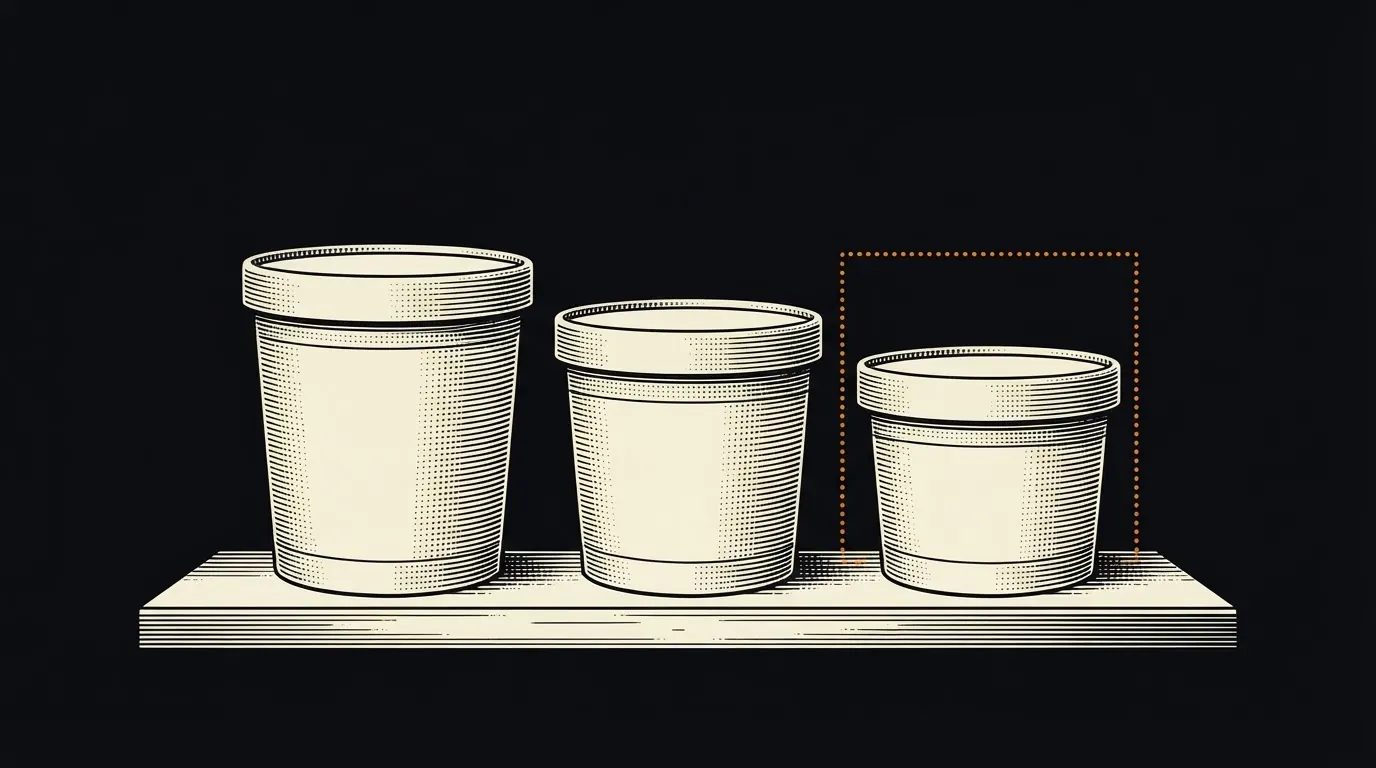
- Ice cream containers (the 2-quart container collapsed to 1.5 quarts and then 1.25 quarts in many brands over two decades verify×DON'T TRUST, VERIFYClaim: Ice cream container sizes shrank from 2 quarts to 1.5 and then 1.25 quarts across major brands.Verify at: Consumer Reports shrinkflation coverage ↗ Source 2 in the list belowCR has tracked ice cream container downsizing across Breyers, Edy's, and store brands since the mid-2000s.)
These categories share a trait: consumers buy on price familiarity. You remember what you paid last time. You do not remember the exact net weight. A 10% size reduction is nearly invisible to most shoppers unless they read the label carefully.
Outside the U.S., the European Commission and several national statistics agencies have published formal studies documenting the practice, including Eurostat methodology notes on how to handle package size changes in harmonized inflation calculations[3].
Why CPI undercounts shrinkflation
The Consumer Price Index measures the cost of a fixed basket of goods. When a product shrinks, the CPI methodology should theoretically adjust for the size change. In practice, several gaps remain.
- Adjustments lag by months. BLS updates the price-per-ounce calculations on a schedule, not in real time. A product that shrinks in March may not be properly indexed until the next monthly price collection.
- Basket composition is updated infrequently. The full CPI basket revision happens annually[1].
- Quality adjustments are estimated, not measured. BLS applies "hedonic adjustments" that attempt to separate quality changes from price changes. The adjustments rely on modeled assumptions that are themselves debated in the academic literature[4] verify×DON'T TRUST, VERIFYClaim: BLS hedonic adjustment methodology is debated in the academic literature.Verify at: BLS hedonic Q&A ↗ · BLS CPI Handbook ↗ Source 4 in the list belowBoskin Commission (1996) and subsequent academic work documents the critique..
- The substitution assumption masks purchasing-power loss. CPI methodology assumes consumers will switch to cheaper alternatives when a favorite product becomes more expensive. That substitution is treated as neutral. In practice, being forced to a lower-quality product is itself a form of lost purchasing powerPurchasing powerWhat money can actually buy, not the number on the bill or in the account. Inflation shrinks it over time: by the BLS consumer price index, it takes more than $8 today to buy what $1 bought in 1971. Same dollar, much less buying ability.Full definition.
The result: reported CPI consistently understates the inflation experienced by households, particularly for goods bought frequently and in small quantities where shrinkflation is easiest to apply without detection.
Quality degradation: the hidden shrinkflation
The worst version doesn't show up in any headline statistic. When businesses cannot raise prices or shrink products further, they reduce the quality of inputs.
In food specifically: fresh ingredients become processed, natural ingredients become artificial, higher-quality proteins are replaced with fillers and extenders. The reformulation of food products toward lower-quality ingredients has been documented across multiple industries over decades[5].
The consequence is not confined to your wallet. It shows up in your health. More calories, fewer nutrients. Higher rates of obesity, metabolic disease, and diet-related chronic illness, concentrated in the populations who spend the highest proportion of income on food[6] verify×DON'T TRUST, VERIFYClaim: Obesity and diet-related chronic illness correlate with income and food spending share.Verify at: CDC NCHS obesity stats ↗ Source 6 in the list belowCDC NCHS tracks obesity prevalence by income quintile; annually updated..
Quality degradation is the form of inflation that CPI cannot measure at all. A box of cereal that is 15% more cornstarch and 15% less actual grain tracks at the same price, the same weight, and the same apparent value. The purchasing-power loss is real. The measurement is silent.
What to do about it
Personal tactics
- Price per unit, not price per package. Every grocery store shelf tag shows price per ounce or per unit. Use it every time. This defeats shrinkflation and shrinkage-via-smaller-package at the shelf.
- Track product weights over time. Photograph the nutrition label, including net weight, for products you buy regularly. Compare across years.
- Buy from sources with less pressure to reformulate. Local producers, farmers markets, and smaller stores where the owner controls the recipe face different cost pressures than national brands. See Spending Less for the full tactical set.
- Buy staples, not processed convenience. Rice, beans, oats, and whole vegetables are harder to shrink or reformulate than a pre-made product with dozens of ingredients.
The deeper answer
Shrinkflation exists because businesses are absorbing monetary inflation. The tactics above help at the individual level. The structural problem is the money supply expansion that makes business input costs rise in the first place. See The Problem for the full explanation of where inflation comes from, and Downstream Consequences for the full cascade this sets off.
Holding a portion of savings in an asset whose supply cannot be expanded is the individual response to a monetary system that shrinks your dollar. See Bitcoin for Beginners.
Where to go from here
Sources
Bracketed numbers and verify badges in the text link to these sources. Figures, rates and rules change: check each source’s date before acting on it.
- U.S. Bureau of Labor Statistics, "Handbook of Methods: Consumer Price Index" · bls.gov/opub/hom/cpi/. BLS methodology for handling package size changes and quality adjustments. ↩
- Consumer Reports, ongoing "Shrinkflation" coverage · consumerreports.org. Documented product downsizes across grocery categories. ↩
- Eurostat, "HICP Methodological Manual" · ec.europa.eu/eurostat/web/hicp/methodology. European treatment of package size and quality adjustments in harmonized consumer price indices. ↩
- Academic literature on hedonic adjustment, including Boskin Commission (1996) and subsequent research on CPI measurement bias. Summary and bibliography at bls.gov/cpi/quality-adjustment/questions-and-answers.htm. ↩
- U.S. Department of Agriculture, Economic Research Service, food composition data across decades · ers.usda.gov. ↩
- U.S. Centers for Disease Control and Prevention, National Center for Health Statistics, obesity prevalence trends by income level · cdc.gov/nchs/fastats/obesity-overweight.htm. ↩
Last updated . Not financial advice. Do your own research. Disclosures · How pages are reviewed