UTXO consolidation:
when does it pay off?
Small UTXOs are expensive to spend in a high-fee environment. Enter what you hold and what you plan to do with it. See whether consolidating now costs more or less than spending UTXOs individually later.
The question it answersShould I consolidate my Bitcoin UTXOs now or later?
Prices: uses the latest daily Bitcoin close in the site’s own data file, not a live quote; no price service is contacted. Privacy: runs in your browser. What you enter stays on your device unless you copy a share link, which puts your inputs in the link.
Fills in from the latest daily close in the site's data file. A price you type is kept in this browser. Enter 0 to see fees in sats; a cleared field also shows sats and goes back to that close the next time the page loads.
Consolidating UTXOs combines your transaction history on-chainon-chainA Bitcoin payment recorded directly and permanently on Bitcoin's main public ledger, settled by the network itself rather than through a faster off-network lane.Full definition. If privacy matters, consolidation reveals that all the included UTXOs belonged to the same wallet. See Bitcoin Privacy Guide.
What this tool assumes
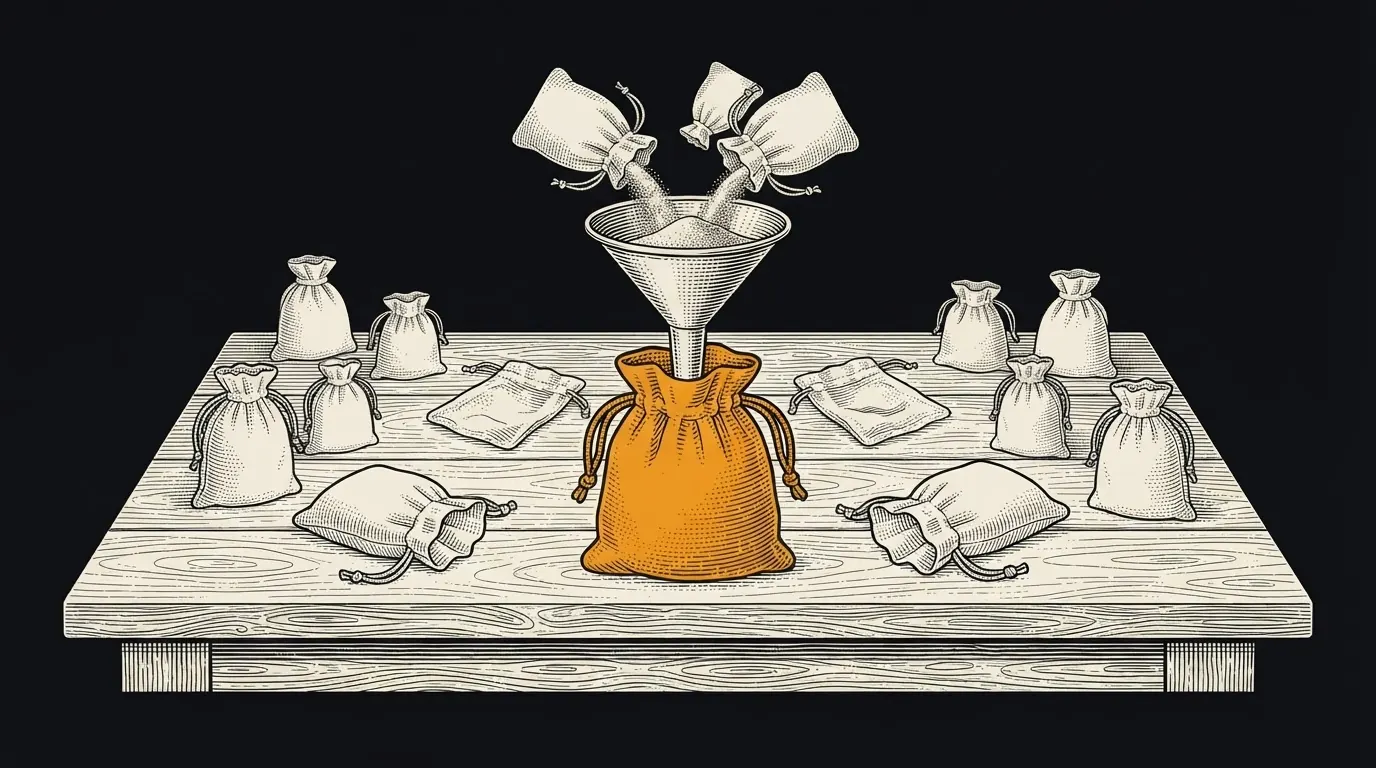
- Consolidation is one transaction with N inputs and 1 output at the current fee rate, followed later by one payment (1 input, 2 outputs) at the future rate.
- Not consolidating means N separate payments later, each 1 input and 2 outputs (recipient plus change), at the future rate.
- Every UTXO is the chosen address type, with a typical signature size. Real transactions can be up to about 1 vB per Legacy input (0.25 vB per SegWit input) smaller; a Taproot key-path input is always 57.5 vB.
- The count runs from 2 to 500 UTXOs, whole numbers only; anything else shows an input message instead of results.
- The verdict compares fees in sats, so the BTC price only converts the display to USD. The price field uses the latest daily close in the site's data file unless you type one or open a share link that carries one; only a typed or shared price is saved in your browser.
- A UTXO worth less than the fee for its own input is covered by the two "cannot be built" checks below: at the current rate such a set cannot pay its consolidation fee, and at the future rate a UTXO that small cannot pay for a separate payment. The average size is optional; a size of 0 or less, or a negative price, shows an input message instead of results.
- With an average size entered, a path counts as possible only when the coins it spends hold more than its fee. When the consolidation fee is at least N × size, or one separate payment costs at least one UTXO, the verdict says that path cannot be built instead of comparing fees. The dust limit on outputs is not modeled.
- Lower fee-rate windows (weekends, late-night UTC) often cut consolidation costs, by 30% to 60% as a rough site estimate, not a published figure.
- Consolidation trades privacy for lower future spend fees; that cost is not priced.
Estimates only. Actual wallet behavior depends on coin-selection algorithm and policy.
HOW THIS IS CALCULATED
This tool runs entirely in your browser: no data is sent to any server. The BTC price field fills with the latest daily close in the site's data file each time the page loads: $81,262, the Coin Metrics end-of-day USD price for 2026-09-19 in the site's data snapshot[1]. A price you type is kept in this browser and a price in a share link is used as given; neither is overwritten, whatever its value. An auto-filled price is not saved, so a return visit gets the current price. Clear the field to hand it back to the saved daily close on the next load.
Transaction size in virtual bytes (vB) = overhead + inputs × input size + outputs × output size, rounded up to a whole vB. Virtual size is transaction weight ÷ 4, rounded up, where witness bytes count once and all other bytes four times[2]. Overhead is version, locktime and the input and output counts (10 bytes; the input count grows from 1 to 3 bytes at 253 or more inputs, adding 2 vB); SegWit and Taproot transactions add a 2-byte marker and flag counted as witness data, which makes 10.5 vB[2]. Sizes used:
- SegWit (P2WPKH): 10.5 vB overhead, 68 vB per input, 31 vB per output.
- Taproot (P2TR): 10.5 vB overhead, 57.5 vB per input (a key-path spend carrying one 64-byte signature[3]), 43 vB per output.
- Legacy (P2PKH): 10 vB overhead, 148 vB per input, 34 vB per output.
With N UTXOs:
- Consolidate now = size(N inputs, 1 output) × current rate.
- Spend individually later = N × size(1 input, 2 outputs) × future rate.
- Savings = the later cost minus (consolidation fee + one later payment of size(1 input, 2 outputs) × future rate), in sats. Positive savings shows Consolidate now, negative shows Wait, zero shows Break-even. USD = sats ÷ 100,000,000 × price; with no price (blank or 0), amounts show in sats.
- Break-even current rate = (N - 1) × size(1 input, 2 outputs) × future rate ÷ size(N inputs, 1 output). Consolidating now wins at any current rate below it.
- With an average UTXO size entered: consolidation fee as a share of N × size.
- With an average UTXO size entered, two checks come before the comparison. If the consolidation fee is at least N × size, the merged output would be zero or negative, so the verdict says consolidating at this rate costs at least what the UTXOs hold and gives the highest current rate that leaves something: N × size ÷ size(N inputs, 1 output). Otherwise, if size is at or below size(1 input, 2 outputs) × future rate, one-by-one payments cannot be built at the future rate, so the verdict says so and shows what consolidating leaves and what spending it later costs.
Without an average UTXO size, the verdict is the fee comparison alone. The count must be a whole number from 2 to 500; above 675 Legacy inputs a single consolidation passes the 400,000 weight-unit limit on a standard transaction[4], and 500 keeps every address type under it. A count outside 2 to 500, a fractional count, a fee rate of 0 or less, a negative price, or a size of 0 or less shows an input message instead of results. The later path assumes one transaction per UTXO; a wallet that combines inputs in one payment pays less. The privacy cost of linking UTXOs is not priced.
Verify the methodology or inspect the source code in your browser's dev tools.
Where to go from here
Sources
Bracketed numbers in the text link to these sources. Figures, rates and rules change: check each source’s date before acting on it.
- Coin Metrics, Price. Checked 2026-09-26. ↩
- Bitcoin Improvement Proposals, BIP 141: Segregated Witness (Consensus layer). Checked 2026-09-26. ↩
- Bitcoin Improvement Proposals, BIP 341: Taproot: SegWit version 1 spending rules. Checked 2026-09-26. ↩
- Bitcoin Core, src/policy/policy.h: MAX_STANDARD_TX_WEIGHT. Checked 2026-09-26. ↩
Calculators are educational estimates, not financial advice. Disclosures · How pages are reviewed