Is renters insurance worth it?
About $15/month for real protection.
Your landlord's policy covers the building and covers exactly $0 of your belongings, your liability, or your hotel bill if the unit becomes unlivable. Renters insurance fills all three gaps for roughly the price of two coffees a month, which is why it is one of the highest-value dollars in personal finance.
Yes, for almost everyone who rents: a typical policy runs about $15–$25/month as of 2026 and buys three things a landlord's insurance never gives you: personal property coverage, personal liability (usually $100k–$300k), and loss-of-use coverage for additional living expenses if a covered peril, such as a covered fire, makes your home uninhabitable, subject to policy limits. Standard renters insurance excludes rising-water flood damage.[D15] The math rarely comes close.
- The average renters policy costs roughly $14–$20/month, about $170–$240/year, per the Insurance Information Institute as of 2026.
- Your landlord's policy covers the structure and $0 of your stuff; a $12,000 apartment of belongings is entirely your problem without a policy.
- Standard policies include personal liability of $100,000 to $300,000, which covers a guest injury or a dog bite anywhere, not just at home.
- Loss-of-use coverage pays for a hotel and meals if a covered event makes your unit uninhabitable, typically 20–30% of your property limit.
- Floods and earthquakes are excluded from every standard policy and need separate coverage; a NFIP flood policy is a distinct purchase.
This page covers personal finance fundamentals that apply regardless of your view on Bitcoin or fiat currencyfiat currencyMoney declared legal tender by a government, not backed by a physical commodity. Its value rests on trust in the issuing government.Full definition.
Renters insurance (the HO-4 policy) protects three things your landlord's insurance never touches: your belongings, your legal liability if you injure someone or damage their property, and additional living expenses if a covered peril makes your home unlivable, subject to policy limits.[D15] For about $15/month you transfer a five-figure downside to an insurer. The only real decision is replacement cost vs. actual cash value, and how much property coverage to carry, both of which you set by taking a 30-minute inventory.
What does renters insurance cover?
A standard HO-4 policy covers three distinct things, and it helps to see them side by side against what your landlord's policy does, which, for your side of the deal, is nothing.
| COVERAGE | YOUR RENTERS POLICY | LANDLORD'S POLICY |
|---|---|---|
| Personal property | Your furniture, electronics, clothes, kitchen gear, up to your chosen limit, and even off-premises (a laptop stolen from your car). Covered. | $0. The landlord insures the building, not one item of yours. |
| Personal liability | Legal and medical costs if you injure someone or damage their property. Standard limits are $100k–$300k. | $0 for you. It protects the landlord, not your legal exposure. |
| Loss of use (ALE) | Hotel, meals, and extra costs if a covered event makes the unit unlivable. Usually 20–30% of your property limit. | $0. You pay for your own hotel out of pocket. |
| Medical payments to others | Small no-fault payments, typically $1,000–$5,000, if a guest is hurt, regardless of blame. | $0 toward your guests. |
| Flood & earthquake | Excluded. Need a separate NFIP flood policy or an earthquake rider. | Excluded for your belongings the same way. |
The Insurance Information Institute lays out these three core coverages and the flood/earthquake exclusion in plain terms verify×DON'T TRUST, VERIFYClaim: A standard renters (HO-4) policy covers personal property, liability, and loss-of-use, and excludes flood and earthquake damage.Verify at: Insurance Information Institute: Renters Insurance ↗The III consumer guide breaks down the three standard coverages and states that flood and earthquake are excluded from a standard policy..
Limits and percentages are typical policy defaults as of 2026 and vary by insurer and state; your declarations page is the source of truth for your policy.
Doesn't my landlord's insurance cover my stuff?
No. This is the single most common misunderstanding renters have. Your landlord carries a policy on the building and their own liability as the property owner. It covers the roof, the walls, and the wiring. It covers $0 of your television, your laptop, your clothes, or your security deposit's worth of furniture. If a kitchen fire two units down spreads and destroys everything you own, the landlord's insurer rebuilds the structure and hands you nothing.
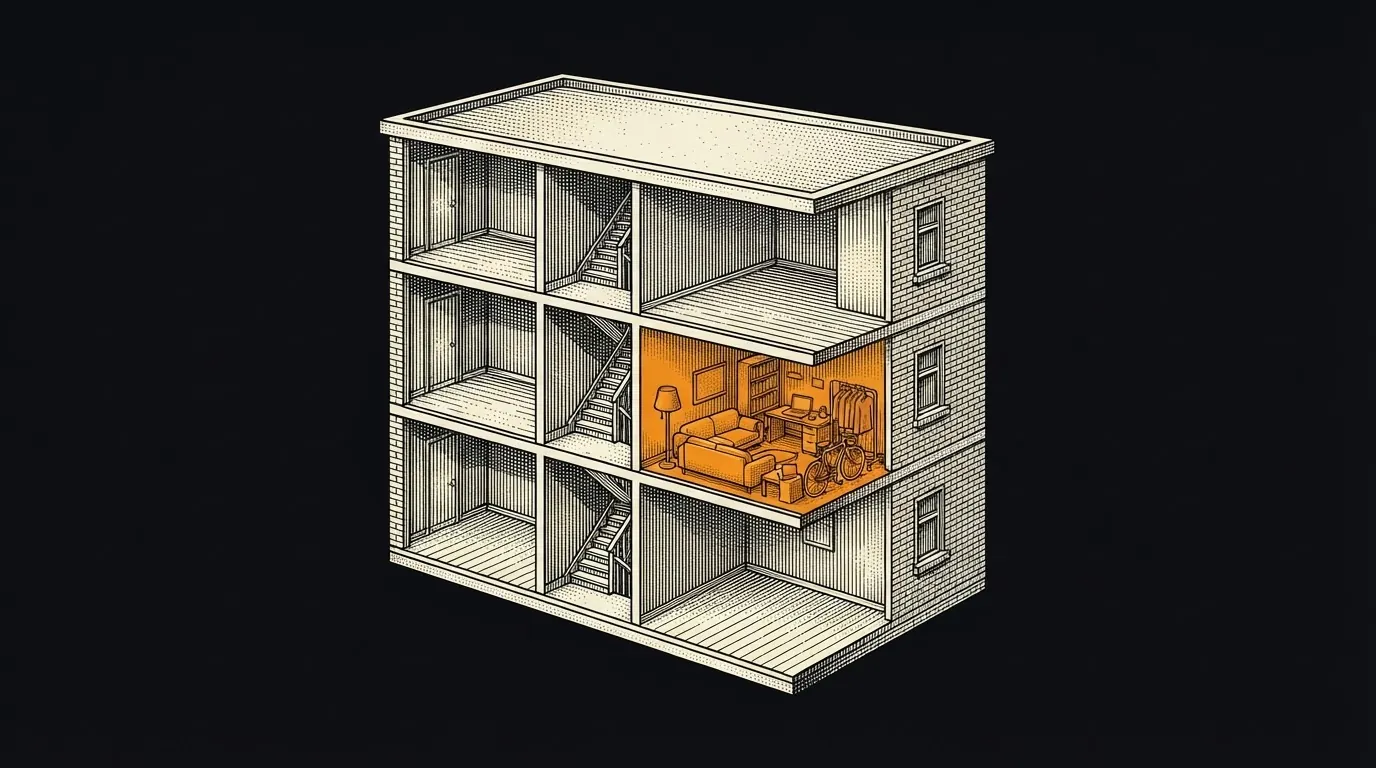
The number that makes this concrete: most people underestimate the replacement value of their belongings badly. Add up a bed, a couch, a desk, a TV, a laptop, a phone, a wardrobe, and a kitchen's worth of small appliances and you are usually somewhere between $15,000 and $30,000 to replace at today's prices. Renters insurance moves that entire number off your balance sheet for about $15/month. The National Association of Insurance Commissioners publishes consumer guidance on exactly this landlord-vs-tenant coverage split verify×DON'T TRUST, VERIFYClaim: A landlord's insurance covers the building but not a tenant's personal property or personal liability.Verify at: NAIC: Consumer Insurance Resources ↗The NAIC's consumer hub explains that landlord policies protect the structure and owner, and directs renters to carry their own policy for belongings and liability..
Personal property coverage follows you, not the apartment. A laptop stolen from your car, a phone stolen on a trip, or a bike taken from a friend's garage is typically covered (minus your deductible), usually up to 10% of your property limit for off-premises theft. The policy is protecting your things wherever they are, not just your four walls.
Replacement cost or actual cash value: which should you pick?
Pick replacement cost value (RCV). It is the single most important box on the whole policy, and it usually costs only a few dollars more per month.
Actual cash value (ACV) pays you what your stuff is worth today, after depreciation. A 5-year-old TV that cost $800 might be worth $200 on an ACV claim. That is a 75% haircut, and you still need a working TV. Replacement cost value (RCV) pays what it costs to buy the item new at today's prices, so that same TV nets you the full replacement cost minus your deductible. On a $15,000 loss, the difference between RCV and ACV can easily be several thousand dollars, for a premium difference of maybe $2–$4/month.
| SCENARIO | ACTUAL CASH VALUE | REPLACEMENT COST VALUE |
|---|---|---|
| 5-yr-old TV (paid $800) | ~$200 payout (depreciated) | Full cost of a new comparable TV, minus deductible |
| Whole apartment lost ($15k new) | Maybe $6k–$9k after depreciation | ~$15k minus deductible |
| Typical premium impact | Cheapest option | Roughly +$2–$4/month |
Figures are illustrative and depend on your depreciation schedule and insurer, but the direction is universal: RCV is worth the small premium bump on every policy I would buy. The III's renters guide describes both settlement methods so you can confirm which one your quote is using verify×DON'T TRUST, VERIFYClaim: Renters policies settle claims either at replacement cost (new-for-old) or actual cash value (depreciated), and buyers choose which.Verify at: Insurance Information Institute: Renters Insurance ↗The III explains the difference between replacement-cost and actual-cash-value settlement on renters policies..
Loss of use is not a promise to pay every hotel or meal bill: it generally reimburses the additional amount above your normal living expenses after a covered loss, within the policy's dollar and time limits. Keep receipts and ask what is approved before booking extended housing.[D15] NFIP flood insurance does not pay additional living expenses or temporary housing. If buying private flood coverage, check that contract's own living-expense terms; do not assume separate flood insurance includes them.[D11]
What perils are covered, and what's excluded?
A standard HO-4 policy is a named-perils contract: it covers your belongings against a specific list, which typically includes fire and smoke, theft, vandalism, windstorm and hail, water damage from burst pipes, and electrical surges. That list handles the overwhelming majority of what goes wrong in a rental.
Two big exclusions catch people off guard, and both are excluded from every standard renters policy in the country:
- Flood. Rising water, whether storm surge, an overflowing river, or flash flooding, is never covered by a standard policy. You need a separate policy, often through the federal NFIP or a private flood insurer. This matters if you are anywhere near a coast or a flood zone.
- Earthquake. Also excluded by default. In quake-prone states it is added by rider or a standalone policy.
There are also sub-limits inside the policy: expensive categories like jewelry, watches, firearms, and cash are typically capped at something like $1,000–$2,500 per category even if your overall limit is $30,000. If you own an engagement ring or a valuable instrument, you schedule it separately as a rider for its appraised value. The NAIC's consumer materials walk through named perils, exclusions, and scheduling high-value items verify×DON'T TRUST, VERIFYClaim: Standard renters policies exclude flood and earthquake and impose per-category sub-limits on valuables like jewelry, requiring separate coverage or riders.Verify at: NAIC: Consumer Insurance Resources ↗The NAIC consumer resources explain named-peril coverage, standard exclusions, and scheduling high-value personal property..
What does the liability coverage do?
This is the coverage people ignore and then desperately need. Personal liability, typically $100,000 to $300,000, pays legal defense costs and any settlement or judgment if you are found responsible for injuring someone or damaging their property. It follows you off the property, not just inside your unit.
The classic examples are concrete: your dog bites someone at the park; a guest slips on your wet floor and breaks a wrist; you accidentally start a fire that damages the neighbor's unit; your kid throws a ball through a car window. A single dog-bite claim averages in the tens of thousands of dollars, and without liability coverage that comes straight out of your savings, plus legal fees. (Note: some insurers exclude specific dog breeds, so ask before you assume you are covered.)
Separately, medical payments to others is a small no-fault bucket, usually $1,000–$5,000, that pays a guest's minor medical bills without anyone having to prove fault. It exists partly to defuse small incidents before they become lawsuits. If your net worthnet worthEverything you own (assets) minus everything you owe (debts). The most comprehensive measure of financial health.Full definition grows past your liability limit, the next step is an umbrella policy that sits on top of it.
How much coverage do you need, and what does it cost?
Set your property limit from an inventory, not a guess. Walk each room with your phone, photograph what is in it, and note rough replacement costs for the big items. Most renters land in the $20,000–$40,000 range once they count. Keep that photo inventory in cloud storage or emailed to yourself. It is what makes a claim fast instead of a fight; the disaster financial recovery playbook shows exactly how that inventory gets used when you file.
On price: the average renters policy runs roughly $14–$20/month ($170–$240/year) as of 2026, though it varies by state, credit, coverage amount, and deductible. Bundling with an auto policy commonly knocks off 5–25%, which sometimes makes the renters policy nearly free at the margin. The III publishes cost benchmarks and the levers that move your premium verify×DON'T TRUST, VERIFYClaim: The average renters insurance policy costs roughly $14–$20 per month, and bundling with auto commonly earns a multi-policy discount.Verify at: III & NAIC: renters insurance facts and statistics ↗The III fact file publishes the NAIC average renters premium (about $14/month in the latest data) and the factors, including bundling, that move it..
Premium: about $180/year.
Downside it removes: a $25,000 total-loss of your belongings plus a $100k+ liability judgment.
Even if you only ever file one meaningful claim in a decade, you are ahead by orders of magnitude. This is textbook insurance: cheap premium, catastrophic tail risk transferred.
Renters insurance is a small, non-negotiable line item on any solid financial checklist. Unlike your emergency fund, it protects against losses far bigger than three-to-six months of cash could absorb.
How should you set your deductible?
The deductible is what you pay out of pocket before the insurer pays anything. Standard options are typically $250, $500, or $1,000. Raising the deductible lowers your premium, and the right level is the one that lines up with the cash you can absorb without stress.
If you have a funded emergency fund, a $500–$1,000 deductible is usually the efficient choice: you are insuring the catastrophe, not the paper cut, and you pocket the premium savings for the small stuff you can self-fund. If a surprise $500 bill would hurt, keep the deductible low until your cash cushion is built. Either way, do not file tiny claims. A $300 claim on a $250 deductible nets you $50 and can raise your rate at renewal.
One structural note: liability and loss-of-use generally do not carry a deductible. The deductible applies to your personal property claims. So a $150,000 dog-bite judgment is paid in full up to your limit, with no deductible taken out first.
No insurer, broker, or anyone else pays this site. See /how-this-site-makes-money/.
Related
- Insurance Information Institute: Renters Insurance · iii.org
- NAIC: Consumer Insurance Resources · content.naic.org
- III & NAIC: renters insurance facts and statistics · iii.org
Last updated 2026-09-25. Not financial advice. Premiums, limits, and policy terms change and vary by state; verify your declarations page before relying on them.