How governments steal from savers
without passing a law.
Financial repression is the systematic use of below-market interest rates, capital controls, and captive domestic audiences to liquidate government debt at the expense of savers. It is not a conspiracy theory. It is a documented policy toolkit with an 80-year track record and a peer-reviewed dataset.
Viewpoint. Besides explaining the topic, this page makes the site’s case on money and Bitcoin. The facts are sourced; that case is the site’s view. How pages are labeled.
Between 1945 and 1980, advanced economies ran negative real interest rates roughly half the time. This silently transferred wealth from savers to governments at 3–4% of GDPGross Domestic Product (GDP)The total value of all goods and services produced in a country in one year. per year. The US financial-repression tax equaled 18.9% of total tax revenues. Italy's equaled 127.5%. The same toolkit is back: debt-to-GDP at WWII levels, rates below inflationinflationA general increase in prices over time, meaning each dollar buys less than it did before.Full definition, and your savings account is the designated loser.
On this page
What financial repression actually is
The term was coined by economists Edward Shaw and Ronald McKinnon in 1973. Carmen Reinhart and M. Belen Sbrancia formalized the empirical case in their 2011 NBER working paper, "The Liquidation of Government Debt."[1]
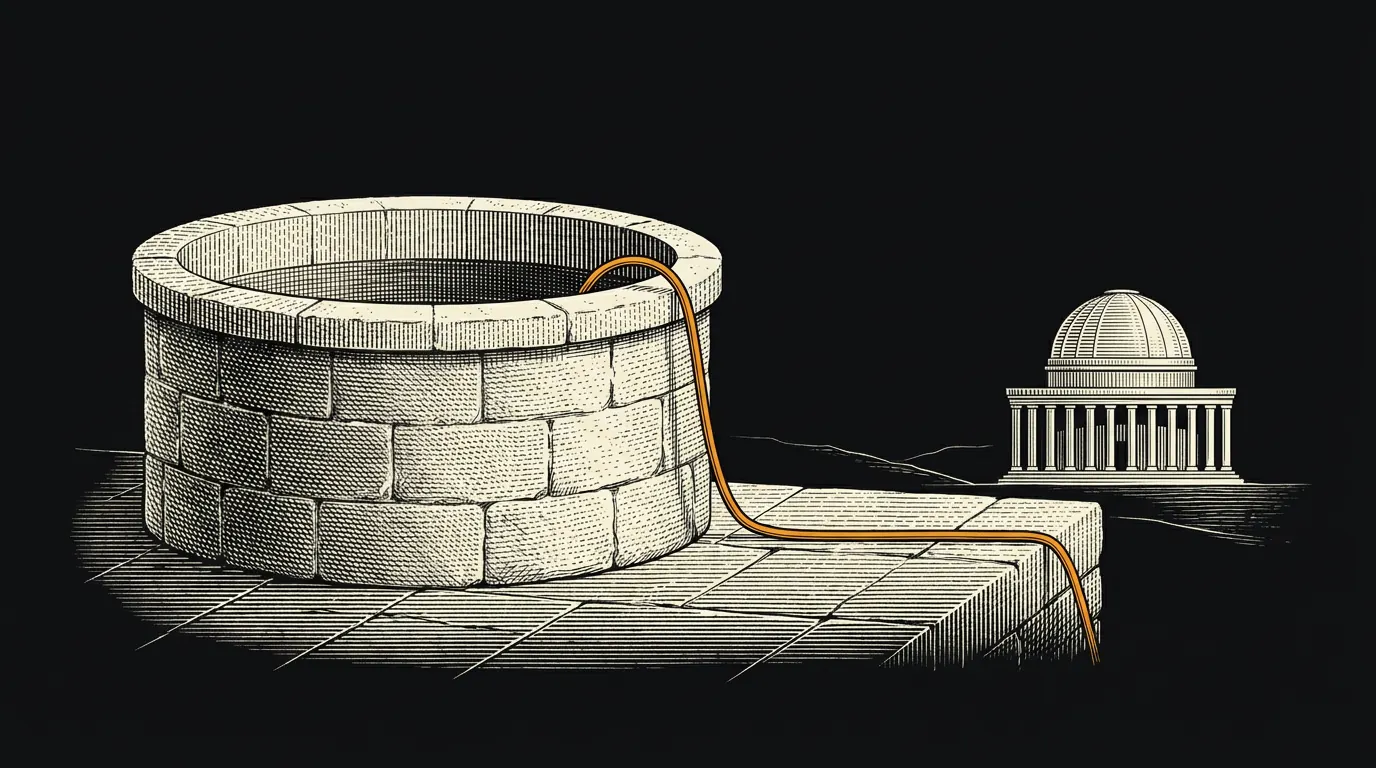
Financial repression is a set of policies that channel funds to the government at below-market rates. It works by ensuring that the return on safe savings instruments (Treasury bonds, bank deposits, pensions) stays below the rate of inflation. The saver earns a nominal return. After inflation, the real return is negative. The difference is a transfer from the saver to the government, because the government's debt is being repaid in money that buys less than when it was borrowed.
This is not a side effect. It is the mechanism. Reinhart and Sbrancia document it across dozens of countries and decades of data.
The data: 1945–1980
US real interest rates were -8% to -9% during 1945–1947. Across the full 1945–1980 period, US real rates never reached 3% in any year. They were below 1% in 63.9% of years and below 2% in 88.9% of years[1].
Realized (ex-post) and pre-tax: each month's T-bill rate minus CPI-U inflation over the prior 12 months. On annual averages the series shows -8.1% in 1946 and -13.8% in 1947; the -8% to -9% figure for 1945–1947 above uses Reinhart and Sbrancia's method[1]. In 2020–2022, 35 of 36 months were negative, and the real yield turned positive in May 2023. The break at October 2025 is the CPI month BLS never published.
The UK was similar: below 3% in 97.2% of years. Australia: below 3% in 92.3% of years. Argentina was the extreme case: negative real rates in 97% of years during 1944–1974, reaching -53.3% in 1959.
This was not accidental. It was the explicit policy response to WWII debt levels. The alternative was default or austerity. Governments chose the invisible option: silent wealth transfer from savers to the Treasury, compounded annually over decades.
The toolkit
Reinhart and Sbrancia identify the specific instruments governments used:
- Interest-rate ceilings. Regulation Q in the US (1933–2011) capped the rate banks could pay on deposits. If inflation was 5% and Reg Q capped deposit rates at 2.5%, savers lost 2.5% per year in real terms with nowhere else to put their money.
- Capital controls. The UK's Exchange Control Act (1947–1979) prevented British citizens from moving money abroad. If you couldn't move capital to a higher-yielding jurisdiction, you were captive to domestic negative-real-rate instruments.
- Directed lending and reserve mandates. Pension funds, insurance companies, and banks were required to hold government bonds as a percentage of assets. This created a captive domestic audience for below-market government debt.
- Gold prohibition. Americans were forbidden to own gold from 1933 to 1974, 41 years. If you couldn't hold gold, you couldn't opt out of the dollar's debasement. The prohibition removed the exit.
Reinhart and Sbrancia describe the financial-repression era as characterized by "a tighter connection between government and banks." The regulatory apparatus was designed to ensure that savings flowed to government bonds at below-market rates. This is not a conspiracy. It is institutional design, documented in legislation and central-bank archives, reviewed by peer economists, and published by the NBER.
The same conditions are back
The parallels between the post-WWII debt situation and today are precise:
The question is whether the resolution follows the same playbook. The options for reducing a debt-to-GDP ratio above 100% are the same as they were in 1946: (1) grow out of it (requires sustained real GDP growth above the real interest ratereal interest rateThe nominal interest rate minus inflation. A 5% savings account at 3% inflation earns 2% real. The only rate that matters for whether your purchasing power grows. Cash with negative real rates loses ground every year, no matter what the statement says.), (2) austerity (politically untenable), (3) default (destroys the Treasury market), or (4) financial repression (silent, gradual, and historically the preferred option).
Option 4 is already running. Real interest rates were negative for most of 2020–2022. The Fed's rate hikes pushed real rates positive by May 2023, but interest expense on the debt immediately crossed $1 trillion per year, creating fiscal pressure to cut rates again. The ratchet tightens. See Fiscal Dominance for the full mechanics.
The exit: assets they cannot repress
Financial repression works by eliminating alternatives. If you cannot hold gold (1933–1974), cannot move capital abroad (UK 1947–1979), and must hold government bonds in your pension, you have no exit. The repression is effective precisely because it is comprehensive.
Bitcoin is the first asset that is simultaneously: scarce by code (21 million hard cap), self-custodied (no intermediary can freeze or redirect it), portable across borders (12 words in your head), and censorship-resistant (no single jurisdiction controls the network). Every prior opt-out from financial repression, gold, foreign currency, foreign bank accounts, required a physical action that could be regulated, taxed, or prohibited. Bitcoin requires only information.
This is why the CBDCCentral Bank Digital Currency (CBDC)A digital version of a country's regular money, created and tracked by the central bank itself rather than commercial banks. conversation matters. A central bank digital currency with programmable spending limits and no cash alternative would close the last remaining exit from financial repression. See Bitcoin vs CBDCs for the surveillance architecture.
Where to go from here
Sources
Bracketed numbers in the text link to these sources. Figures, rates and rules change: check each source’s date before acting on it.
- Reinhart, Carmen M. and M. Belen Sbrancia. "The Liquidation of Government Debt." NBER Working Paper 16893, March 2011. Tables 4, 5, and 6 contain the real-interest-rate data, threshold analysis, and revenue-equivalent calculations cited above · nber.org/papers/w16893. ↩
- Congressional Budget Office. "The Budget and Economic Outlook: 2025 to 2035." January 2025. Debt-to-GDP projections, net interest as share of revenue · cbo.gov.
- American Presidency Project (UCSB). Executive Order 6102, April 5, 1933 (gold confiscation) · presidency.ucsb.edu. Gold ownership restored for US citizens January 1, 1975.
- Bank of England. Exchange Control Act 1947 · controls abolished October 1979 under Thatcher. UK National Archives · nationalarchives.gov.uk.
Last updated . Not financial advice. Do your own research. Disclosures · How pages are reviewed