Wealth vs Riches:
the key difference.
Rich is what you see: the car, the house, the lifestyle. Wealth is what you don't see: the unspent income, the invested assets, the options you haven't used. Most people confuse the two, and the confusion keeps them broke.
This page covers personal finance fundamentals that apply regardless of your view on Bitcoin or fiat currencyfiat currencyMoney declared legal tender by a government, not backed by a physical commodity. Its value rests on trust in the issuing government.Full definition.
Wealth is accumulated income you haven't spent. Rich is high current income with visible spending. The doctor driving a leased BMW and living in a $1.2M house with a $900K mortgage is rich. The teacher who saved 25% of her $55K salary for 30 years and has $1.4M in index funds is wealthy. Rich can disappear with one job loss. Wealth persists because it's stored in assets, not lifestyle. Your saving rate, not your income, determines whether you become wealthy. High earners who spend everything they make are one paycheck from broke, same as someone earning minimum wage.
The distinction that changes everything
Rich = high income. Wealthy = high net worthnet worthEverything you own (assets) minus everything you owe (debts). The most comprehensive measure of financial health.Full definition from accumulated, unspent income.
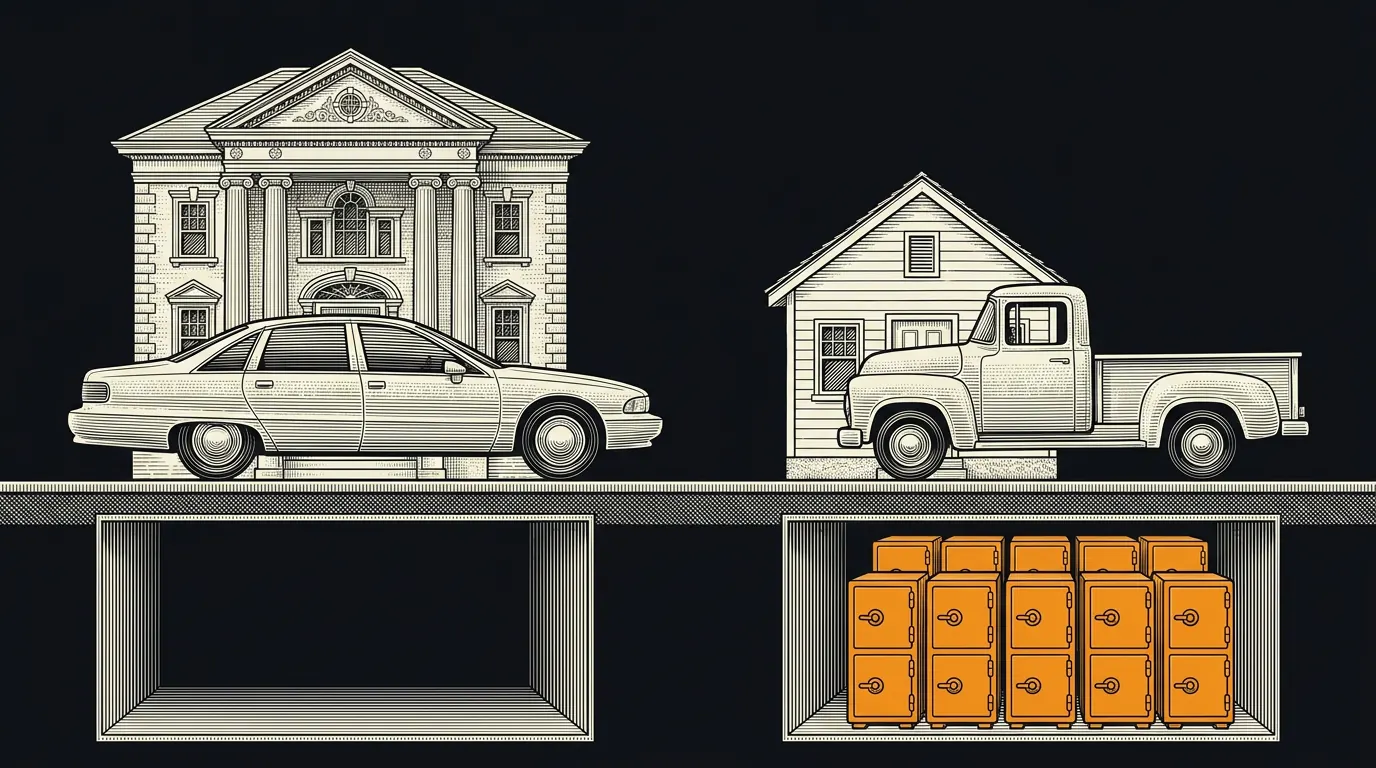
The confusion happens because spending is visible and saving is invisible. You see your neighbor's new car. You don't see their 401(k) balance. You assume the car means they're doing well. It means they spent money. Whether they have any left is a separate question.
| Rich | Wealthy |
|---|---|
| High income | High net worth (assets minus liabilities) |
| Visible: lifestyle, spending, status goods | Invisible: invested assets, unspent income |
| Depends on continued income | Persists without income |
| Measured monthly | Measured in decades |
| Fragile: one job loss ends it | Resilient: assets generate their own income |
The saving rate is the wealth metric
Income doesn't predict wealth. Saving rate does. Two households earning $100K: one saves 5%, one saves 20%. After 25 years at 7% real return, the 5% saver has $326K. The 20% saver has $1.3M. Same income, same market, 4x difference in outcome.
Saving Rate vs Wealth: $100K Income, 25 Years
Assumes $100K gross incomegross incomeYour total income before any taxes or deductions are subtracted., 7% real return, 25-year horizon. No salary growth assumed.
The saving rate has a ceiling effect on spending but no ceiling on wealth. Each percentage point of saving rate, sustained over decades, adds more to net worth than the equivalent raise. A 5% raise that gets spent adds nothing. A 5% saving rate increase that compounds adds hundreds of thousands.
Stealth wealth: the millionaire next door pattern
Thomas Stanley's research found that the typical US millionaire does not look like a millionaire. The median millionaire in his sample:
- Lives in a house worth less than 3x their annual income
- Drives a used car (most common: Ford F-150, followed by Toyota Camry)
- Buys suits for under $400
- Has never spent more than $235 on a watch
- Saves 15-20% of income
- Invests in index funds and employer retirement plans
The pattern: wealth accumulates when income exceeds lifestyle, and the gap gets invested. The people who look rich, with the luxury car and the big house, are often high-income low-net-worth. Stanley called them "Income Statement Affluent" vs "Balance Sheet Affluent."
The stealth wealth approach has practical benefits beyond accumulation. Lower visible spending reduces social pressure to spend more. Friends who don't know you have money don't ask for loans. Family members who don't see wealth don't develop expectations. Keeping wealth invisible protects it.
Why high earners go broke
The mechanism: lifestyle inflationinflationA general increase in prices over time, meaning each dollar buys less than it did before.Full definition. Income rises, spending rises to match, saving rate stays flat. A $200K earner with a $200K lifestyle has the same saving rate as a $50K earner with a $50K lifestyle. Both save zero. The $200K earner has more expensive problems when income stops.
The trap: each lifestyle upgrade is a permanent increase in the break-even cost of living. The bigger house has higher property taxes, insurance, and maintenance forever. The luxury car has higher insurance, repairs, and depreciation. The private school tuition compounds for 13 years per child. These are not one-time expenses. They are ongoing commitments that raise the floor.
The fix: when income rises, hold lifestyle flat for 6-12 months. Direct the entire raise to savings or investments. After a year, decide whether the lifestyle upgrade is worth the wealth tradeoff. Most upgrades look less appealing after you've watched the money compound for 12 months.
See Spending Less for the specific tactics, and Savings Rate for the math.
Net worth vs lifestyle cost
The number that matters is not your net worth. It's your net worth divided by your annual lifestyle cost. That ratio tells you how many years of freedom you've accumulated.
| Net worth | Annual lifestyle | Years of freedom | Status |
|---|---|---|---|
| $200K | $80K | 2.5 | Emergency cushion |
| $500K | $60K | 8.3 | Coast FIFinancial Independence (FI)The point where your investments generate enough income to cover your living expenses permanently.Full definition possible |
| $1M | $40K | 25 | Financially independent |
| $1M | $100K | 10 | Comfortable, not free |
| $3M | $120K | 25 | Financially independent |
Same net worth, different lifestyle cost, different outcome. The millionaire with a $40K lifestyle is free. The millionaire with a $100K lifestyle has a decade. This is why cutting lifestyle cost is the highest-leverage move: it simultaneously increases the numerator (more money to invest) and decreases the denominator (less money needed to be free).
See Net Worth Milestones and FIRE for the full framework.
The paradox of spending
Wealth is destroyed by the spending that creates the appearance of wealth. Every dollar spent on visible status is a dollar that can't compound. The BMW in the driveway cost $70K. In 30 years at 7%, that $70K would have been $534K. The driveway displays $70K. The portfolio would have held half a million.
This doesn't mean spend nothing. It means understand the tradeoff. Each lifestyle expense has two costs: the sticker price and the foregone compound growth. A $30K car today costs $30K plus $198K in 30-year foregone returns. A $5K vacation costs $5K plus $33K.
The people who build wealth over decades don't skip every expense. They skip the expenses that don't add lasting value and redirect the money to assets that compound. They drive reliable used cars, live in modest houses, and invest the difference. The pattern is boring. The outcomes are not.