Is your money safe in the bank?
Insured to $250k, but read the fine print.
Federal deposit insurance is fully backed and has never failed to pay an insured depositor since 1933. The $250,000 limit has specific rules: it protects deposits, not investments, and covers nominal dollars rather than purchasing power.
Yes, up to $250,000 per depositor, per insured bank, per ownership category, backed by the US government. Above that, or in the wrong account type, you are exposed. Insurance covers nominal dollars, not purchasing powerpurchasing powerWhat a dollar can buy, not what the dollar number says. A 1971 dollar bought a gallon of gas. Today's dollar buys roughly a third of one. Same dollar, much less buying ability.Full definition: a fully insured balance still lost roughly 20% of its value to inflationinflationA general increase in prices over time, meaning each dollar buys less than it did before.Full definition from 2020 to 2025.
- The FDICFederal Deposit Insurance Corporation (FDIC)The US agency that insures bank deposits up to $250,000 per depositor if a bank fails. limit is $250,000 per depositor, per bank, per ownership category as of 2026, a couple can insure $500,000 jointly plus $250,000 each in single accounts at one bank.
- Investments are not covered: stocks, bonds, mutual funds, annuities, and crypto held through a bank carry $0 FDIC coverage, no matter where you bought them.
- Credit unions get the same $250,000 protection through the NCUA's Share Insurance Fund, not the FDIC: identical limit, different agency.
- In the 2023 SVB failure, roughly 88% of deposits were above the $250,000 limit; regulators covered them anyway, but that was a discretionary backstop, not a rule you can count on.
- Insurance protects your dollar count, not its value: $100,000 insured in 2020 bought about what $80,000 bought by 2025 after ~24% cumulative inflation.
This page covers deposit-insurance mechanics that apply regardless of your view on Bitcoin or fiat currencyfiat currencyMoney declared legal tender by a government, not backed by a physical commodity. Its value rests on trust in the issuing government.Full definition. The purchasing-power section connects to the broader debasement thesis.
Money in a checking or savings account at an FDIC-insured bank (or an NCUA-insured credit union) is safe up to $250,000, and you can stack far past that using ownership categories and multiple banks. What insurance does not cover is anything you invested, anything above your limit, and the slow erosion of what each dollar buys. The bank can hold your dollars perfectly and still hand you back less value than you put in.
How much of my money is insured?
The standard FDIC insurance amount is $250,000 per depositor, per insured bank, for each account ownership category, as of 2026 verify×DON'T TRUST, VERIFYClaim: FDIC insurance covers $250,000 per depositor, per insured bank, per ownership category, backed by the full faith and credit of the US government.Verify at: FDIC: Deposit Insurance ↗The FDIC's deposit-insurance hub states the $250,000 standard limit and the per-depositor, per-bank, per-category structure.. Three words are the whole game: depositor, bank, category. Each one is a separate lever for stacking coverage.
The common mistake is thinking $250,000 is a per-person or per-account cap. It is neither. Because coverage multiplies across ownership categories, one person at one bank can insure far more than $250,000 without opening an account anywhere else. The main categories are single accounts, joint accounts, certain retirement accounts, and revocable trust (payable-on-death) accounts, each insured separately.
| OWNERSHIP CATEGORY (ONE BANK) | WHO / HOW | INSURED AMOUNT |
|---|---|---|
| Single accounts | One person, accounts in their name alone (all single accounts at the bank are combined). | $250,000 per owner |
| Joint accounts | Two or more co-owners with equal rights; each owner insured up to $250,000 on their share. | $250,000 per co-owner ($500,000 for a couple) |
| Certain retirement accounts | IRAsIndividual Retirement Account (IRA)A retirement account with tax advantages and eligibility rules. Traditional IRA contributions may be deductible; taxable withdrawals generally enter income. Roth contributions use after-tax money, and qualified Roth withdrawals are tax-free.Full definition and similar self-directed retirement deposits (the bank-deposit portion only). | $250,000 per owner |
| Revocable trust / PODPayable on Death (POD)A name you write on a bank account that says: when I die, this person gets the money directly. The account skips the slow court process for sorting out a dead person's assets.Full definition | Payable-on-death accounts, insured up to $250,000 per eligible beneficiarybeneficiaryThe person or entity you name to receive an account or insurance policy when you die. (rules simplified in 2024). | $250,000 per beneficiary (cap applies) |
Worked example, all at one bank: a married couple can hold $250,000 each in single accounts ($500,000), plus $500,000 in a joint account ($250,000 per co-owner), for $1,000,000 of coverage before touching retirement or POD categories. Don't eyeball this. The FDIC's free EDIE the Estimator calculates your exact coverage by category verify×DON'T TRUST, VERIFYClaim: The FDIC provides a free online tool, EDIE the Estimator, that calculates deposit-insurance coverage across ownership categories.Verify at: FDIC: EDIE the Estimator ↗EDIE is the FDIC's official calculator; enter your accounts and it reports insured vs. uninsured amounts per category..
Category rules and the revocable-trust simplification are current as of 2026. The $250,000 base limit has been in place since 2008 and was made permanent in 2010; verify with EDIE before relying on a specific structure.
What is NOT covered by FDIC insurance?
This is where people lose money they assumed was safe. FDIC insurance covers deposit products only: checking, savings, money market deposit accounts, and CDs. It covers $0 of anything you invested, even if you bought it at the same bank branch through the same app verify×DON'T TRUST, VERIFYClaim: FDIC insurance covers deposit products only; stocks, bonds, mutual funds, annuities, and crypto are not covered even when purchased through an insured bank.Verify at: FDIC: Deposit Insurance (what's covered) ↗The FDIC's deposit-insurance page lists covered deposit products and explicitly excludes investment products, even those sold at insured banks.. The uninsured list:
- Investments: stocks, bonds, mutual funds, ETFsExchange-Traded Fund (ETF)A basket of investments (stocks, bonds, or Bitcoin) that trades on a stock exchange like a single share., and annuities carry $0 FDIC coverage. Brokerage assets are instead protected by SIPCSecurities Investor Protection Corporation (SIPC)A nonprofit that pays back customers up to $500,000 if a stock brokerage firm goes bankrupt and loses their shares. It protects against the firm failing, not against your investments dropping in value. (up to $500,000, including a $250,000 cash sublimit), which covers a broker failing, not your investments losing value.
- Crypto: Bitcoin and other crypto get $0 FDIC coverage. A bank or app calling itself "FDIC-insured" insures your cash deposit, never the crypto. Several 2022–2023 failures made this painfully concrete.
- Uninsured fintechs: many neobanks are apps, not banks; they hold your money at a partner bank. If the fintech's ledger breaks (as in the 2024 Synapse collapse, which froze funds for an estimated 100,000+ customers), "pass-through" FDIC coverage can be slow or contested. Coverage runs to the actual insured bank, not the app.
- Contents of a safe deposit box: cash or valuables in a bank vault box are not FDIC-insured.
Rule of thumb: if the product can lose value on its own (a stock, a coin, a bond fund), the FDIC does not touch it. Insurance protects against the bank failing, never against your choices failing. For where crypto and "digital dollars" sit in this picture, see stablecoins.
Are credit unions as safe as banks?
Yes, with the same $250,000 protection. It comes from a different agency. Federally insured credit unions are covered by the National Credit Union Share Insurance Fund (NCUSIF), administered by the NCUA, which insures share accounts up to $250,000 per member, per credit union, per ownership category, also backed by the full faith and credit of the US government verify×DON'T TRUST, VERIFYClaim: The NCUA insures credit-union share accounts up to $250,000 per member, per credit union, per ownership category, mirroring FDIC coverage and backed by the full faith and credit of the US government.Verify at: NCUA: Share Insurance Estimator details ↗The NCUA's share-insurance page confirms the $250,000 per-member, per-category structure and the federal backing, parallel to the FDIC..
Two things to check. First, confirm the institution is federally insured. A handful of state-chartered credit unions carry private insurance instead, which is not government-backed. Look for the NCUA sign, exactly as you'd look for the FDIC sign at a bank. Second, the NCUA runs its own coverage calculator, the Share Insurance Estimator, mirroring the FDIC's EDIE.
For a bank, search the FDIC's BankFind. For a credit union, search the NCUA's Research a Credit Union tool. If the institution isn't listed as federally insured, treat any deposit above what you can afford to lose as uninsured until proven otherwise. The "FDIC" or "NCUA" logo on a website is a claim, not proof. The government databases are proof.
Didn't Silicon Valley Bank fail in 2023, so is this real?
It's real, and SVB is the case study for both the strength and the limit of the system. Silicon Valley Bank collapsed in March 2023 after a classic bank runbank runWhen many depositors try to withdraw at once, overwhelming a bank that has lent out most deposits. Self-fulfilling: rational response when you expect others to run is to run first. FDIC insurance prevents this by removing the incentive to panic.: it had parked deposits in long-dated Treasuries and mortgage bonds that lost market value when rates rose, word spreadspreadThe difference between the market price of Bitcoin and what an exchange charges you, a hidden cost on top of stated transaction fees.Full definition among a tightly networked depositor base, and customers tried to pull roughly $42 billion in a single day. No bank keeps that on hand. That's the run mechanic, and it can break even a solvent-on-paper bank in hours.
The wrinkle: SVB's clientele was startups and venture funds carrying operating balances in the millions, so an estimated ~88% of its deposits sat above the $250,000 insurance limit (the Federal Reserve's post-mortem put uninsured deposits near 94%). Under the ordinary rules, those depositors were in line to take losses. Instead, regulators invoked a systemic risk exception and made all depositors whole, insured and uninsured alike.
The SVB backstop was a discretionary emergency action, not a promise. It required a special invocation and applied to specific banks the government judged systemically important. Planning around "they'll cover uninsured deposits anyway" is planning around a political decision, not a legal guarantee. The number you can rely on is still $250,000 per category. Structure your cash as if the exception won't come, because for most banks, it won't.
The right lesson isn't "banks are unsafe." Every insured depositor in every failed US bank since 1933 has been made whole, and insured deposits at SVB were available within a business day. Stay inside your coverage limits, and don't let a rare backstop become your plan.
Safe from what: the bank, or inflation?
The honest part deposit insurance never advertises: it guarantees your nominal dollar count, not what those dollars buy. The FDIC promises that $100,000 comes back as $100,000. It makes no promise about whether $100,000 still buys a car, a year of college, or the same grocery cart it did when you deposited it.
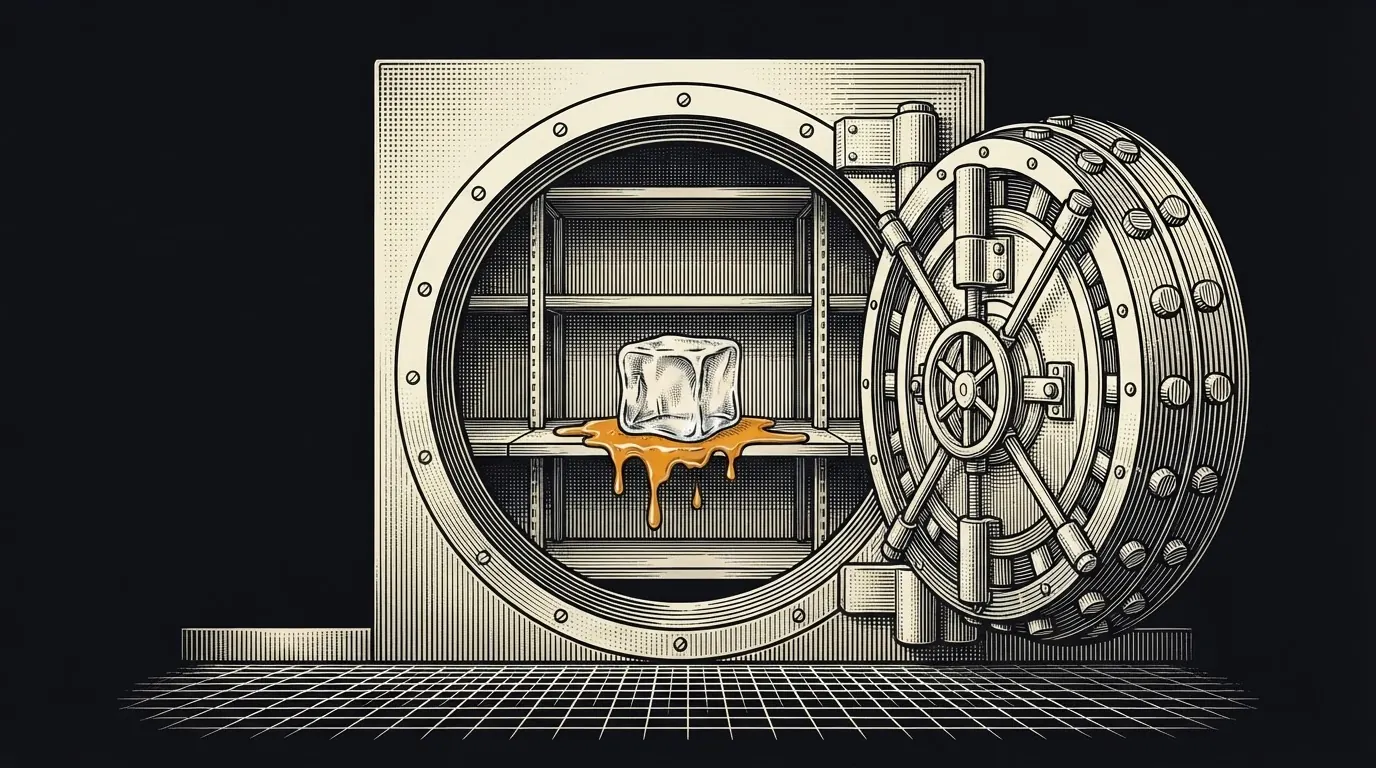
US consumer prices rose roughly 24% cumulatively from 2020 to 2025. A perfectly, fully FDIC-insured $100,000 left in a low-yield account over that stretch still lost about $20,000 of purchasing power, while the balance on the statement never dropped a cent. Insurance paid out in full. You still got poorer.
This is the quiet risk of a large idle cash balance, and it's structural, not a fluke of one bad stretch. A currency that expands its supply over time trends toward losing value; the deposit-insurance sticker on the door does nothing to stop it. That gap between "your dollars are safe" and "your money holds value" is the entire premise of the problem this site exists to explain.
The practical takeaway isn't "leave the bank." Insured deposits are the correct home for an emergency fund and near-term cash. That safety is exactly what you want for money you might need next month. It's for money you won't need for years that "insured but eroding" becomes the wrong default.
When should I spread cash across banks or move it out?
Match the tool to the job. The decision hinges on two questions: is your balance above $250,000 in one category, and is the money working or idling?
- Under $250,000, money you may need soon: one insured bank or credit union is fine. Don't overthink it. Confirm it's federally insured and move on.
- Over $250,000 in cash: spread across ownership categories and/or multiple insured banks so no single category exceeds the limit, or use a network service (e.g., IntraFi/ICS) that splits one deposit across many banks to keep it fully insured. Run it through EDIE first.
- Idle cash losing to inflation: at minimum, move it to a high-yield savings account, still FDIC-insured, but paying a real yield instead of near-0%. As of 2026 the gap between a big-bank savings ratesavings rateThe share of income saved or invested. State whether the denominator is gross or take-home income and how payroll contributions are counted; comparisons require a consistent definition.Full definition and a competitive HYSA is often several full percentage points.
- Cash you want government-backed and yielding: short-term US Treasuries (T-bills) are backed by the same US government, have no $250,000 cap because they're direct obligations, and interest is exempt from state and local income tax. See cash management for the T-bill / money-market ladder.
Zoom out and it's a two-layer answer. Layer one, "is my nominal money safe from the bank going under?": yes, if you stay inside insurance limits and verify the institution. Layer two, "is my money safe from losing value?": that one the FDIC can't help with, and it's the layer this site is about. Start with banking basics if you're building the whole stack from scratch.
No bank, credit union, fintech, or anyone else pays this site. See /how-this-site-makes-money/.
Related
- FDIC: Deposit Insurance · fdic.gov
- FDIC: EDIE the Estimator · edie.fdic.gov
- NCUA: Share Insurance Estimator details · ncua.gov
Last updated 2026-09-25. Not financial advice. Insurance limits and category rules change; verify current figures with the FDIC and NCUA before relying on them.