Debit or credit card: which should you use?
Paying the full balance matters.
The two cards look identical at the register and behave nothing alike under the hood: different federal laws, different fraud math, different psychology. The right answer is not universal. It hinges entirely on whether you pay your statement in full every month.
Credit, if and only if you pay the full statement balance every month: $0 fraud liability in practice, ~2% rewards, and a credit history debit cannot build. If you have ever carried a balance, use debit or cash. At 22%+ APRAnnual Percentage Rate (APR)The yearly cost of borrowing money, shown as a percentage.Full definition, one revolved year erases a year of rewards.
- Stolen credit card: your liability is capped at $50 by federal law and $0 by network policy, and the disputed money is the bank's, not yours.
- Stolen debit card: liability is $50 only if you report within 2 business days, up to $500 within 60 days, potentially unlimited after, and it is your checking balance that is gone while the bank investigates.
- Rewards gap: roughly 2% vs roughly 0%. On $2,500/month of spending that is about $600/year.
- Debit activity is not reported to any of the three credit bureaus. It builds exactly zero credit history.
- People reliably spend more when paying by card than by cash. If credit lifts your spending more than ~2%, the rewards are a net loss.
This page covers personal finance fundamentals that apply regardless of your view on Bitcoin or fiat currencyfiat currencyMoney declared legal tender by a government, not backed by a physical commodity. Its value rests on trust in the issuing government.Full definition.
A credit card is the bank's money with a $0 fraud guarantee, ~2% cash back, and a credit-score engine attached. A debit card is your money with weaker legal protection, no rewards, and no credit-building. Credit wins on every measurable dimension for people who pay in full monthly. Debit wins for everyone else, because a 22%+ APR is bigger than every reward, protection, and perk combined.
Credit vs debit, side by side
| DIMENSION | CREDIT CARD | DEBIT CARD |
|---|---|---|
| Fraud law | Fair Credit Billing Act. Liability capped at $50; all major networks contractually take it to $0 (FTC). | Electronic Fund Transfer Act / Reg E. $50 if reported within 2 business days, up to $500 within 60 days, potentially unlimited after 60 days (CFPB). |
| Whose money is at risk during a dispute | The bank's. You do not have to pay the disputed charge while it is investigated. | Yours. Your checking balance is drained, and the bank can take up to 10 business days to issue provisional credit. |
| Rewards | 1.5–2% cash back is standard on no-annual-fee cards as of mid-2026 (e.g. the Fidelity Visa). | Roughly 0%. Debit rewards mostly disappeared after Regulation II capped large-bank debit interchange in 2011 (Federal Reserve). |
| Credit-score impact | Builds payment history (35% of FICO) and utilization data (30%) (myFICO). See how the score is calculated. | None. Debit activity is not reported to any of the 3 bureaus. |
| Rental cars & hotel holds | Hold of $200–$500+ sits on the credit line. Your cash is untouched. | The same hold freezes real money in your checking account for days; some rental agencies decline debit or add a credit check. |
| Overspending risk | Higher. Research consistently finds people spend more when paying by card. Details below. | Lower. Spending stops at your actual balance. |
| Downside if used wrong | Revolving at 22%+ APR, which cancels everything in this column. | Overdraft fees and fraud exposure. See bank fees for getting those to $0. |
Card terms and hold amounts change; figures are as of mid-2026. Fraud-liability rules are federal law and stable.
What happens when each card gets stolen?
This is the single biggest practical difference, and it is written into two different federal laws.
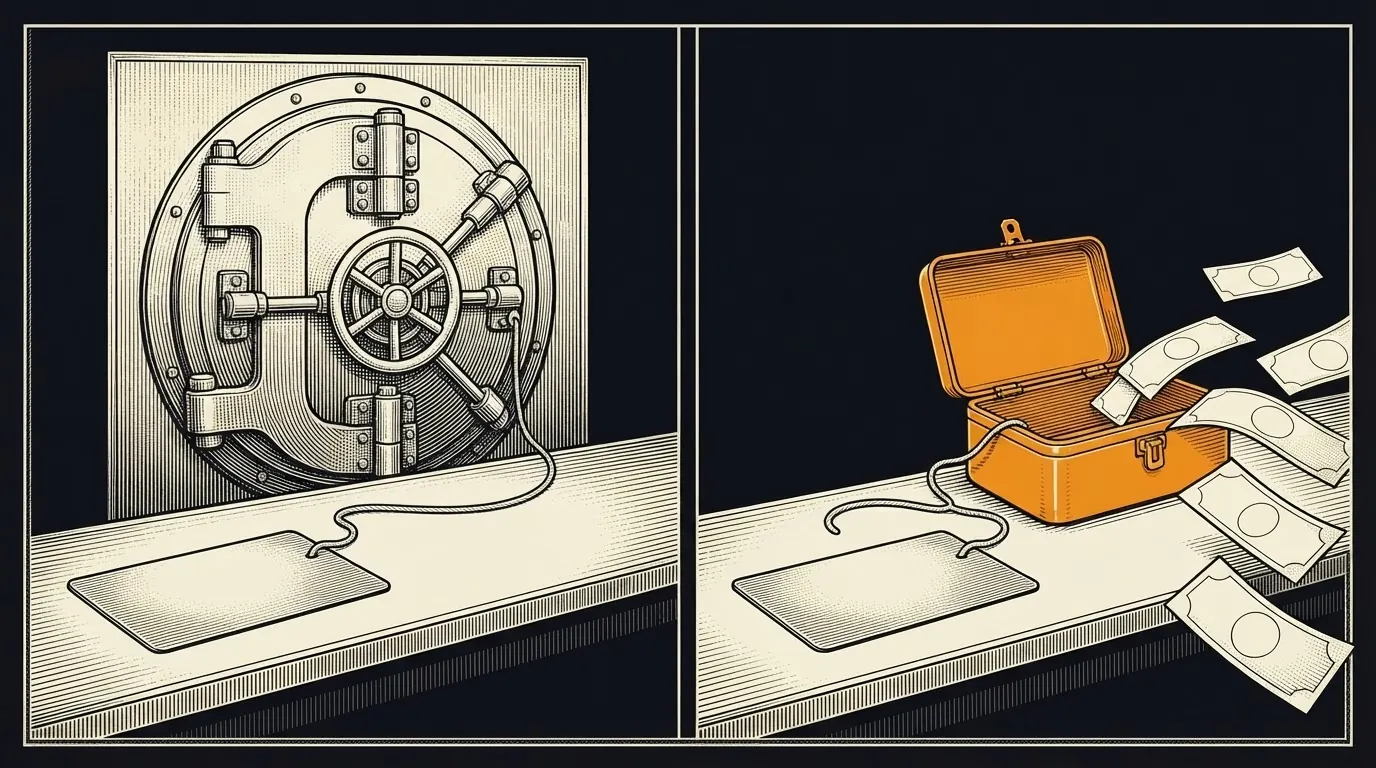
Credit card stolen: the Fair Credit Billing Act caps your liability for unauthorized charges at $50, and Visa, Mastercard, American Express, and Discover all publish zero-liability policies that take that to $0 in practice verify×DON'T TRUST, VERIFYClaim: The FCBA caps credit-card fraud liability at $50, and major card networks reduce it to $0 by policy.Verify at: FTC: Lost or Stolen Credit, ATM, and Debit Cards ↗The FTC's consumer guide states the $50 FCBA cap and the tiered debit rules side by side.. While the charge is disputed, you are not required to pay it. The missing money is the issuer's problem, not yours.
Debit card stolen: the Electronic Fund Transfer Act (Regulation E) uses a clock, not a cap. Report within 2 business days of learning about the loss and your liability is capped at $50. Report within 60 days of your statement and it rises to $500. After 60 days, your liability is potentially unlimited verify×DON'T TRUST, VERIFYClaim: Under Reg E, debit fraud liability is $50 if reported within 2 business days, up to $500 within 60 days, and potentially unlimited after 60 days, with up to 10 business days before provisional credit.Verify at: CFPB: unauthorized transactions and Reg E ↗The CFPB explains the liability tiers and the bank's investigation timeline, including provisional credit..
With debit fraud, the stolen money comes out of your checking account the moment it happens. The bank can take up to 10 business days to put provisional credit back while it investigates. If $1,200 disappears on a Friday and your rent drafts on Monday, the rent bounces even though you did nothing wrong. Credit-card fraud never touches your cash.
If you use a debit card anyway, two habits close most of the gap: turn on transaction alerts so you catch fraud inside the 2-business-day / $50 window, and do not keep your savings in the same account the card draws from.
Stop reading about rewards. The average credit card APR is roughly 24% as of mid-2026. One month of interest on a $3,000 balance is about $60, more than a typical month of 2% cash back on $2,500 of spending ($50). The comparison is over before it starts.
Switch to debit, then go to the debt payoff order and run your actual balance through the credit card payoff calculator. Come back to this page at zero.
Does using a debit card build credit?
No. Debit card activity is not reported to Equifax, Experian, or TransUnion. Ten years of flawless debit use contributes exactly 0 points to a credit score, because none of the 5 FICO factors ever sees it. FICO scores are used by roughly 90% of top US lenders verify×DON'T TRUST, VERIFYClaim: FICO scores are used by roughly 90% of top US lenders.Verify at: myFICO: what is a FICO score ↗myFICO publishes the "90% of top lenders" figure. Most free apps show a VantageScore instead, which is similar but not what most lenders pull., and the free score in most apps is a VantageScore, which is not the number most lenders pull.
If building credit is the goal and you do not want (or cannot get) a regular card, the clean path is a secured card from a major bank: a refundable deposit of $200–$500 becomes your limit, activity reports to all 3 bureaus, and the card typically graduates to unsecured after 7–12 months of on-time payments. As of mid-2026, Discover it Secured is a representative no-annual-fee example. Avoid high-fee subprime unsecured cards; the full playbook, including which issuers to avoid, is on the credit building page.
Two facts worth knowing once you do have a card: utilization is reported on the statement closing date, not the due date, so paying before the close lowers what the bureaus see, and under 10% reported utilization scores meaningfully better than under 30%. And you can pull your full reports from all three bureaus free every week at annualcreditreport.com, a pandemic-era change made permanent in 2023. Paying any other site for your own report is a waste of money.
Do you spend more with a credit card?
On average, yes, and this is the honest cost that rewards marketing never mentions. In a well-known MIT experiment (Prelec and Simester, 2001), participants bidding on the same item offered up to roughly twice as much when told they would pay by credit card instead of cash. Federal Reserve payment-diary data points the same direction: cash dominates small purchases, cards dominate larger ones, and total spending tilts upward as payment friction disappears (Federal Reserve Payments Study).
The mechanism is boring and human: handing over cash hurts a little, tapping a card does not, and "I'm earning 2%" actively rationalizes marginal purchases. This is normal psychology, not a character flaw.
2% cash back on $2,500/month = $50/month.
If paying by card lifts your spending just 5%, that is $125/month of extra spending.
Net effect of the "rewards": -$75/month. The card only wins if your spending stays flat.
The self-test is simple: compare 2–3 months of card spending against the same months on debit or cash the prior year, same categories. If the card months are more than ~2% higher, the rewards are not winning, and debit is the rational choice for the categories where you drift.
When is a debit card the right choice?
Debit is the correct tool in at least four situations:
- You have ever revolved a balance. A 22%+ APR is roughly 10x the reward rate. One habit relapse costs more than years of cash back earn. This is the whole ballgame.
- Your spending rises on credit. If the self-test above shows more than a ~2% lift, debit's hard stop at your actual balance is worth more than the rewards.
- You want a structural spending cap. A debit card declines at $0. A credit card declines at your limit, which is typically 3–10x your monthly spending.
- You cannot get, or do not want, a credit account right now. That is a legitimate position. Make it safe: transaction alerts on, savings held in a separate account, fraud reported within 2 business days to keep the $50 cap.
If you run debit as your daily driver, pair it with a checking account that charges $0 in monthly and overdraft fees; the bank fees page shows how. And for rental cars and hotels, expect a $200–$500+ hold on your real cash for several days, which is the one errand where borrowing a credit card's credit line helps.
What about prepaid cards?
Prepaid cards are debit's weaker sibling: you load money on, spend it down, and build no credit. Since the CFPB's prepaid rule took effect in 2019, registered prepaid accounts get Reg E-style fraud protections similar to debit cards (CFPB prepaid rule), but only if you register the card, and the fee structures are routinely worse: monthly fees of $0–$10, reload fees up to $5.95 at retail, and out-of-network ATM fees on top.
Legitimate uses exist: a first card for a teenager, a hard envelope for one spending category, or a stopgap without a bank account. For everything else, a second no-fee checking account with its own debit card does the same job with better protection and zero fees. There is no situation where a prepaid card beats both a debit and a credit card at their own game.
No card issuer, bank, or anyone else pays this site. See /how-this-site-makes-money/.
Related
- FTC: Lost or Stolen Credit, ATM, and Debit Cards · consumer.ftc.gov
- CFPB: unauthorized transactions and Reg E · consumerfinance.gov
- myFICO: what is a FICO score · myfico.com
- Fidelity Visa · fidelity.com
- Federal Reserve · federalreserve.gov
- myFICO · myfico.com
- Discover it Secured · discover.com
- annualcreditreport.com
- Federal Reserve Payments Study · federalreserve.gov
- CFPB prepaid rule · consumerfinance.gov
Report immediately and preserve the written record
Credit-card billing errors
Call the issuer promptly. To preserve billing-error rights, also send written notice within 60 calendar days after the charge appeared on the statement. Use the issuer’s billing-disputes address and keep a copy and delivery record. The issuer generally has 30 days to acknowledge the notice unless it has already completed the required resolution procedure. Keep undisputed payments on schedule and confirm how the disputed amount will be handled.[10]
Debit cards and electronic transfers
If a debit card or access credential is lost or stolen, report it within two business days of discovering the loss to generally limit liability to $50 or the unauthorized amount, whichever is less. Waiting longer can expose you to as much as $500. Missing the statement’s 60-day reporting window can expose you to later unauthorized transactions that timely notice would have prevented.[14]
If an unauthorized transfer appears while you still have the card and no access credential was lost or stolen, report it immediately and no later than 60 days after the statement was sent. The rules differ from the lost-card case. Do not assume an authorized scam payment, wire or check has the same protections. Tell the bank what happened and ask which process applies.[14]
Record the transaction, statement date, discovery date, report date and case number. Follow requests for written confirmation promptly: missing that follow-up can affect temporary-credit rights. Ask for the findings and evidence if the bank rejects your claim.[14]
Last updated 2026-09-25. Not financial advice. Fraud-liability rules are federal law; card terms and fees change, verify before relying on them.