Bitcoin vs real estate:
which is the better long-term investment?
Real estate offers leverage, cash flowcash flowMoney coming in minus money going out over a month or year. A positive number means you earn more than you spend; negative means the opposite.Full definition, tax treatment. Bitcoin has real advantages, higher CAGRCompound Annual Growth Rate (CAGR)The steady yearly growth rate that would take an investment from its starting value to its ending value, with gains compounding. Example: $1,000 growing to $2,000 over 10 years is a CAGR of about 7.2%. It hides the ups and downs along the way, which matters for a volatile asset like Bitcoin., zero maintenance, sovereignty. The honest answer is understanding where each one wins and building accordingly, not a blanket winner.
Viewpoint. Besides explaining the topic, this page makes the site’s case on money and Bitcoin. The facts are sourced; that case is the site’s view. How pages are labeled.
Check before acting. Rates, prices, fees and product terms change often. Confirm the current figures with the provider or the linked source before you act.
Neither wins outright. Real estate uses leverage: a 20% down payment on a $400,000 property controls the full $400,000, plus cash flow and favorable tax treatment. Bitcoin offers a higher historical CAGR, zero maintenance and full sovereignty. The right mix is both, sized to your goals.
On this page
- Real estate advantages (be honest about these)
- Bitcoin advantages (be honest about these too)
- 10-year return comparison don't trust, verify × DON'T TRUST, VERIFY Claim: All figures in the 10-year return table (S&P 500, Case-Shiller, leveraged rental, Bitcoin). Verify at: FRED + CoinGecko ↗ Source 2 in the list below Returns are end-point sensitive. Verify each figure against the underlying data source for your chosen date range.
- Primary residence: not an investment
- Rental property: legitimate but not passive
- Bitcoin: asymmetric, no management, no expertise required
- The both/and answer
Real estate returns ~8–10% long-term (leveraged) with rental cash flow. Bitcoin has returned ~150% annualized over its first 15 years with zero cash flow and extreme volatility. Real estate is leveraged, illiquid, and local. Bitcoin is unleveraged, liquid, and global. They answer different questions.
- Real estate's edge: leverage (5:1 typical via mortgage), cash flow, tax advantages (depreciation, 1031 exchange), and inflationinflationA general increase in prices over time, meaning each dollar buys less than it did before.Full definition protection via rent.
- Bitcoin's edge: absolute scarcity, global liquidityliquidityHow quickly and easily you can convert an asset to cash without significantly affecting its price.Full definition, no maintenance costs, no tenants, no property tax, no geographic risk.
- Median U.S. home price appreciation: ~3.5–4% nominal/year. Leveraged equity return is higher but comes with debt service.
- Bitcoin's 15-year CAGR (~80%) is historically unprecedented and likely to compress as the asset matures.
- They're not mutually exclusive. A reasonable allocation could include both: real estate for income, Bitcoin for asymmetric upside.
- Real estate wins on leverage, cash flow, depreciation, and tangibility
- Bitcoin wins on return CAGR, zero management, portability, and divisibility
- Primary residence is housing, not an investment (apply the 5% rule)
- The honest answer is both, sized to your situation
Real estate advantages (be honest about these)
- Leverage. A 20% down payment on a $400K property gets you $400K of exposure. The mortgage amplifies returns on the upside. A 5% price increase on $400K is 25% on your $80K down, before accounting for principal paydown.
- Cash flow. Rental properties can produce monthly income from tenants. That income can cover the mortgage, pay for maintenance, and leave a positive spreadSpreadThe gap between two prices or rates. In trading, it is the difference between the price buyers pay (ask) and the price sellers get (bid). Many Bitcoin apps and money-transfer services also build a markup into the price they quote you, a cost on top of the advertised fee even when that fee is $0.Full definition.
- Tax advantages. Depreciation shelters rental income on paper. 1031 exchanges let you defer capital gainscapital gainsThe profit from selling an asset for more than you paid for it. Taxed differently depending on how long you held the asset. indefinitely by rolling proceeds into a new property. Mortgage interest is deductible on primary residences (up to the cap).
- Tangibility. People understand a house. Spouses, parents, bankers. It's easier to get buy-in on "we bought a duplex" than "we bought 0.5 BTCBitcoin (BTC)The ticker symbol for Bitcoin, used on exchanges and in price quotes.Full definition."
- Forced savings. Paying a mortgage every month automatically builds equity. Most people are not disciplined enough to save that much voluntarily. The mortgage does the saving for you.
- Inflation hedgehedgeAn investment made to offset potential losses in another position, like buying gold to protect against currency declines.. Real assets generally track nominal prices over long periods. Rents rise with inflation.
Bitcoin advantages (be honest about these too)
- Higher historical CAGR. Bitcoin's 10-year CAGR has been 50%+ don't trust, verify×DON'T TRUST, VERIFYClaim: Bitcoin's trailing 10-year CAGR has been above 50%.Verify at: CoinGecko ↗ Source 1 in the list belowCAGR depends on the exact date range. Recalculate against current price for today's figure.. US real estate's long-term CAGR is 3–5% unleveraged, 10–15% leveraged. Different risk profiles, but the return gap is wide.
- No maintenance. Bitcoin doesn't have leaky roofs, difficult tenants, HVACHeating, Ventilation, and Air Conditioning (HVAC)The system that controls temperature and air quality in a building, also a skilled trade career path. replacements, property managers, HOAHomeowners Association (HOA)An organization in some residential communities that sets rules and charges monthly fees for shared maintenance. fees, or calls at midnight about a busted pipe.
- Globally portable. 12 words crosses any border. Real estate is the least portable asset class in the world.
- Divisible. You can buy $10 of Bitcoin. The minimum real estate transaction is typically $50K+ after closing costs.
- No leverage required. Bitcoin's returns come from the underlying asset appreciation, not a borrowed multiplier. No margin call risk.
- No counterparty. Self-custody means you don't depend on a bank, a title company, a tenant, or a government to enforce your ownership.
- Liquid 24/7. You can exit any position on any day at any hour. Real estate takes 30–90 days and tens of thousands in transaction costs.
10-year return comparison don't trust, verify×DON'T TRUST, VERIFYClaim: All figures in the 10-year return table (S&P 500, Case-Shiller, leveraged rental, Bitcoin).Verify at: FRED + CoinGecko ↗ Source 2 in the list belowReturns are end-point sensitive. Verify each figure against the underlying data source for your chosen date range.
| Investment | $10K in 2016 | Value in 2026 | CAGR |
|---|---|---|---|
| S&P 500 (VFIAX) | $10,000 | ~$37,000 | ~14% |
| US Median Home (Case-Shiller) | $10,000 | ~$18,000 | ~6% |
| Leveraged rental (20% down, good market) | $10,000 down | ~$55,000 | ~19% |
| Bitcoin | $10,000 | ~$1,800,000+ | ~68% |
Bitcoin's CAGR is from a low 2016 base and includes multiple 70%+ drawdowns. The ride was brutal. The endpoint is the endpoint. Next 10 years will not replicate this, monetization is non-linear, and each doubling is harder to come by.
Primary residence: not an investment
Your primary residence is housing. The mental model that treats it as an investment leads to bad decisions, overspending on the house, under-saving in retirement accounts, assuming you can "sell and downsize" at retirement (many can't or won't).
The 5% rule: your annual unrecoverable cost of ownership (property tax ~1% + maintenance ~1% + cost of capital ~3%) runs about 5% of the home value per year; if renting a comparable home costs less than that, you'd be better off renting and investing the difference. For a $400K home, that's $20K/year. That is the rent to beat, about $1,667 a month.
None of this means don't own a home. It means own a home because you want to live in it, not as a retirement strategy.
Rental property: legitimate but not passive
Rental real estate legitimately compounds net worthnet worthEverything you own (assets) minus everything you owe (debts). The most comprehensive measure of financial health.Full definition over time. It's also a job. Anyone who tells you otherwise is selling a course.
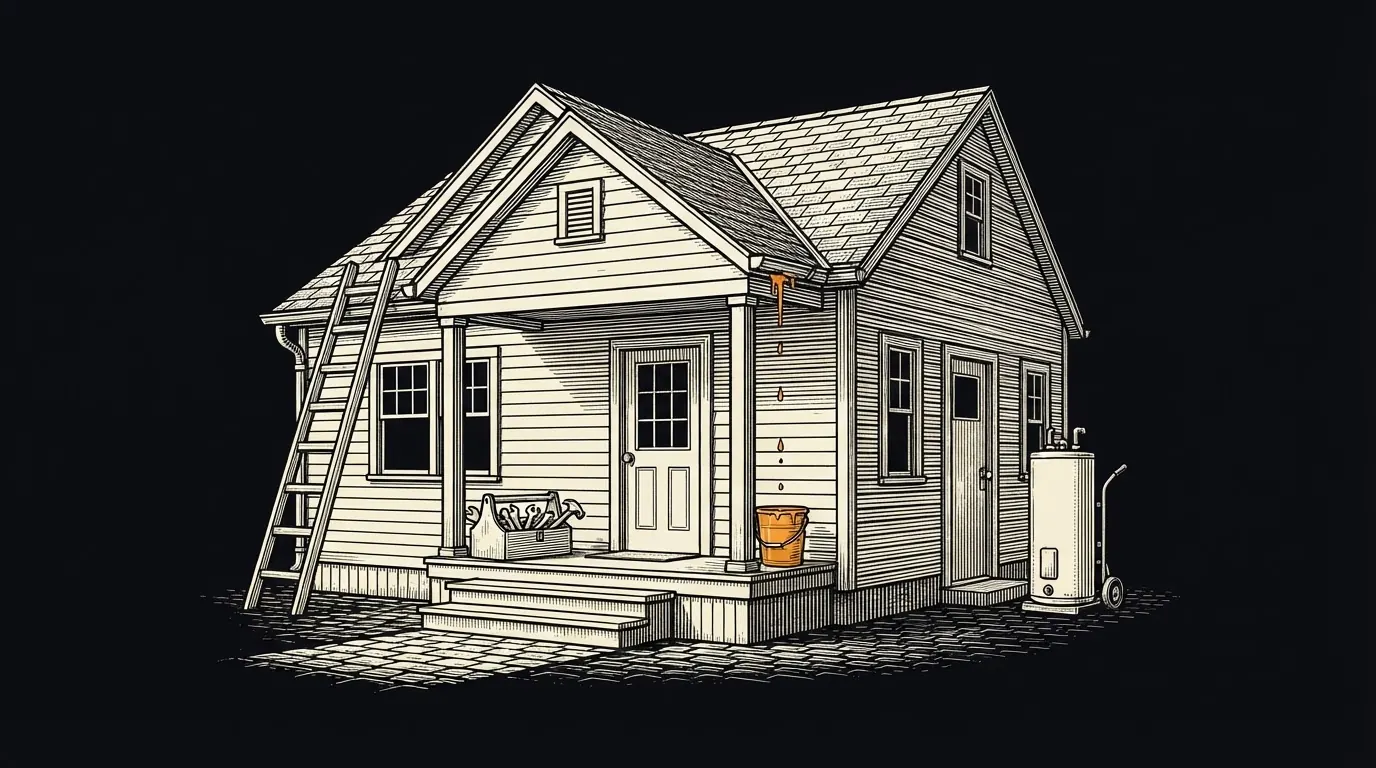
Running the numbers: after a property manager takes 8–10%, after vacancy allowance (5%), after maintenance (1–2% of property value annually), after insurance, after property taxes, and after the mortgage, a "cash flow positive" rental often nets 3–8% on the cash invested in normal markets. Leverage makes that ~15%+ on the down payment.
The upside: over 10–20 years, principal paydown + appreciation + tax shelter stacks into real net worth. Rentals have minted more millionaires than Bitcoin has, if we're being honest.
The downside: capital intensive (you need $50K+ down, typically six figures for anything decent), locally concentrated, illiquid, subject to local regulation, requires expertise or delegation.
Bitcoin: asymmetric, no management, no expertise required
Bitcoin is an asymmetric bet on continued monetization of a fixed-supply asset. You don't need a property manager, a local market expert, a CPA who specializes in real estate, or a $50K down payment.
You need: a DCADollar-cost averaging (DCA)Investing a fixed amount on a regular schedule, such as $50 every payday, regardless of price. It spreads out when money enters the market and buys more units when prices are low, but it does not guarantee a better price than investing all at once, a profit or protection against loss.Full definition setup (5 minutes), a hardware wallet (a few hundred dollars), and the ability to not sell. That's it.
The downside is volatility. The 70% drawdowns are real and they will happen again. The return profile is reward for sitting through them.
The both/and answer
This is a portfolio question, not Bitcoin vs real estate.
- Own a home if you want stable housing and can afford the all-in cost without straining your savings rateSavings rateThe share of income you save or invest, usually (income minus spending) divided by income. Saving $1,000 of $5,000 take-home pay is a 20% rate. Whether you use gross or take-home pay, and whether 401(k) contributions and an employer match count, changes the number, so compare rates only on the same definition.Full definition. Don't overspend because "real estate always goes up." Run the 5% rule.
- Hold Bitcoin as your asymmetric long-term allocation. 1–10% of net worth for most people, higher for those who understand the thesis.
- Consider rental property if you want the cash flow, are willing to do the work, and have enough capital that a single illiquid asset won't dominate your portfolio.
- Don't lever Bitcoin. Don't lever real estate beyond your ability to cover the mortgage through a downturn.
The portfolio that owns a modest home + a growing Bitcoin stack + retirement accounts compounding in the background beats the portfolio that's all-in on one thing, for most people. It also beats most of the courses selling you a shortcut.
The answer is not "which one." The answer is "how much of each, sized honestly to your situation and your appetite for managing assets." Neither replaces the other.
Where to go from here
Sources
Verify badges in the text link to these sources. Figures, rates and rules change: check each source’s date before acting on it.
- CoinGecko, CoinGecko ↩
- Federal Reserve Bank of St. Louis (FRED), FRED + CoinGecko ↩
- Case-Shiller US National Home Price Index, fred.stlouisfed.org. don't trust, verify×DON'T TRUST, VERIFYClaim: Case-Shiller US National Home Price Index current value.Verify at: FRED ↗Index updates monthly.
- S&P 500 total return data, fred.stlouisfed.org. don't trust, verify×DON'T TRUST, VERIFYClaim: S&P 500 index and total return data.Verify at: FRED ↗Daily index updates.
- Bitcoin price history, CoinGecko, coingecko.com. don't trust, verify×DON'T TRUST, VERIFYClaim: Bitcoin price history and CAGR.Verify at: CoinGecko ↗Updates continuously. CAGR is date-range sensitive.
- BiggerPockets, rental real estate cash flow analysis, biggerpockets.com
- Ben Felix, "Renting vs Buying a Home: 5% Rule", rationalreminder.ca
Last updated . Not financial advice. Past returns do not predict future returns, especially for Bitcoin. Disclosures · How pages are reviewed