Bitcoin and tariffs:
why trade wars make the case for sound money.
Tariffs are sold as protecting American workers. What they do is raise prices on imported goods, shrink consumer purchasing powerPurchasing powerWhat money can actually buy, not the number on the bill or in the account. Inflation shrinks it over time: by the BLS consumer price index, it takes more than $8 today to buy what $1 bought in 1971. Same dollar, much less buying ability.Full definition, and pressure central banks to print more currency to paper over the damage. Bitcoin's fixed supply doesn't care about trade policy. That's the entire point.
Check before acting. Rules described here reflect the law as of the update date above. Check for later changes before you act.
This page argues tariffs tax imported goods, raise prices, and pressure central banks to print more currency; the 2025 package added a baseline 10% tariff on most trading partners. The Supreme Court struck that tariff down on 2026-02-20, and since 2026-07-24 Section 301 tariffs of 10% or 12.5% apply to most imports from 60 economies. Bitcoin's fixed supply does not respond to trade policy, though that is not a guarantee its price will rise.
On this page
- What tariffs do to purchasing power
- How tariff cycles correlate with monetary debasement
- The current tariff environment don't trust, verify × DON'T TRUST, VERIFY Claim: 2026 tariff environment and effective US average tariff rate. Verify at: Tax Foundation tariff tracker ↗ Source 1 in the list below Tariff policy changes frequently. Verify current status before citing specific rates.
- Why Bitcoin is relevant
- Historical parallel: Bretton Woods + the Nixon shock
- The honest take
- Tariffs are taxes on imports paid by consumers, not by foreign countries
- Historically, tariff cycles correlate with monetary debasement, governments print to offset the drag
- Bitcoin's fixed 21M supply is immune to tariff-driven monetary policymonetary policyThe central bank's control of money supply and interest rates to influence the economy.
- No border, no tariff, no seizure, 12 words cross any frontier
What tariffs do to purchasing power
A tariff is a tax on imported goods. When a 25% tariff is placed on imported steel, the importer, a US company, pays the government 25% of the declared value at customs. That cost is then added to the final price and passed through the supply chainsupply chainThe network of suppliers, manufacturers, and distributors that produce and deliver goods. to American consumers.
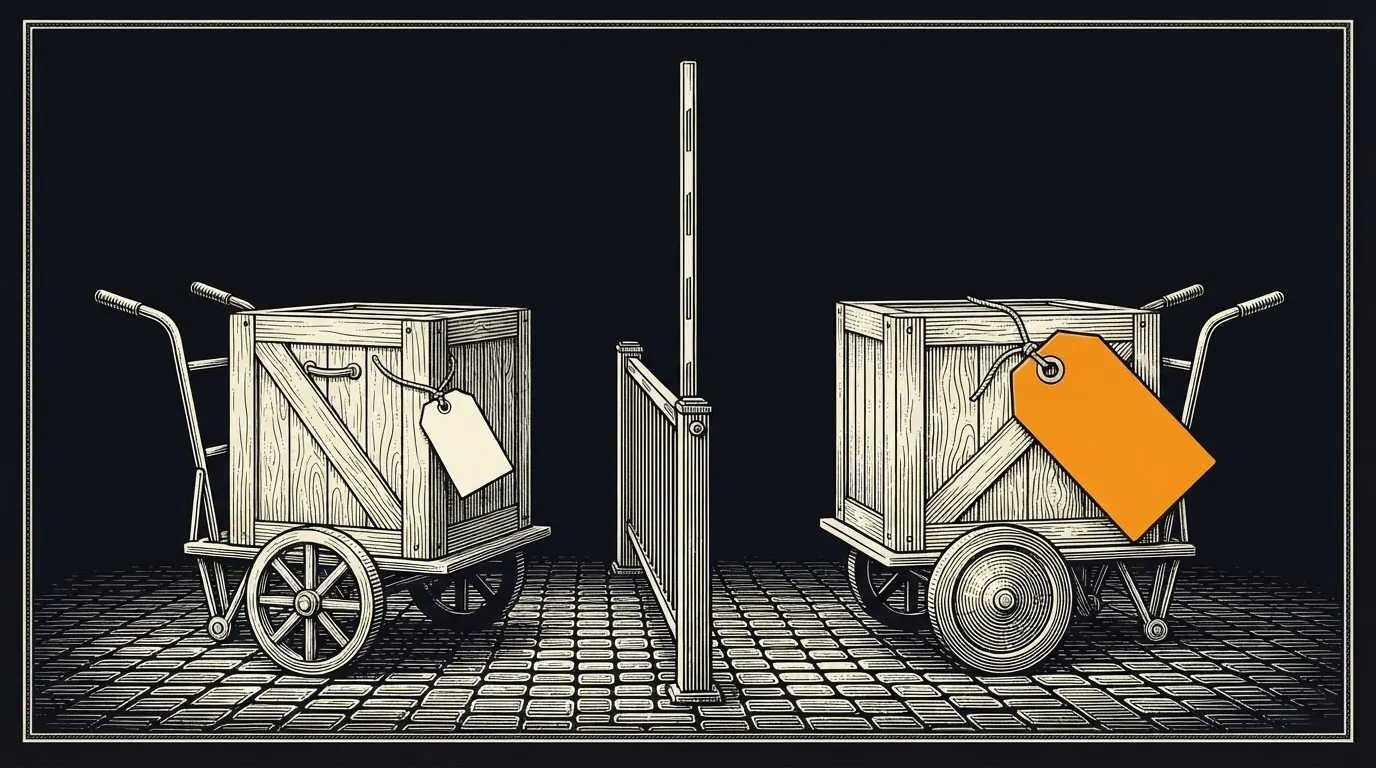
"China pays the tariff" is a political talking point. American companies pay the tariff, and American consumers pay the higher price. This is basic trade accounting, not controversial among economists. Studies from the Tax Foundation, Peterson Institute, and Federal Reserve have all reached the same conclusion for every major US tariff round from 2018 onward.
The net effect: tariffs function as a regressive consumption tax. They hit working- and middle-class households harder than high-income households because lower-income households spend a larger share of income on goods rather than services.
How tariff cycles correlate with monetary debasement
Tariffs raise prices. Higher prices slow consumer spending. Slower consumer spending pressures the economy. Politicians facing an economic slowdown ask the central bank for relief. The central bank responds by cutting rates, expanding the balance sheet, or both. Currency supply increases. Purchasing power falls further.
This pattern isn't theoretical. It's visible in:
- 1930s Smoot-Hawley: tariffs deepened the Depression; Roosevelt confiscated gold in 1933 and devalued the dollar against gold
- 1971 Nixon shockNixon ShockPresident Nixon's August 15, 1971 package that closed the gold window: foreign governments could no longer swap dollars for US gold at $35 an ounce. It also added a 10% import tax and froze wages and prices. Called temporary, the gold closure became permanent, leaving the dollar backed by trust in government, not metal.Full definition: imposed 10% import surcharge the same day he closed the gold window and ended the gold standard
- 2018–2019 Trump Round 1: Fed pivoted from QT to rate cuts within 12 months
- 2020 pandemic response: supply-chain disruption plus tariffs plus $5T of new dollars = inflationinflationA general increase in prices over time, meaning each dollar buys less than it did before.Full definition wave
The through-line: politically it's easier to print than to remove tariffs. So the printing happens.
The current tariff environment don't trust, verify×DON'T TRUST, VERIFYClaim: 2026 tariff environment and effective US average tariff rate.Verify at: Tax Foundation tariff tracker ↗ Source 1 in the list belowTariff policy changes frequently. Verify current status before citing specific rates.
The 2025 tariff package expanded Section 301 duties on China, imposed new tariffs on Mexico and Canada, and introduced a baseline universal tariff of 10% on most trading partners. The effective average US tariff rate rose to a level not seen since the 1940s.
The effects were predictable: import prices rose, supply chains relocated (at significant cost), retaliatory tariffs hit US agricultural exports, and core goods inflation ticked up about 1.5–2 percentage points above trend within the first year. don't trust, verify×DON'T TRUST, VERIFYClaim: Core goods inflation ticked up ~1.5-2 percentage points above trend in the first year of the 2025 tariff package.Verify at: BLS Consumer Price Index ↗ Source 2 in the list belowInflation print updates monthly. Tariff pass-through estimates vary by study.
On 2026-02-20 the Supreme Court held in Learning Resources, Inc. v. Trump that the International Emergency Economic Powers Act (IEEPA) does not authorize tariffs, which struck down the 10% baseline tariff and the drug-trafficking tariffs on Canada, Mexico and China. A temporary 10% surcharge under Section 122 of the Trade Act ran from 2026-02-24 to 2026-07-24, and since 2026-07-24 Section 301 tariffs of 10% or 12.5% apply to most imports from 60 economies. don't trust, verify×DON'T TRUST, VERIFYClaim: The Supreme Court held on 2026-02-20 that IEEPA does not authorize tariffs; a 10% Section 122 surcharge (2026-02-24 to 2026-07-24) and then Section 301 tariffs of 10% or 12.5% on 60 economies (from 2026-07-24) followed.Verify at: Supreme Court, Learning Resources, Inc. v. Trump, No. 24-1287 ↗ Source 3 in the list below · White House, Section 122 temporary import surcharge proclamation ↗ Source 4 in the list below · USTR, Section 301 forced labor action ↗ Source 5 in the list belowTariff policy changes frequently. Verify current status before citing specific rates.
The Fed's response has been tighter-than-expected policy short-term, but the political pressure to ease is intense. History suggests easing wins.
Why Bitcoin is relevant
Bitcoin's supply schedule is fixed by code. Not by the Fed, not by Congress, not by trade negotiations. 21 million coins, period. Every four years the issuance rate halves. By 2140 issuance stops entirely.
- Fixed supply. No government can inflate away tariff costs into a Bitcoin holder's stack. The tariffs still happen; the consumer prices still rise; but the purchasing power of the Bitcoin is preserved as long as adoption continues.
- Globally portable. Bitcoin doesn't care about customs lines. A seed phraseSeed phraseA wallet backup written as a list of words, usually 12 or 24, that can recreate the wallet's private keys. In a single-signature wallet, anyone who sees it can take the bitcoin unless a separate passphrase also protects it. Keep it offline and private; recovery may also need the passphrase and wallet setup details.Full definition crosses any border. If tariffs escalate into capital controls, Bitcoin is the only asset that doesn't need a passport.
- No border, no tariff, no seizure. Bitcoin is not a good. It's not imported. It's not subject to trade policy. It exists on every node, simultaneously, forever.
- Neutral monetary base. Every government participating in the network (and every one opposing it) agrees on the same ledger.
Historical parallel: Bretton Woods + the Nixon shock
The Bretton Woods system pegged the dollar to gold and every other major currency to the dollar. It worked from 1944 to 1971. It broke because the US ran persistent balance-of-payments deficits, foreigners holding dollars demanded gold, and the US didn't have enough gold to honor the claims.
Nixon's August 15, 1971 address did two things at once: closed the gold window (ending Bretton Woods) and imposed a 10% import surcharge (a tariff). The imbalance was addressed not by repaying the gold, but by redefining what the money was.
Since 1971 the dollar has lost about 87% of its purchasing power against a basket of goods. More at Purchasing Power: The Dollar's Slow Erosion. This is the playbook: trade imbalance → tariff → devaluation.
The honest take
Tariffs are short-term political tools. They feel strong. They poll well. They signal toughness on trade partners. And sometimes, in narrow strategic cases, they have legitimate national-security justification.
But their long-term monetary consequences are the same every time: higher consumer prices, pressure on the central bank to ease, currency debasement as the release valve. The worker the tariff was supposed to protect ends up paying it twice, once at the checkout counter, again through the weaker dollar.
Bitcoin doesn't care. You can't tariff a network. You can't devalue a fixed supply.
The best hedgehedgeAn investment made to offset potential losses in another position, like buying gold to protect against currency declines. against bad trade policy is an asset whose rules are outside any single government's reach, not a different government.
Where to go from here
Sources
Verify badges in the text link to these sources. Figures, rates and rules change: check each source’s date before acting on it.
- Tax Foundation, tariff incidence analysis, taxfoundation.org ↩
- BLS Consumer Price Index data series, bls.gov/cpi. don't trust, verify×DON'T TRUST, VERIFYClaim: Current CPI print.Verify at: Bureau of Labor Statistics ↗CPI updates monthly, usually mid-month. ↩
- Supreme Court of the United States, Learning Resources, Inc. v. Trump, No. 24-1287 (decided February 20, 2026), supremecourt.gov ↩
- The White House, Imposing a Temporary Import Surcharge to Address Fundamental International Payments Problems (proclamation, February 20, 2026), whitehouse.gov ↩
- Office of the U.S. Trade Representative, USTR Takes Action in Forced Labor Section 301 Investigations (July 23, 2026), ustr.gov ↩
- Peterson Institute for International Economics, US-China trade war data, piie.com
- Federal Reserve Board, tariff pass-through studies, federalreserve.gov
- Nixon address of August 15, 1971, American Presidency Project, presidency.ucsb.edu
Last updated . Not financial advice. Disclosures · How pages are reviewed